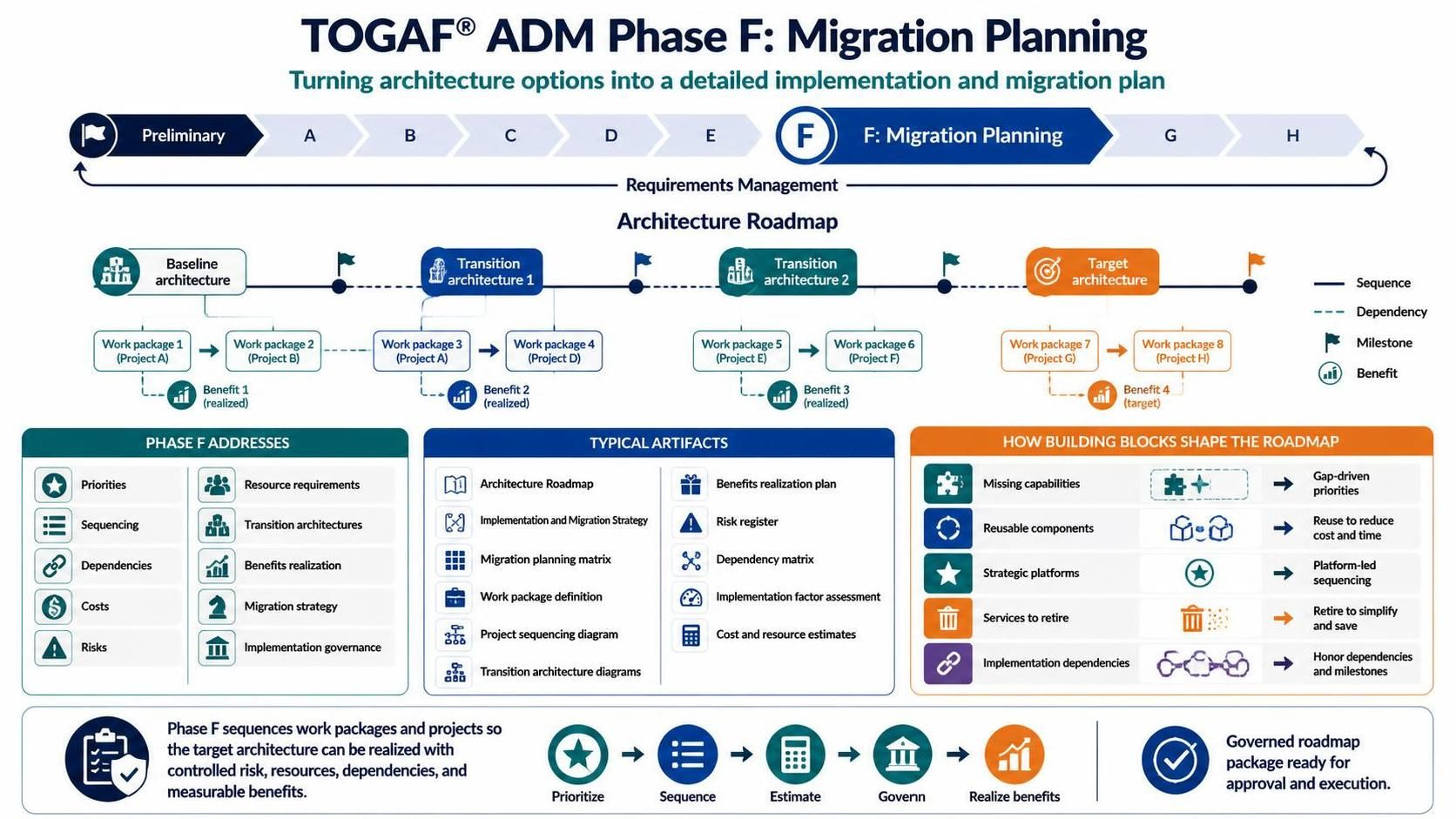
Transitioning from high-level architectural vision to concrete business value is often the most challenging aspect of Enterprise Architecture. TOGAF® (The Open Group Architecture Framework) addresses this challenge through the Architecture Development Method (ADM), specifically focusing on Phase F: Migration Planning. This phase is critical because it transforms abstract architectural options into a detailed, actionable implementation and migration plan.
In this tutorial, we will deconstruct the architecture roadmap, analyze the mechanics of building blocks, and explore the governance required to ensure a successful transition. We will also highlight how modern tooling, such as Visual Paradigm TOGAF ADM Tool, streamlines this complex process.
1. The Architecture Roadmap: From Baseline to Target
The core visual output of Phase F is the Architecture Roadmap. Unlike a simple Gantt chart, this roadmap represents the evolution of the enterprise architecture over time. It connects the current state to the future state through a series of logical steps.
The Lifecycle Stages
The roadmap is structured around four distinct architectural states:
- Baseline Architecture: The starting point. This represents the current systems, processes, and capabilities of the organization.
- Transition Architecture 1: An intermediate state. This is the first step in the journey, often designed to solve immediate problems or address critical gaps without waiting for the full target solution.
- Transition Architecture 2: Subsequent intermediate states. These are necessary stepping stones that bridge the gap between the initial transition and the final vision.
- Target Architecture: The final destination. This is the fully realized architecture that aligns with the organization’s strategic goals.
Visualizing the Journey
As illustrated in the diagram, the roadmap is not just a timeline; it is a dependency map. It shows how Work Packages (groups of projects or tasks) are sequenced to deliver specific Benefits.
- Sequencing: Solid lines indicate the chronological order of implementation.
- Dependencies: Dashed lines highlight that a subsequent work package cannot begin until a prerequisite is met.
- Milestones: Flags mark significant achievements or decision points.
- Benefits Realization: Charts indicate the value gained at each stage, ensuring that the migration is delivering ROI continuously, not just at the end.
2. The Mechanics of Building Blocks
One of the most powerful concepts in the TOGAF framework is the use of Building Blocks. These are the reusable components that make up the architecture. In Phase F, building blocks are not just technical definitions; they are strategic assets used to shape the roadmap.
Strategic Decisions Based on Building Blocks
When planning the migration, architects must make four critical decisions regarding building blocks:
- Identify Missing Capabilities: By comparing the Baseline to the Target, we identify gaps. These “missing capabilities” become the primary drivers for new development projects.
- Reuse Components: The diagram emphasizes reusing existing components. This strategy reduces cost and time, leveraging what the organization already owns.
- Strategic Platforms: Certain platforms are identified as strategic. These should be prioritized to ensure the architecture is built on a solid, supported foundation.
- Retire Services: Not everything needs to be migrated. A key part of the plan is identifying legacy services to retire. This “retire to simplify” approach saves costs and reduces technical debt.
3. Planning the Migration Strategy
Once the roadmap is visualized, the focus shifts to the detailed planning required to execute it. Phase F addresses specific criteria to ensure the plan is robust:
- Priorities: Determining which work packages deliver the most value and must be tackled first.
- Sequencing: Logical ordering of projects to manage dependencies.
- Costs and Resource Requirements: Estimating the financial and human capital needed for the migration.
- Risks: Identifying potential pitfalls and creating mitigation strategies.
- Governance: Establishing a framework to oversee the implementation and ensure adherence to the architecture.
4. Typical Artifacts of Phase F
To successfully manage this complexity, architects produce a set of standard artifacts. These documents serve as the blueprint for the implementation team:
- Architecture Roadmap: The high-level visual timeline.
- Implementation and Migration Strategy: The “how-to” guide for the transition.
- Migration Planning Matrix: A detailed breakdown of tasks and timelines.
- Work Package Definition: Specific descriptions of individual projects.
- Benefits Realization Plan: Metrics and methods for tracking value.
- Dependency Matrix: A map showing how projects rely on one another.
5. The Role of Recommended Tooling: Visual Paradigm
Executing Phase F manually can be overwhelming due to the sheer volume of data and the complexity of dependencies. To address this, the industry recommends specialized modeling tools. Visual Paradigm TOGAF ADM Tool is a prime example of a solution designed to support this methodology.
Using Visual Paradigm offers several distinct advantages for architects:
- Integrated Modeling: It allows for the creation of diagrams directly linked to the underlying data, ensuring that the visual roadmap is always consistent with the detailed plans.
- Gap Analysis Automation: The tool can automatically identify missing capabilities between the baseline and target architectures, populating the “Missing Capabilities” section of the roadmap instantly.
- Collaboration: It facilitates a governed environment where stakeholders can review and approve the roadmap before execution begins.
- Traceability: It ensures that every work package in the roadmap can be traced back to a specific business requirement or architectural goal.
Conclusion
Phase F is the bridge between theory and reality in the TOGAF framework. By systematically addressing priorities, dependencies, and costs, and by leveraging building blocks to drive strategic decisions, organizations can navigate complex transformations with confidence. Utilizing the architecture roadmap as a central planning tool—and supported by robust software like Visual Paradigm TOGAF ADM Tool—ensures that the migration is not just a technical exercise, but a strategic initiative that delivers measurable business benefits.