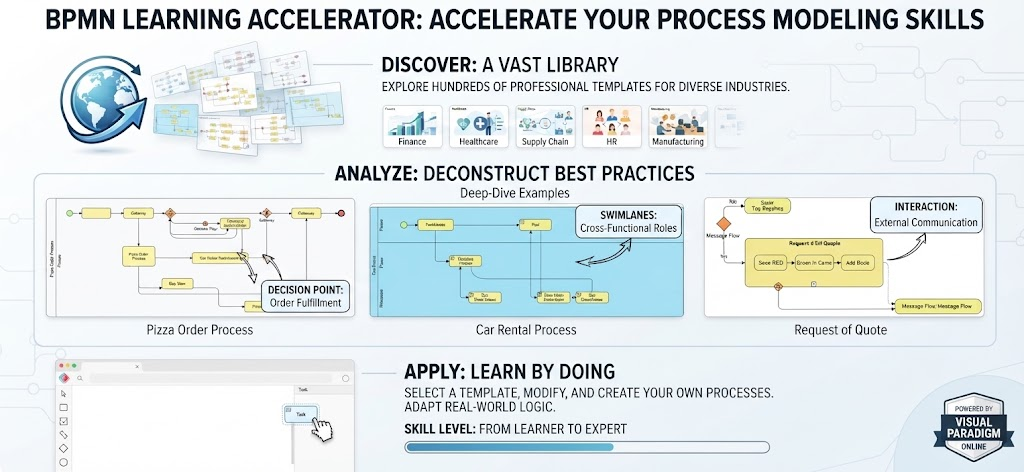
In the realm of business process modeling, efficiency and accuracy are paramount. Traditional diagramming often begins with a blank canvas, requiring users to reconstruct standard industry workflows from memory. This tutorial explores a more robust methodology: Learning-by-Example using rich template collections within Visual Paradigm Online. By leveraging pre-built, standard-compliant models, professionals can accelerate documentation by 50-70% while ensuring strict adherence to BPMN 2.0 notation standards.
1. The Architecture of Template-Based Modeling
At the core of this system is the concept that diagrams are not static images, but fully editable models. The platform hosts an extensive gallery covering a wide spectrum of industries, allowing users to select a foundational architecture that mirrors their specific needs.
Industry-Specific Foundations
Templates serve as the structural skeleton for your process. Instead of guessing where a Start Event or Gateway should be placed, you begin with proven examples:
- Standard Business Procedures: Templates like the Pizza Order Process, Car Rental Process, and Hiring Process provide clear examples of linear workflows and decision points.
- Specialized Workflows: For complex environments, templates such as Surgical Procedures and Order Fulfillment offer intricate logic structures that would be difficult to design from scratch.
2. Understanding BPMN Standards and Semantics
One of the most critical advantages of using these templates is educational value. They serve as annotated tools that help users grasp the exact semantic usage of BPMN flow elements.
Key Modeling Concepts
When you load a template, you are inspecting a model that adheres to industry standards. This ensures:
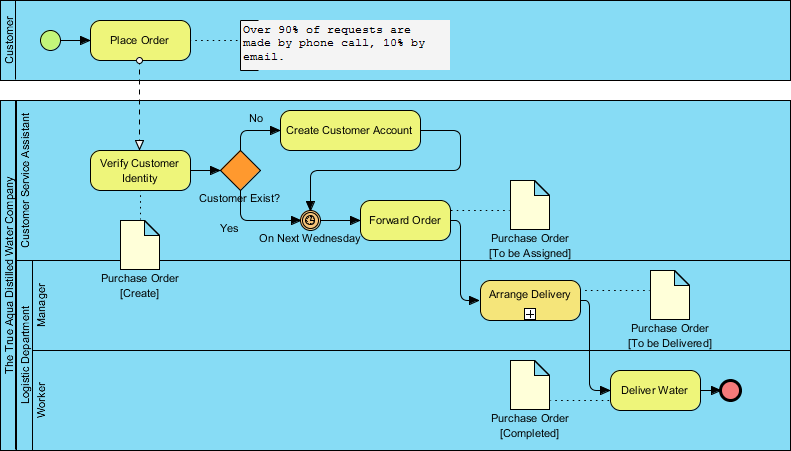
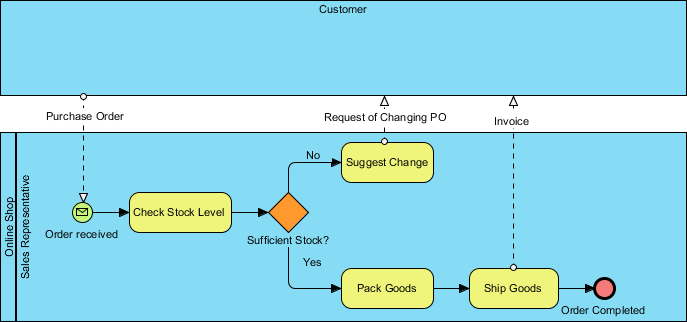
- Correct Event Triggers: Understanding when an event initiates a process.
- Data Associations: Properly linking data objects to tasks.
- Gateway Logic: Implementing correct decision paths (Exclusive vs. Parallel).
By studying these pre-built structures, you learn the why behind the how, reducing the likelihood of modeling errors in your custom diagrams.
3. Step-by-Step: Instant Customization Workflow
The transition from a generic template to a custom solution is seamless. The following workflow demonstrates how to adapt a model for your specific requirements:
Step 1: Load the Template
Select a relevant template from the gallery. For instance, a hospital administrator mapping a Patient Discharge Workflow would start with the Surgical Procedures or a generic healthcare template.
Step 2: Inspect Structural Layout
Load the template directly into the web workspace. Examine the structural layout to understand the flow of control. Identify the Tasks, Gates, and Events that define the process boundaries.
Step 3: Modify Nodes and Tasks
Templates are fully editable. You can rename tasks to reflect your specific context. For example, rename a task from “Post-Op Recovery” to “Discharge Paperwork”.
Step 4: Adjust Logic and Gateways
Modify gateways to reflect unique business rules. If your workflow requires insurance verification before discharge, adjust the gateways in the template to include this decision step, ensuring compliance while saving hours of design time.
4. Efficiency and Best Practices
Adopting a template-based strategy offers tangible benefits beyond simple time savings.
Accelerated Documentation
Using templates accelerates documentation by 50-70% compared to creating diagrams from scratch. This allows teams to focus on process optimization rather than syntax and layout.
Enforced Best Practices
Professional templates adhere to strict BPMN 2.0 notation standards. By starting with a compliant model, you enforce best practices automatically, ensuring that your final diagrams are readable, standardized, and ready for integration with other systems.
Conclusion
Visual Paradigm Online transforms the modeling process from a creative exercise into a structured engineering task. By leveraging the Learning-by-Example approach, you lower the barrier to entry, ensure semantic accuracy, and significantly reduce the time required to document complex business architectures.