In the complex world of software development and business operations, a disconnect often occurs between the people who define business requirements and the engineers who build the technical solutions. Business Process Model and Notation (BPMN) bridges this gap. It is the standardized graphical representation that translates abstract business goals into executable technical blueprints.
This tutorial breaks down the architecture of a standard BPMN workflow, explaining the visual symbols, the logic flow, and the strategic importance of using this ISO-certified standard.
The Architecture of a Workflow: Visualizing the “Order Fulfillment” Process
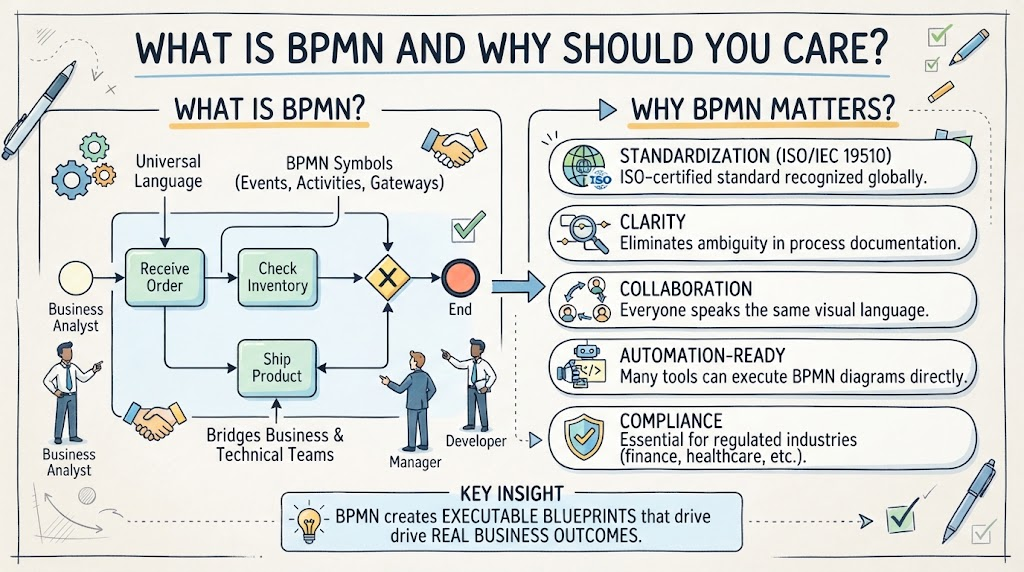
At the heart of BPMN is the ability to map out a sequence of events. The diagram provided illustrates a classic “Order Fulfillment” scenario. Let’s deconstruct the architectural components shown in this visual model.
1. The Process Lifecycle: Start to Finish
Every BPMN diagram begins and ends with specific markers that define the scope of the work.
- The Start Event: Represented by a simple circle (often white), this marks the trigger for the process. In our diagram, the process is initiated when a Business Analyst or an external system signals to Receive Order.
- The End Event: Represented by a thick red circle, this indicates the successful termination of the process. Once the product is shipped, the lifecycle concludes.
2. Activities: The Work Being Done
The rounded rectangles in the diagram represent Tasks or Activities. These are the specific actions that consume time or resources.
- Receive Order: The intake of a customer request.
- Check Inventory: A verification step to ensure stock availability.
- Ship Product: The fulfillment of the order.
3. Gateways: The Logic of Flow Control
The most critical architectural element in this diagram is the yellow diamond, known as a Gateway. In BPMN, gateways act as traffic controllers. They determine the path the process will take next based on specific conditions.
In the provided model, we see a diamond with an “X” inside (an Exclusive Gateway). This represents a decision point:
- Condition Evaluation: The process arrives at the gateway after checking inventory.
- Divergence: The gateway checks if the inventory is sufficient.
- Yes: The flow moves to the “Ship Product” task.
- No: The process might loop back or halt (depending on the specific logic defined).
4. The Human Element: Swimlanes and Collaboration
The diagram highlights that processes are rarely automated end-to-end. It features stakeholders like the Business Analyst, the Manager, and the Developer. These figures represent the “Swimlanes” concept in BPMN, where different roles are assigned responsibility for specific tasks. This ensures that the “Developer” knows exactly what technical constraints to apply, while the “Manager” oversees the compliance.
Why BPMN Matters: The Technical & Business Value
Why should you care about this specific notation? As highlighted in the “Why BPMN Matters?” section of the reference material, the benefits extend far beyond simple drawing.
1. Standardization (ISO/IEC 19510)
BPMN is not a proprietary format; it is an ISO-certified standard. This means that the symbols used to draw a process in one company mean exactly the same thing in another. It eliminates the ambiguity of custom diagrams where one team might interpret a symbol differently than another.
2. Clarity and Ambiguity Elimination
Text-based requirements often lead to misinterpretation. A sentence like “If the stock is low, check again later” is open to interpretation. A BPMN diagram forces the analyst to explicitly define the logic loop. The visual nature of the diagram makes the process flow immediately understandable to non-technical stakeholders.
3. Automation-Ready Architecture
This is perhaps the most powerful technical aspect. BPMN is not just a drawing; it is executable. Many modern workflow engines (such as Camunda or Activiti) can take a BPMN XML file and turn it into running software code. This allows for a direct translation from “Business Blueprint” to “Technical Implementation.”
Key Insight: From Blueprint to Outcome
The ultimate goal of implementing BPMN is to create Executable Blueprints. By standardizing the communication between the Business Analyst and the Developer, organizations can ensure that the software they build actually solves the business problem. It drives real business outcomes by ensuring that every line of code written aligns with the defined process logic.
Whether you are designing a finance workflow or a healthcare patient intake system, mastering BPMN is the key to building robust, compliant, and efficient system architectures.