


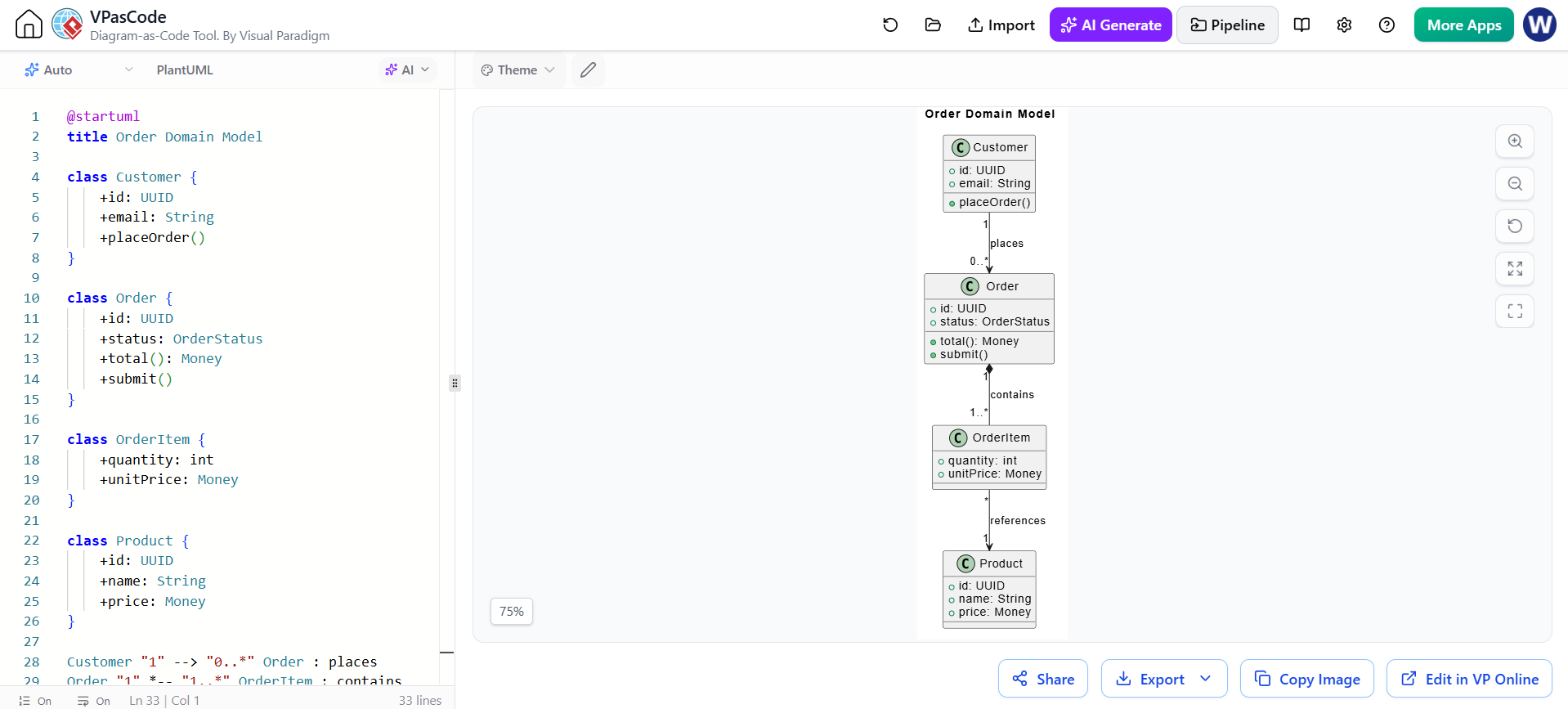
In the realm of software architecture, bridging the gap between abstract business logic and concrete implementation is a critical challenge. This tutorial explores the concept of Domain Modeling using the Order System as a practical case study. We will analyze how to translate business requirements into a structured Class Diagram using VPasCode, Visual Paradigm’s “Diagram-as-Code” tool.
By understanding the relationships between entities like Customer, Order, and Product, you can create a blueprint that serves both developers and stakeholders.
1. The Power of Diagram-as-Code
Traditional diagramming tools often rely on drag-and-drop interfaces, which can lead to “manual fatigue” and inconsistent formatting. VPasCode shifts this paradigm by allowing you to define your architecture using a simple text-based syntax. This approach offers several distinct advantages:
- Version Control Friendly: Since the diagram is text, you can use Git to track changes, diff specific attributes, and manage history.
- Speed: It is often faster to type a relationship definition than to draw a line and configure its cardinality manually.
- Refactoring: Renaming a class or updating a method signature in the code automatically updates the visual diagram.
2. Analyzing the Domain Model
The core of our system is the Order Domain Model. This is a static structure diagram (Class Diagram) that defines the “Nouns” of our application. Let’s break down the four key entities shown in the diagram.
The Customer Entity
The Customer class represents the external actor initiating the transaction. It holds identifying information and the primary action.
class Customer {
    +id: UUID
    +email: String
    +placeOrder()
}
Notice the use of UUID (Universally Unique Identifier). This is a best practice for primary keys in distributed systems, ensuring no two customers across different microservices ever have the same ID.
The Order Entity
The Order class is the heart of the transaction. It aggregates the state of the purchase.
class Order {
    +id: UUID
    +status: OrderStatus
    +total(): Money
    +submit()
}
Key observations here:
- Computed Properties: The
total(): Moneymethod implies a calculation is performed dynamically, rather than just storing a static number. - Enum Usage:
OrderStatussuggests a strict state machine (e.g., PENDING, SHIPPED, CANCELLED) which is crucial for business logic.
3. Defining Relationships
Classes are isolated until we define how they interact. VPasCode uses standard UML syntax to define these cardinalities and relationship types.
Composition vs. Association
The relationship between Order and OrderItem is defined as:
Order "1" *-- "1..*" OrderItem : containsThe solid diamond () indicates Composition. This means OrderItem has a strong ownership by Order. If the Order object is deleted, the OrderItem objects are also destroyed. This is a critical architectural decision that defines data lifecycle.
One-to-Many Association
The link between Customer and Order is a standard association:
Customer "1" --> "0..*" Order : placesThis “One-to-Many” relationship (1 to 0..) signifies that one Customer can place zero or many Orders. This flexibility is essential for e-commerce systems.
4. Best Practices in Modeling
When building these diagrams, adhere to the following principles to ensure your architecture remains scalable and understandable.
- Separation of Concerns: Do not mix runtime behavior (Sequence Diagrams) with static structure (Class Diagrams) in the same view. Keep the Class Diagram focused on data structure.
- Use Meaningful Labels: Always label your relationships (e.g., “places”, “contains”, “references”). Unlabeled arrows force stakeholders to guess the business logic.
- High-Level Abstraction: As noted in the context, “Avoid showing every class, endpoint, and database table.” A domain model should focus on the business domain, not the infrastructure (like database tables).
Conclusion
By utilizing VPasCode, you move from static drawing to active coding of your architecture. The Order Domain Model we explored provides a solid foundation for building an e-commerce backend, ensuring that data integrity and business rules are clearly defined before a single line of Java or C# code is written.
Related posts:
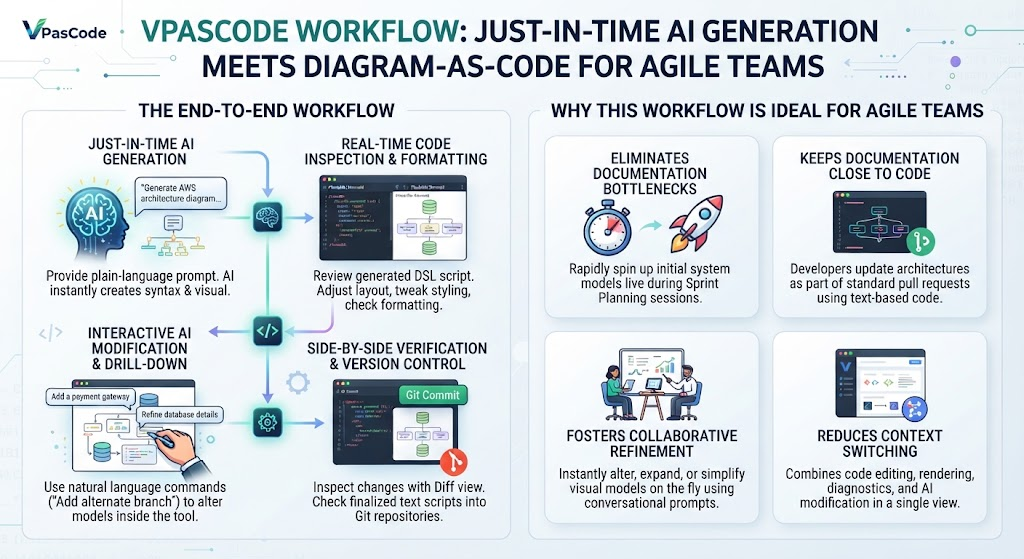 Mastering System Architecture with VPasCode: A Guide to Just-in-Time Diagram-as-Code
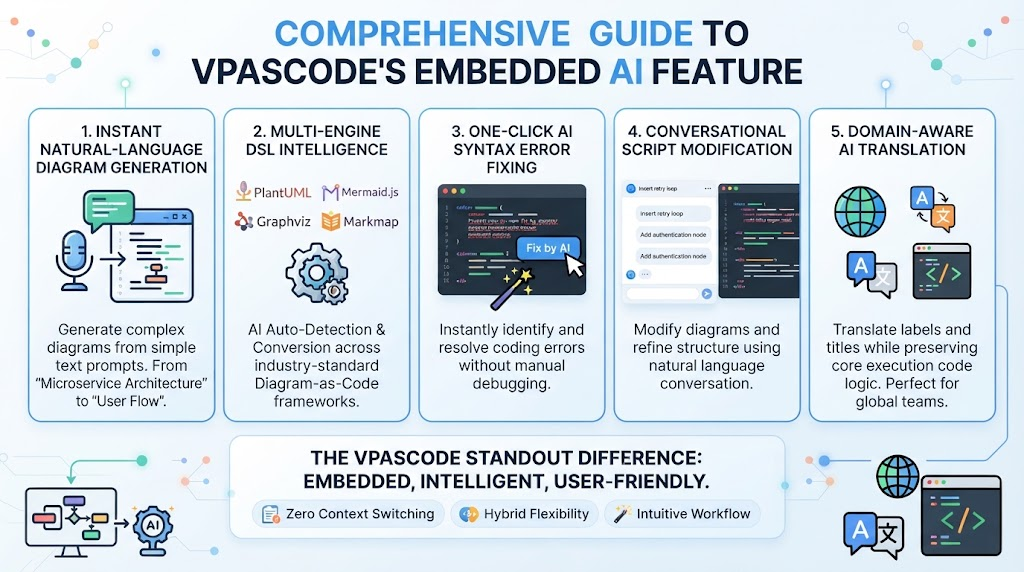 Mastering Diagram-as-Code: A Deep Dive into VPasCode’s Embedded AI Architecture
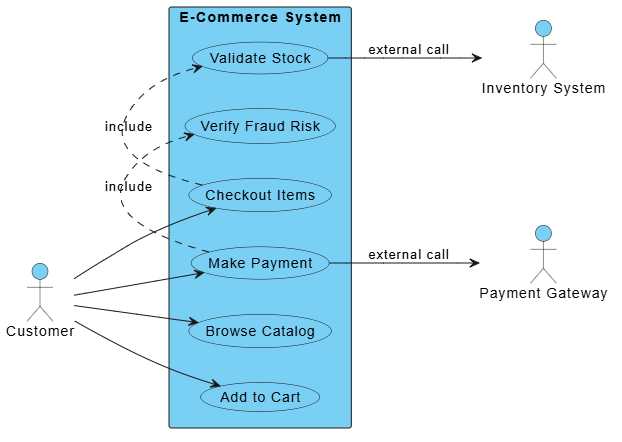 Mastering System Architecture: Refining Use Case Diagrams with VPasCode and Embedded AI
 Mastering Browser-Based Modeling: A Guide to VPasCode Architecture and Workflow