


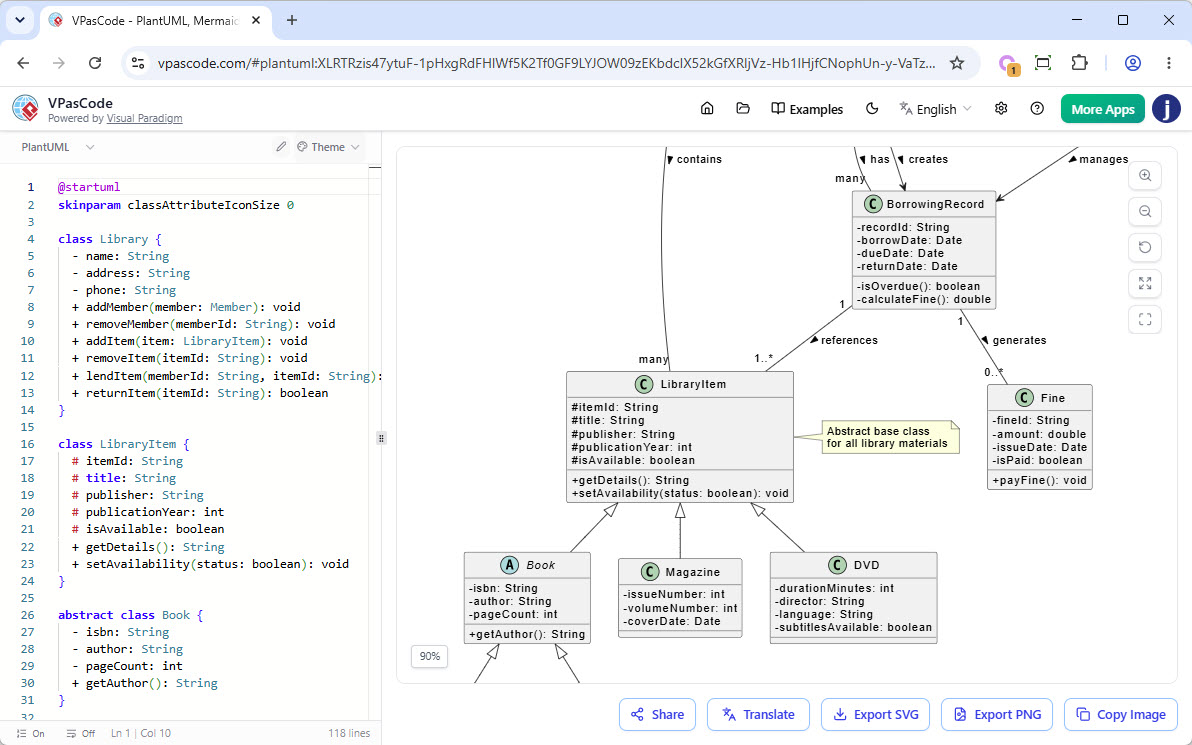
In the modern software development lifecycle, the gap between documentation and implementation is often bridged by a tool that understands both. VPasCode (Visual Paradigm as Code) empowers developers to define complex system architectures using text-based languages like PlantUML. This tutorial explores the architecture of a classic object-oriented system—the Library Management System—demonstrating how text definitions translate into robust visual Class Diagrams.
Understanding the Core Concept: Diagram-as-Code
The fundamental premise of VPasCode is “Write Code, Get Diagrams.” Instead of dragging and dropping shapes in a GUI, you write structured code. This approach offers several distinct advantages for enterprise architects and developers:
- Version Control: Diagrams become text files that can be tracked in Git, allowing for diff tracking and historical comparisons.
- Collaboration: Developers can review and merge diagram changes just like source code.
- Efficiency: Generating complex inheritance hierarchies or massive association lines is significantly faster via text than manual drawing.
Step-by-Step: Architecting the Library System
Let us deconstruct the architecture presented in the visual output. We will build this system layer by layer, moving from the core domain to specific implementations.
1. Defining the Domain Entities
The system begins with the Library class. This is the central aggregate root that manages the collection of members and items. It defines the public API for the system, such as adding or removing members.
class Library {
    - name: String
    - address: String
    - phone: String
    + addMember(member: Member): void
    + removeMember(memberId: String): void
    + addItem(item: LibraryItem): void
    + removeItem(itemId: String): void
    + lendItem(memberId: String, itemId: String): void
    + returnItem(itemId: String): boolean
}
2. Modeling Abstract Base Classes
A critical aspect of object-oriented design is the separation of common behavior from specific implementations. The LibraryItem class acts as the abstract base class for all materials in the library. Notice the use of the # symbol, which denotes protected visibility in PlantUML. This allows subclasses to access these attributes while keeping them hidden from external clients.
class LibraryItem {
    # itemId: String
    # title: String
    # publisher: String
    # publicationYear: int
    # isAvailable: boolean
    + getDetails(): String
    + setAvailability(status: boolean): void
}
3. Implementing Inheritance Hierarchies
The power of inheritance is demonstrated through the Book, Magazine, and DVD classes. These all inherit from LibraryItem. This structure allows the system to treat all items uniformly via polymorphism, while still handling specific details (like ISBN for books or duration for DVDs).
abstract class Book {
    - isbn: String
    - author: String
    - pageCount: int
    + getAuthor(): String
}
4. Establishing Relationships and Cardinality
A class diagram is incomplete without relationships. The diagram illustrates several vital associations:
- Composition (Library to LibraryItem): A library “contains” many items. If the library is destroyed, the items are meaningless.
- Association (LibraryItem to BorrowingRecord): Items are linked to borrowing records. The label
1..indicates that one item can be associated with many records over time. - Aggregation (BorrowingRecord to Fine): A record “generates” a fine if overdue. The
0..indicates a record might generate zero or more fines.
Advanced Features: Real-Time Rendering and AI Diagnostics
When writing code for diagrams, syntax errors are inevitable. VPasCode integrates AI diagnostics directly into the editor. If you attempt to write invalid PlantUML, the system highlights the error and suggests fixes, ensuring that your diagram remains valid and renderable.
Furthermore, the platform supports “Seamless Conversion.” Once your text diagram is rendered, it can be converted into a native, editable model within the Visual Paradigm Desktop application. This allows you to leverage the precision of text editing for the bulk of the work, and then switch to the GUI for deep analysis, reverse engineering, or generating documentation.
Conclusion
By utilizing VPasCode, the Library Management System architecture is not just a static image but a dynamic, version-controlled asset. This method of modeling ensures that your system design remains consistent with your codebase, reducing the “documentation debt” that often plagues software projects.