In the rapidly evolving landscape of Software as a Service (SaaS), efficient customer support is not merely a service function; it is a critical component of system architecture. The workflow described in Example 4 illustrates a robust mechanism for handling customer tickets, specifically focusing on the distinction between general inquiries and technical defects. Understanding this structure is vital for developers and business analysts aiming to optimize operational efficiency.
Understanding Swimlanes in Process Modeling
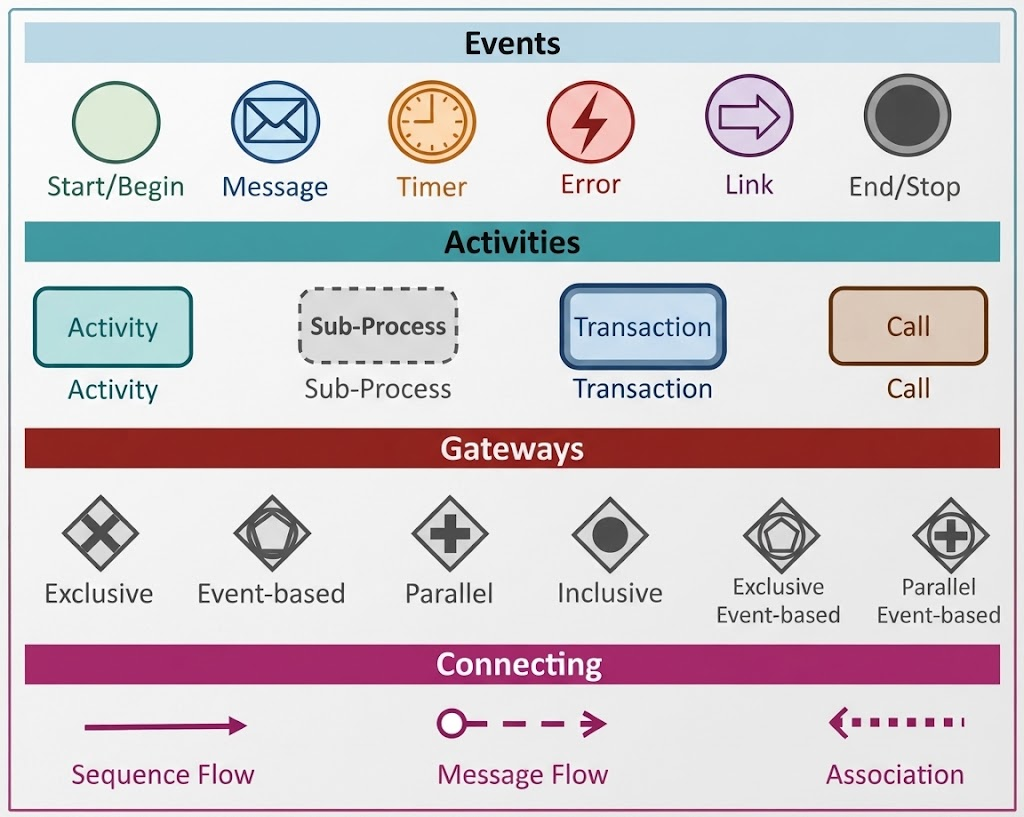
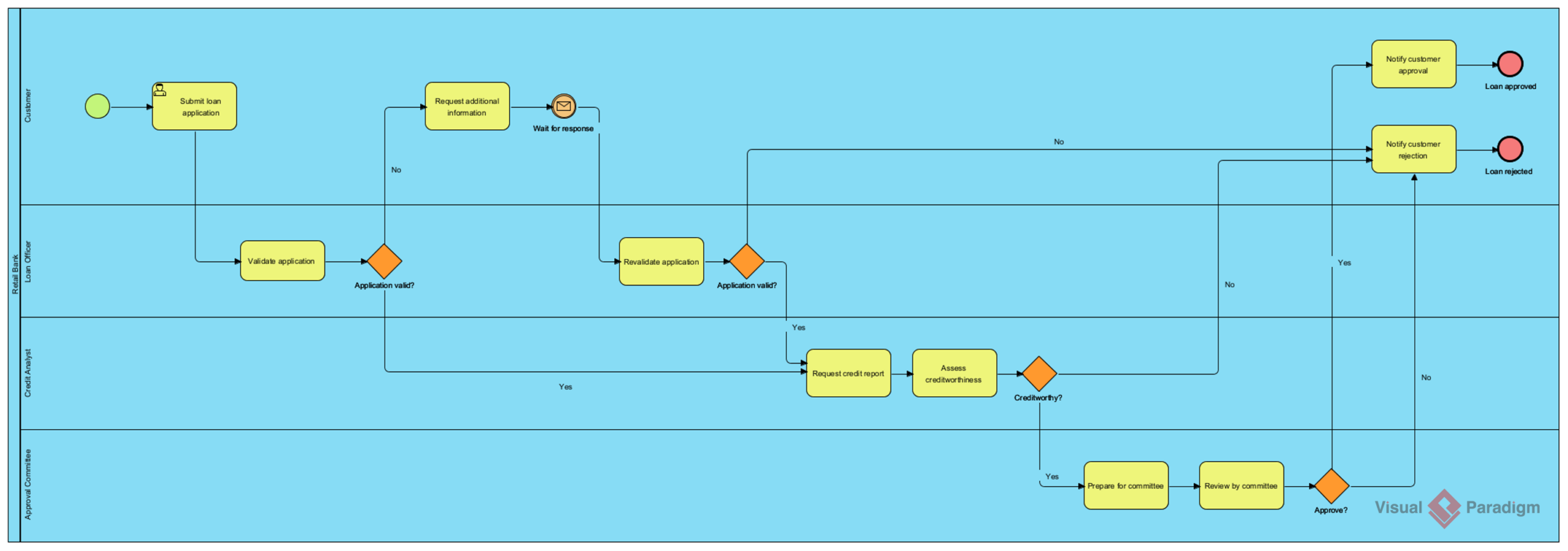
The provided workflow utilizes a concept known as swimlanes, a standard feature in Business Process Model and Notation (BPMN). Swimlanes visually separate responsibilities, ensuring clarity on who performs which action. In this architecture, we observe three distinct lanes:
- Customer: The initiator of the process, submitting the initial request via a ticketing system.
- Support Team: The first line of defense responsible for triage, categorization, and final verification.
- Engineering Team: The technical specialists tasked with investigating and resolving complex issues, specifically bugs.
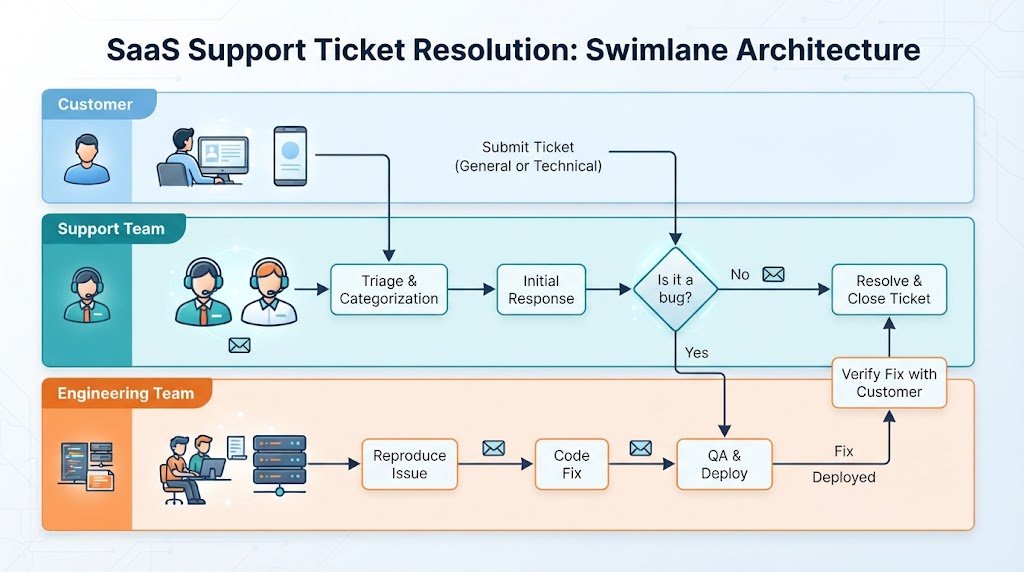
By segregating these roles, the system prevents bottlenecks. For instance, engineers are not interrupted by routine categorization tasks, allowing them to focus on code-level fixes.
Decision Logic and Gateways
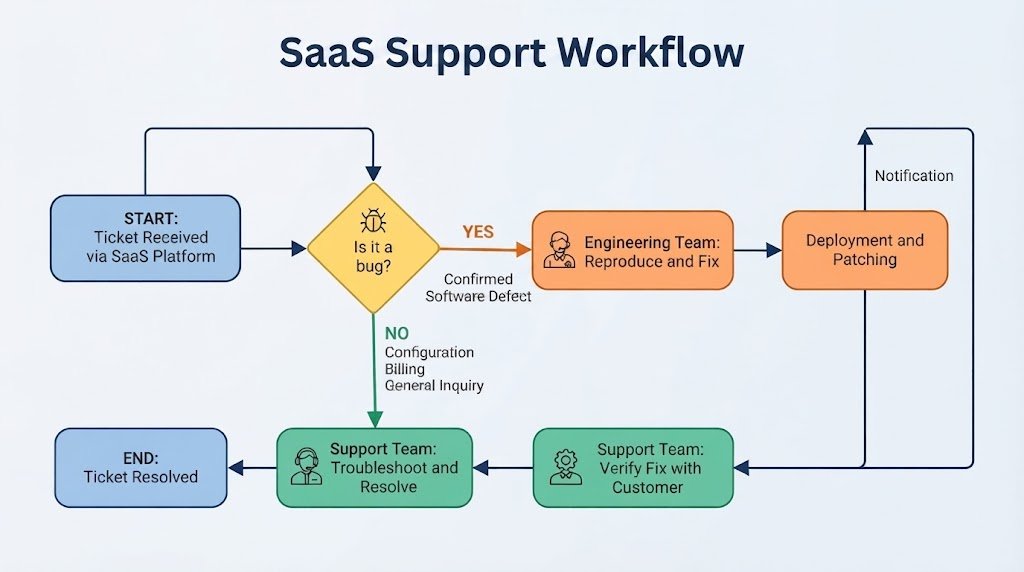
At the heart of this workflow lies a critical decision point. The process flow includes a conditional branch represented by the question: Is it a bug? This acts as a Gateway in process modeling terms. It dictates the path the data takes based on specific criteria.
- No Branch: If the issue is a configuration error, a billing question, or a feature request, the Support Team resolves the ticket directly. This minimizes latency for simple issues.
- Yes Branch: If the issue is identified as a software defect, the workflow routes the ticket to the Engineering Team. This ensures that code-level problems are handled by those with the appropriate permissions and expertise.
Message Flows and Inter-Team Integration
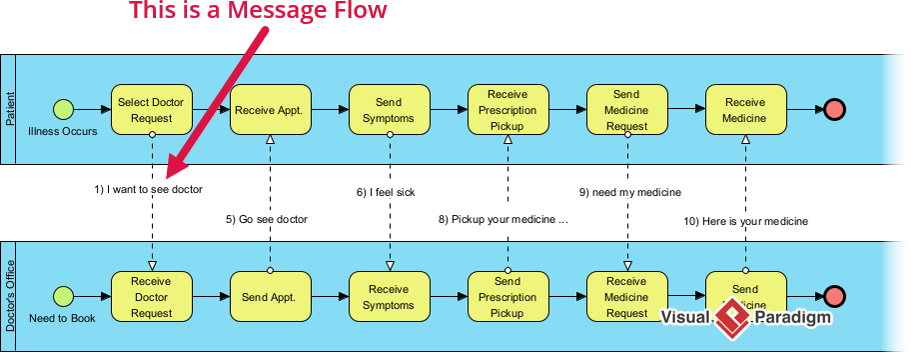
A sophisticated support architecture relies on seamless communication channels, often referred to as Message Flows. In this scenario, the transition from Support to Engineering is not a manual handoff but an automated or structured message flow.
When the Engineering Team completes a fix, they must notify the Support Team. This notification triggers the final verification step. Without this explicit flow, tickets might remain open indefinitely, creating a false sense of security regarding resolution status. The architecture ensures that:
- Updates are traceable between teams.
- The
Supportrole retains ownership of the customer relationship until the Engineering fix is verified. - The process concludes only when the customer-facing team confirms the solution.
Best Practices for System Architecture
Designing workflows like the one in Example 4 requires adherence to several architectural best practices to ensure scalability and maintainability.
1. Clear Ownership
Every step in the workflow must have a clear owner. The transition from “Support” to “Engineering” should not be ambiguous. This reduces the risk of tickets falling through the cracks.
2. Automated Routing
Using a ticketing system that automatically routes based on the Is it a bug? decision logic reduces manual overhead. This can be achieved through API integrations between the support platform and the issue tracking system (e.g., Jira).
3. Feedback Loops
The final step, where Support verifies the fix, acts as a quality assurance gate. It ensures that the engineering solution actually solves the customer’s problem before the ticket is closed.
Conclusion
By analyzing this customer support ticket resolution process, we see how a well-defined workflow enhances both technical operations and customer satisfaction. The separation of concerns, clear decision logic, and defined message flows create a resilient system capable of handling complex interactions in a SaaS environment. Implementing these modeling concepts ensures that support teams can scale without compromising the quality of service.