


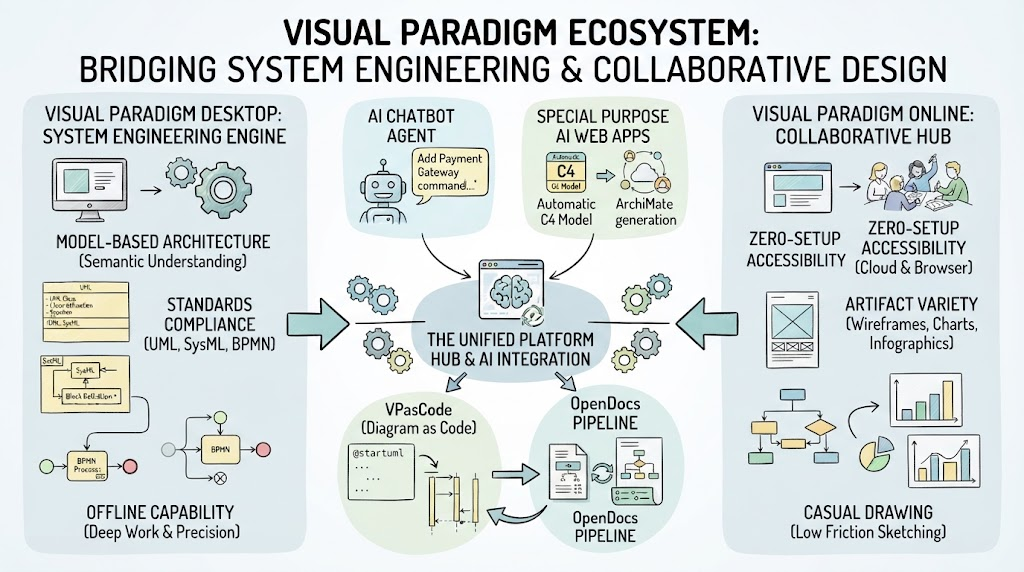
In the complex world of software architecture, teams often face a difficult choice: use powerful, rigorous tools that are hard to collaborate on, or use simple, collaborative tools that lack deep semantic understanding. The Visual Paradigm Ecosystem solves this dichotomy by unifying these distinct approaches into a single, cohesive platform.
This tutorial breaks down the architecture of this ecosystem, showing how it integrates traditional Model-Based Systems Engineering (MBSE) with modern Agile practices, AI integration, and “Diagram as Code” methodologies.
1. The Engineering Core: Visual Paradigm Desktop
At the heart of the ecosystem lies the Visual Paradigm Desktop. This is the heavy-lifter for professional architects and engineers who require precision and strict adherence to industry standards. It is designed for “Deep Work & Precision.”
Model-Based Architecture
Unlike simple drawing tools, the desktop application provides Semantic Understanding. This means the diagrams you create are not just pictures; they are data models. When you draw a sequence diagram, the tool understands the logic behind it, allowing for rigorous analysis.
Standards Compliance
The platform ensures your architecture remains professional and interoperable by supporting industry-standard modeling languages:
- UML (Unified Modeling Language): For object-oriented software design.
- SysML (Systems Modeling Language): For complex systems engineering.
- BPMN (Business Process Model and Notation): For business process mapping.
Offline Capability
For tasks requiring intense focus and security, the desktop environment offers full Offline Capability, allowing you to work on complex models without an internet connection.
2. The Collaborative Hub: Visual Paradigm Online
On the other end of the spectrum is Visual Paradigm Online. This component addresses the need for speed, accessibility, and team collaboration. It is designed for “Low Friction Sketching” and rapid prototyping.
Zero-Setup Accessibility
One of the biggest barriers to entry for enterprise modeling tools is installation and configuration. Visual Paradigm Online offers Zero-Setup Accessibility, running entirely in the cloud and browser. This means stakeholders can view or edit diagrams instantly without installing heavy software.
Artifact Variety
While the desktop focuses on technical modeling, the online environment supports a wider variety of visual artifacts to support the entire product lifecycle:
- Wireframes: For UI/UX design.
- Charts & Graphs: For data visualization.
- Infographics: For high-level presentations.
3. The Brain of the Operation: AI & The Unified Hub
The true magic of the ecosystem happens in the center: The Unified Platform Hub & AI Integration. This connects the heavy desktop tools with the agile online tools, powered by Artificial Intelligence.
The AI Chatbot Agent
Visual Paradigm integrates an intelligent AI agent that acts as a technical assistant. Instead of manually dragging and dropping elements, you can interact via natural language commands. For example, you might ask the agent to “Add Payment Gateway command…”, and it will automatically update your diagram logic.
Special Purpose AI Web Apps
The ecosystem includes specialized AI applications that automate specific modeling tasks. A prime example shown in the architecture is the Automatic C4 Model generation. By using tools like ArchiMate, the AI can take existing data and automatically generate high-level context diagrams, saving architects hours of manual setup time.
4. Modern Workflow: VPasCode & OpenDocs Pipeline
Finally, the ecosystem embraces the “Diagram as Code” movement, bridging the gap between software development and system design.
VPasCode (Diagram as Code)
For developers who prefer typing over clicking, Visual Paradigm offers VPasCode. This allows you to write code to define your diagrams. Using syntax similar to standard UML tools (like @startuml), developers can version-control their architecture diagrams alongside their source code. This ensures that your documentation stays in sync with your actual codebase.
OpenDocs Pipeline
To automate the delivery of this documentation, the ecosystem utilizes the OpenDocs Pipeline. This feature automates the process of converting your diagrams into various formats (PDF, HTML, etc.) and publishing them. It acts as a CI/CD pipeline specifically for your documentation, ensuring that your system architecture documentation is always up-to-date and accessible to the team.
Conclusion
The Visual Paradigm Ecosystem is not just a tool; it is a methodology. By splitting capabilities into robust desktop modeling and flexible online collaboration, and tying them together with an intelligent AI agent, it offers a seamless workflow. Whether you are a systems engineer needing strict SysML compliance or a product manager needing a quick wireframe, this unified platform provides the right tool for the job.
Related posts:
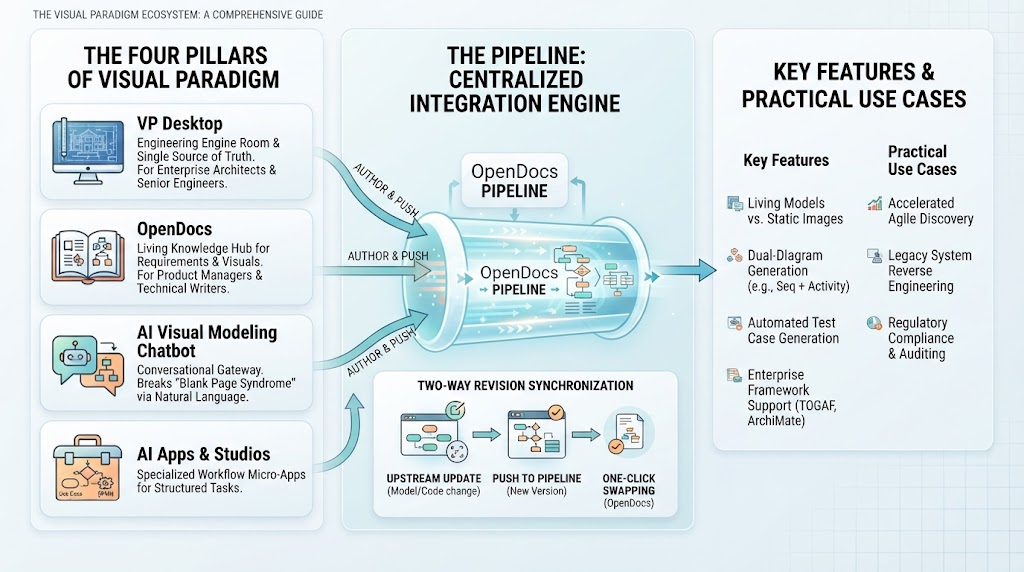 Mastering the Visual Paradigm Ecosystem: From Concept to Code with The Pipeline
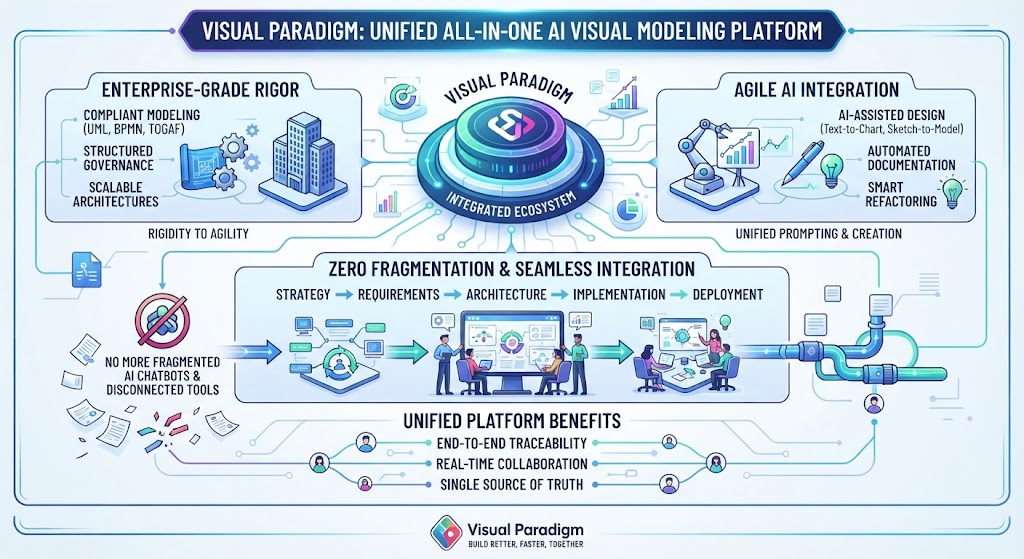 Mastering Unified Modeling: The Architecture of Enterprise Agility with Visual Paradigm
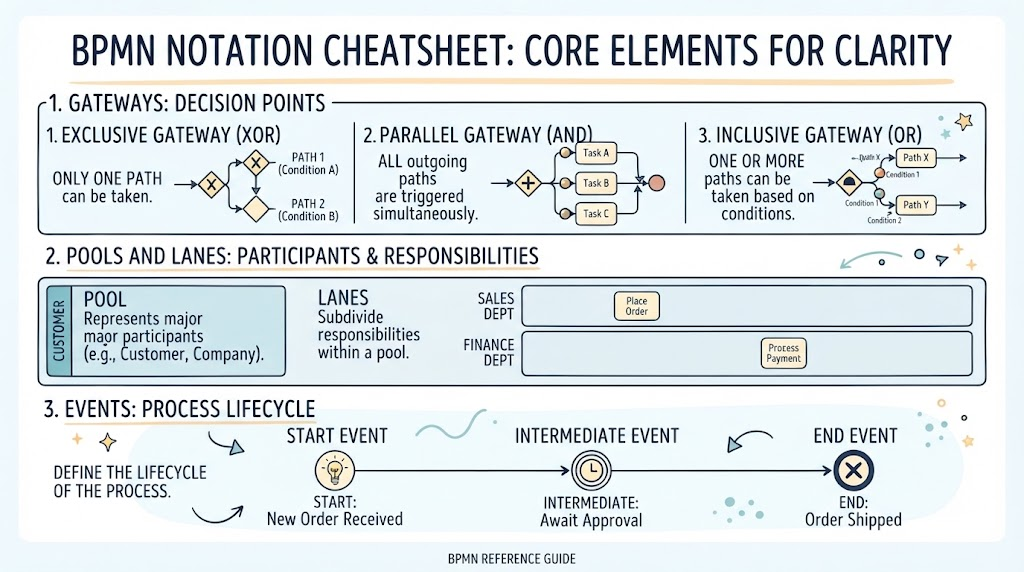 Mastering BPMN: A Visual Guide to Core Notation for Process Clarity
 Mastering System Architecture: Refining Use Case Diagrams with VPasCode and Embedded AI