


In the world of Enterprise Architecture (EA), the TOGAF® ADM (Architecture Development Method) serves as the compass for navigating complex organizational transformations. While many practitioners jump straight into designing business or technology architectures, the Preliminary Phase is the critical foundation that determines whether an architecture practice will succeed or fail.
This tutorial breaks down the specific outputs, artifacts, and building blocks required to establish a robust Enterprise Architecture capability. We will walk through the system architecture of this phase, explaining how formal outputs, descriptions, and reusable capabilities interact to set the stage for future success.
The Role of the Preliminary Phase
The Preliminary Phase is not about designing a specific system; it is about establishing the organization’s architecture capability. Before you can build a house, you must have the tools, the blueprints, and the construction team ready. Similarly, this phase prepares the enterprise to execute the rest of the ADM cycle (Phases A through H).
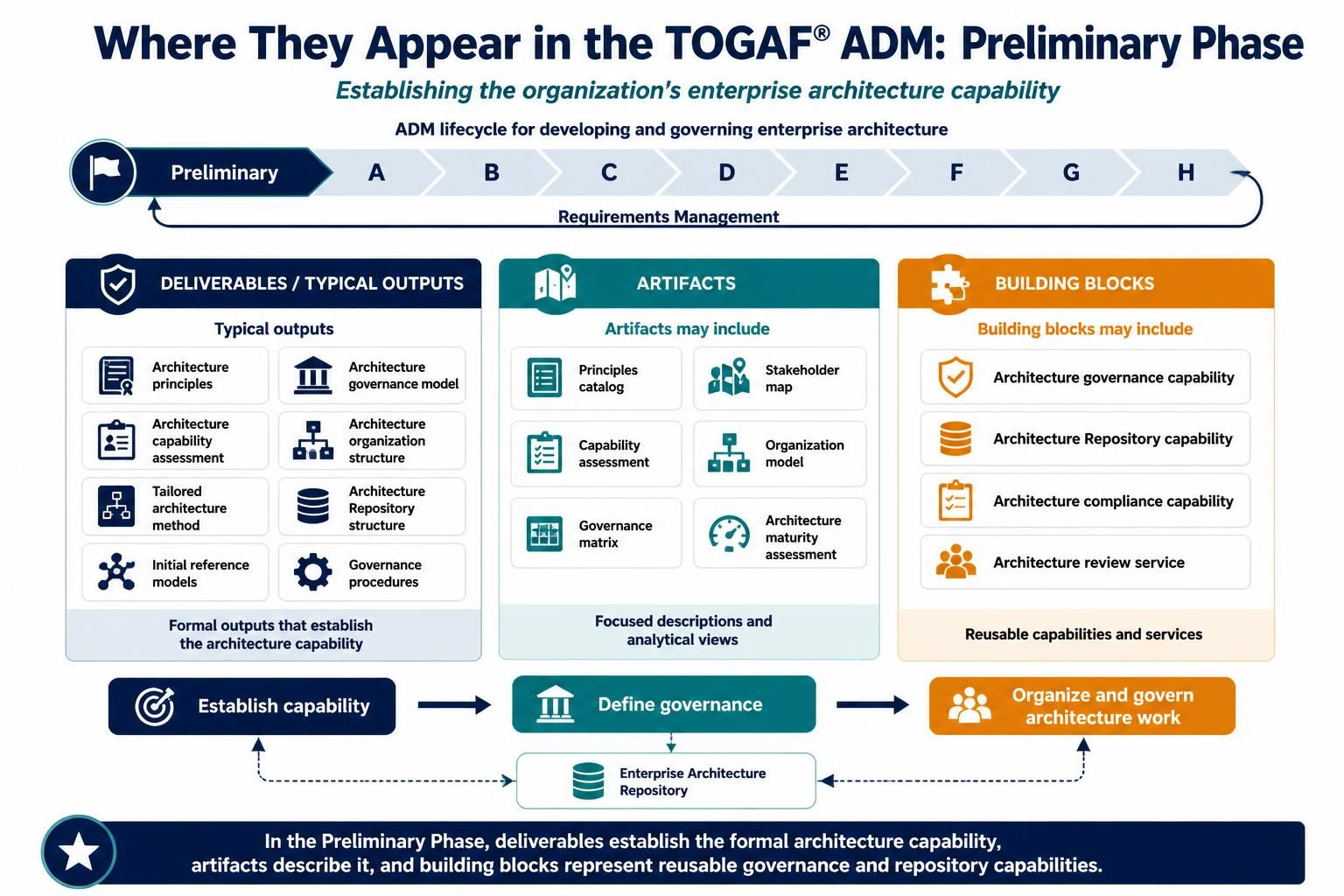
As illustrated in the TOGAF lifecycle diagram, this phase feeds into a continuous loop of Requirements Management, ensuring that the architecture governance is always aligned with the evolving needs of the business.
1. Deliverables: The Formal Outputs
The first column of the architecture represents the Deliverables, or the typical outputs produced during this phase. These are the tangible results that establish the formal architecture capability. Without these, the architecture function lacks legitimacy and direction.
- Architecture Principles: These are the fundamental rules and guidelines that govern the enterprise’s IT and business decisions. They act as the “constitution” for your architecture.
- Architecture Governance Model: A framework that defines how architecture decisions are made, who is responsible, and how compliance is enforced.
- Architecture Capability Assessment: A critical evaluation of the current state of the organization’s architecture maturity, identifying gaps that need to be filled.
- Tailored Architecture Method: A customized version of the TOGAF ADM adapted to the specific needs, culture, and constraints of the organization.
- Initial Reference Models: Standard models (like industry standards) that provide a baseline for understanding the enterprise landscape.
- Governance Procedures: The day-to-day operational rules for managing the architecture function.
Visualizing the Flow
In the diagram, these deliverables are linked to the action “Establish capability.” This signifies that the output of this stage is a fully functional architecture department ready to operate.
2. Artifacts: The Descriptions and Views
If deliverables are the “what,” artifacts are the “how” and “why.” These are the Focused descriptions and analytical views that support the governance model. They provide the necessary context for stakeholders to understand the architecture.
- Principles Catalog: A comprehensive list of all established principles, often categorized by their scope (e.g., Business, Data, Application, Technology).
- Stakeholder Map: A visual representation of the key players in the enterprise, their interests, and their influence on the architecture.
- Organization Model: A depiction of the architecture team structure, defining roles and responsibilities.
- Capability Assessment: Detailed analysis of specific capabilities, often using maturity models.
- Governance Matrix: A tool that maps governance activities to specific architecture domains or projects.
- Architecture Maturity Assessment: A detailed report on the maturity level of the architecture practice against industry standards.
3. Building Blocks: Reusable Capabilities
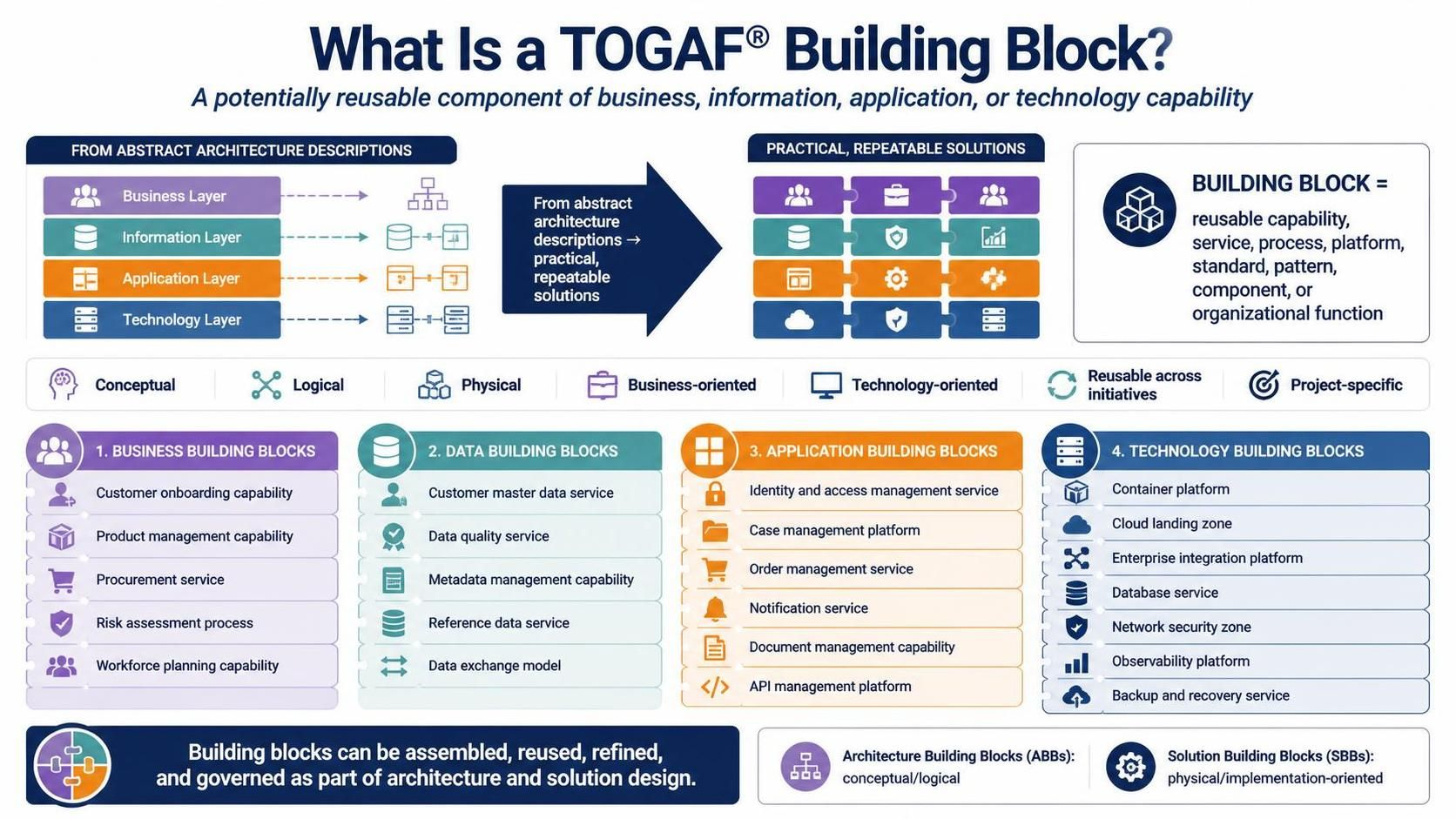
The final component of the Preliminary Phase is the Building Blocks. In TOGAF, a Building Block (BB) is a reusable component that can be used across the enterprise. In this context, they represent the Reusable capabilities and services that the architecture team will offer.
- Architecture Governance Capability: The ability to review and approve architecture designs.
- Architecture Repository Capability: The infrastructure and tools used to store and manage architecture content.
- Architecture Compliance Capability: Services that ensure projects adhere to the defined principles and standards.
- Architecture Review Service: Formal review processes conducted by the architecture board.
These building blocks are essential because they allow the architecture function to scale. Instead of reinventing the wheel for every project, the organization leverages these pre-established capabilities.
Integrating the Enterprise Architecture Repository
At the bottom of the diagram, you will notice a central component: the Enterprise Architecture Repository. This is the backbone of the entire process. It connects the “Establish capability,” “Define governance,” and “Organize and govern architecture work” activities.
The repository acts as a single source of truth. It stores the artifacts (like the Principles Catalog and Stakeholder Map) and provides access to the Building Blocks (like the Compliance Capability) for all stakeholders. It ensures that the architecture is not just a set of documents, but a living, accessible asset.
Conclusion
Successfully navigating the Preliminary Phase requires a clear understanding of the interplay between formal deliverables, descriptive artifacts, and reusable building blocks. By establishing a strong governance model and a robust repository, organizations can ensure that their future architecture projects are aligned with strategic goals.
To streamline this complex process, it is highly recommended to leverage specialized tooling. For a seamless experience in managing TOGAF ADM phases, we suggest using Visual Paradigm TOGAF ADM Tool. This software automates the generation of these deliverables, manages the repository effectively, and provides visualization tools to map out the architecture capabilities, making the Preliminary Phase more efficient and less prone to manual error.
Related posts:
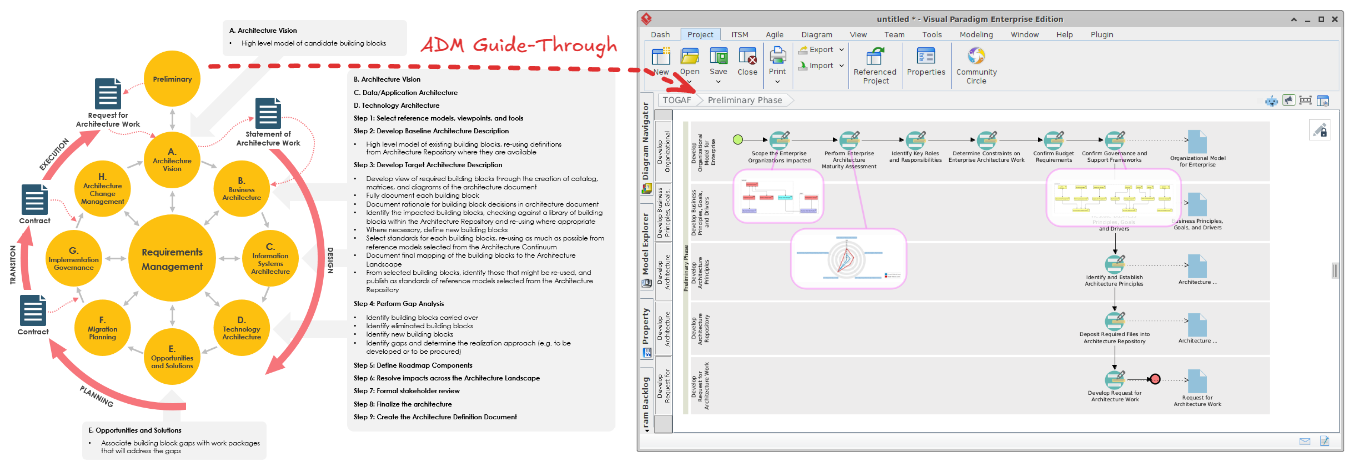 Mastering the TOGAF ADM: A Visual Paradigm Step-by-Step Guide
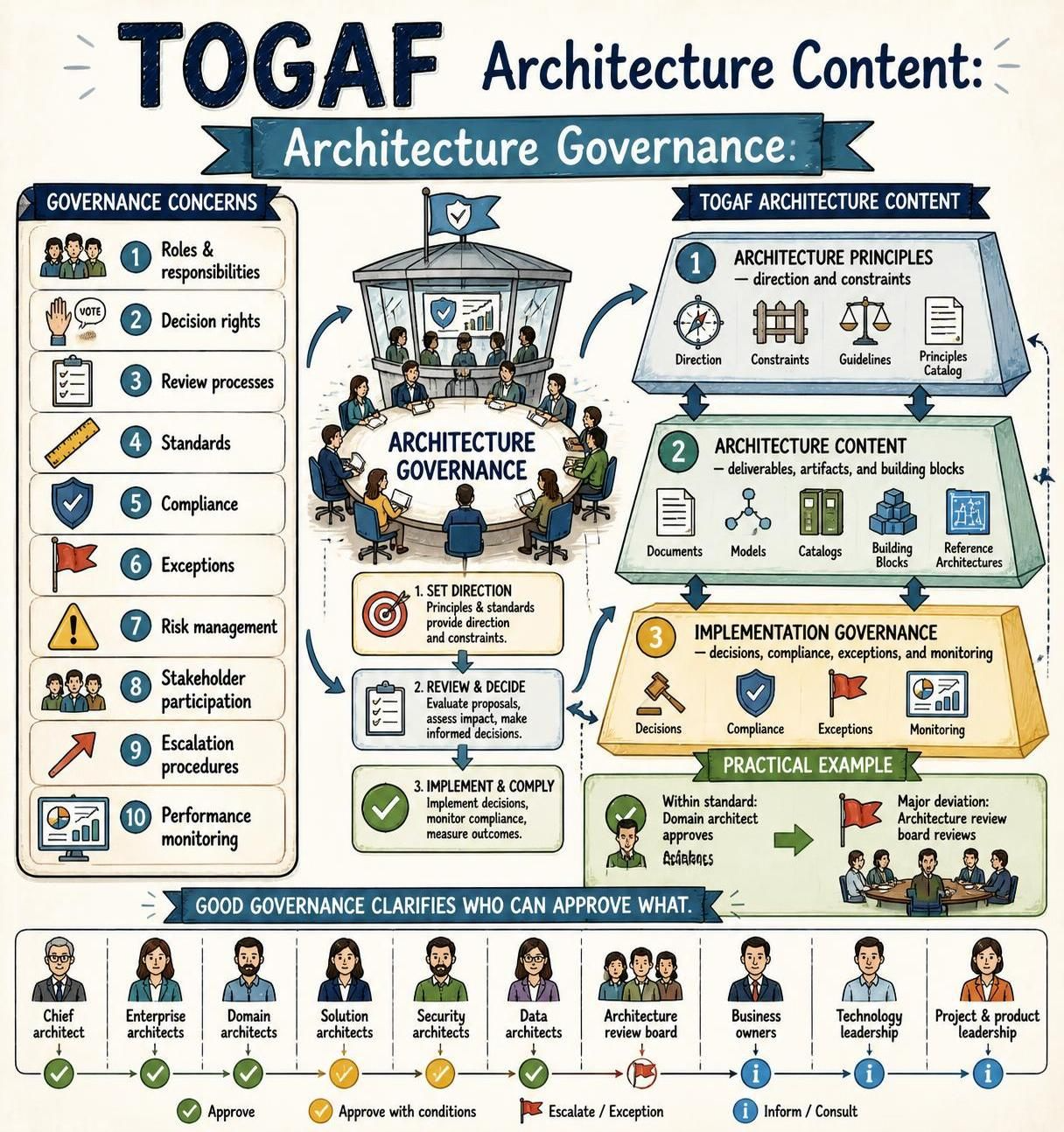 Mastering TOGAF Architecture Governance: A Comprehensive Guide to Roles, Principles, and Decision Rights
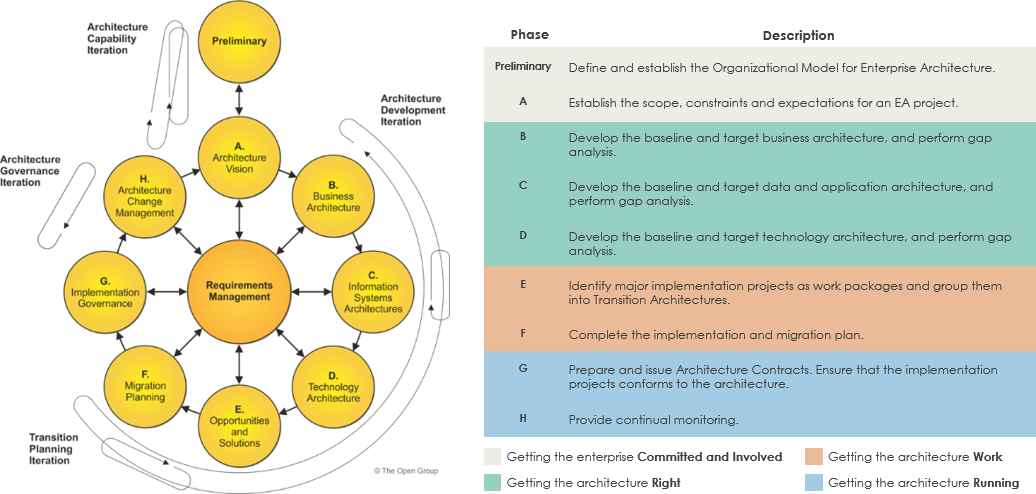 Mastering the TOGAF ADM: A Comprehensive Guide to Enterprise Architecture Development
 Mastering TOGAF Building Blocks: From Abstract Architecture to Practical Implementation