


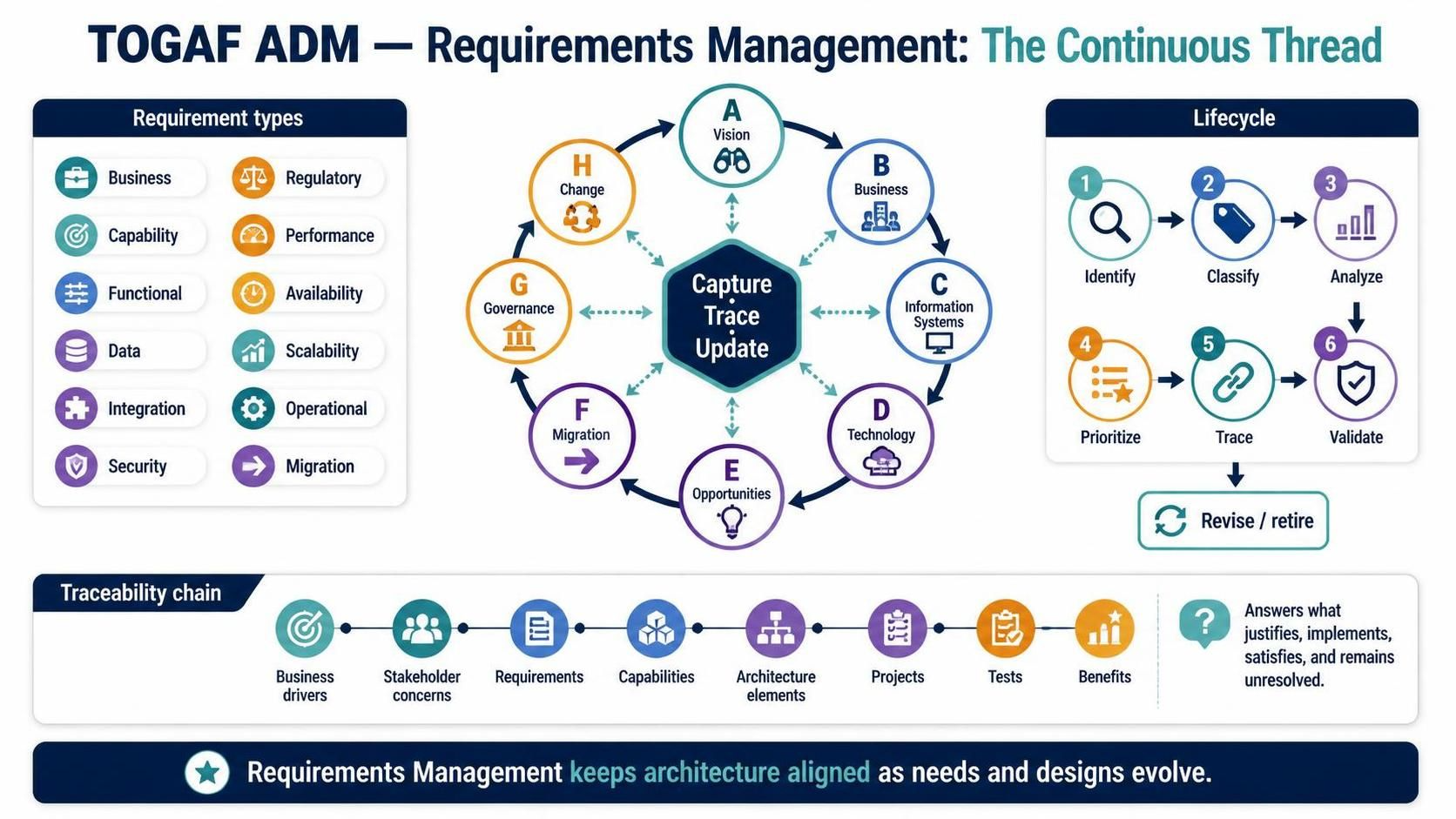
In the complex world of Enterprise Architecture, few concepts are as critical—and as misunderstood—as Requirements Management. Often mistaken for a simple checklist or a preliminary step taken only at the start of a project, Requirements Management in the TOGAF framework is actually a continuous thread that weaves through every single phase of the Architecture Development Method (ADM).
This tutorial explores the visual model of Requirements Management, breaking down how it functions as the backbone of architectural stability. We will walk through the lifecycle of a requirement, the types of requirements you must manage, and the vital chain of traceability that ensures your architecture remains aligned with business goals.
The Core Concept: A Continuous Thread
At the center of the TOGAF ADM cycle is a hexagon labeled “Capture, Trace, Update.” This central hub represents the engine of Requirements Management. Unlike traditional project management where requirements are “frozen” after the planning phase, TOGAF dictates that requirements must be dynamic.
As the architecture evolves through phases A (Vision) through H (Change Management), new information emerges. The requirements must be captured, traced against the architecture, and updated to reflect the current reality. This ensures that the architecture is never “out of sync” with the needs of the organization.
Decoding the Requirements Lifecycle
How do we actually manage these requirements? The diagram outlines a robust 6-step lifecycle that acts as a workflow for any requirement entering the system.
- Identify: The process begins by gathering raw inputs. These can come from business drivers, stakeholder concerns, or regulatory mandates.
- Classify: Once identified, requirements must be categorized. This ensures we know whether we are dealing with a business need, a technical constraint, or a security mandate.
- Analyze: Here, we look for conflicts and dependencies. Does this new security requirement conflict with an existing performance requirement? This step ensures logical consistency.
- Prioritize: Resources are finite. We must determine which requirements are critical (Must-Have) and which are desirable (Nice-to-Have).
- Trace: This is the most technical step. We map the requirement to specific architecture elements. We define exactly which capability or system component satisfies this requirement.
- Validate: Finally, we ensure the requirement has been met. If it hasn’t, the cycle continues to Revise / Retire the requirement, closing the loop.
Understanding Requirement Types
A common pitfall in architecture is focusing solely on “Functional Requirements” (what the system does). The diagram illustrates that a comprehensive architecture must handle a diverse spectrum of requirement types. You must manage:
- Business & Capability Requirements: The high-level “Why” and “What” of the organization.
- Functional & Data Requirements: The specific behaviors and information structures of the system.
- Integration & Migration Requirements: How the new system connects with legacy systems and how we transition to it.
- Quality Attributes: This includes Security, Performance, Availability, Scalability, and Usability.
- Regulatory & Operational Requirements: The external rules and the day-to-day realities of running the system.
The Traceability Chain: Answering the “Why”
The most powerful aspect of this model is the Traceability Chain located at the bottom of the diagram. This chain connects the abstract to the concrete.
Imagine a stakeholder asks a difficult question: “Why are we spending $500,000 on this specific server upgrade?” Without traceability, you are guessing. With the TOGAF traceability chain, you can trace the path backwards:
- Benefits: The upgrade improves speed.
- Tests: The system tests show speed is a metric.
- Projects: The project is building the new server.
- Architecture Elements: The server is a key technology component.
- Capabilities: This server enables the “Real-time Reporting” capability.
- Requirements: This capability satisfies the “High Performance” requirement.
- Stakeholder Concerns: This requirement addresses the CFO’s concern about slow data.
- Business Drivers: Finally, this drives the company’s strategic goal of Market Leadership.
This chain allows architects to answer critical questions such as: “Which business objective justifies this system?” or “What is the impact of changing a requirement?”
Conclusion
Mastering Requirements Management is the difference between building a static IT system and evolving a dynamic enterprise architecture. By treating requirements as a continuous thread that is captured, traced, and updated, architects ensure that every dollar spent is justified by a business driver.
To effectively implement this rigorous process, organizations should leverage specialized modeling software. The Recommended tooling for this task is the Visual Paradigm TOGAF ADM Tool, which provides the necessary features to automate these traceability chains and manage the complex lifecycle of requirements across the ADM cycle.
Related posts:
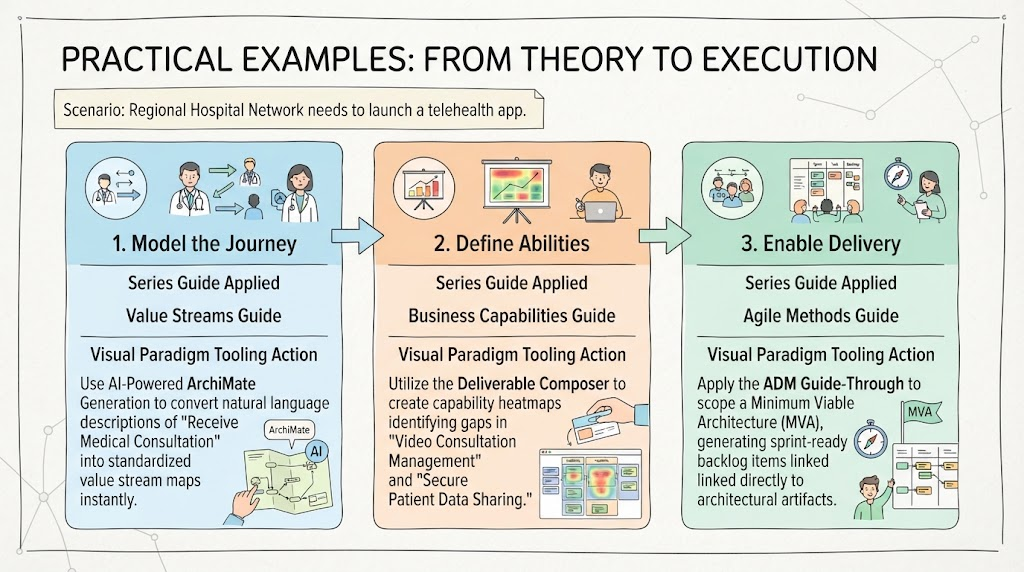 From Theory to Execution: A Practical Guide to Enterprise Architecture with Visual Paradigm
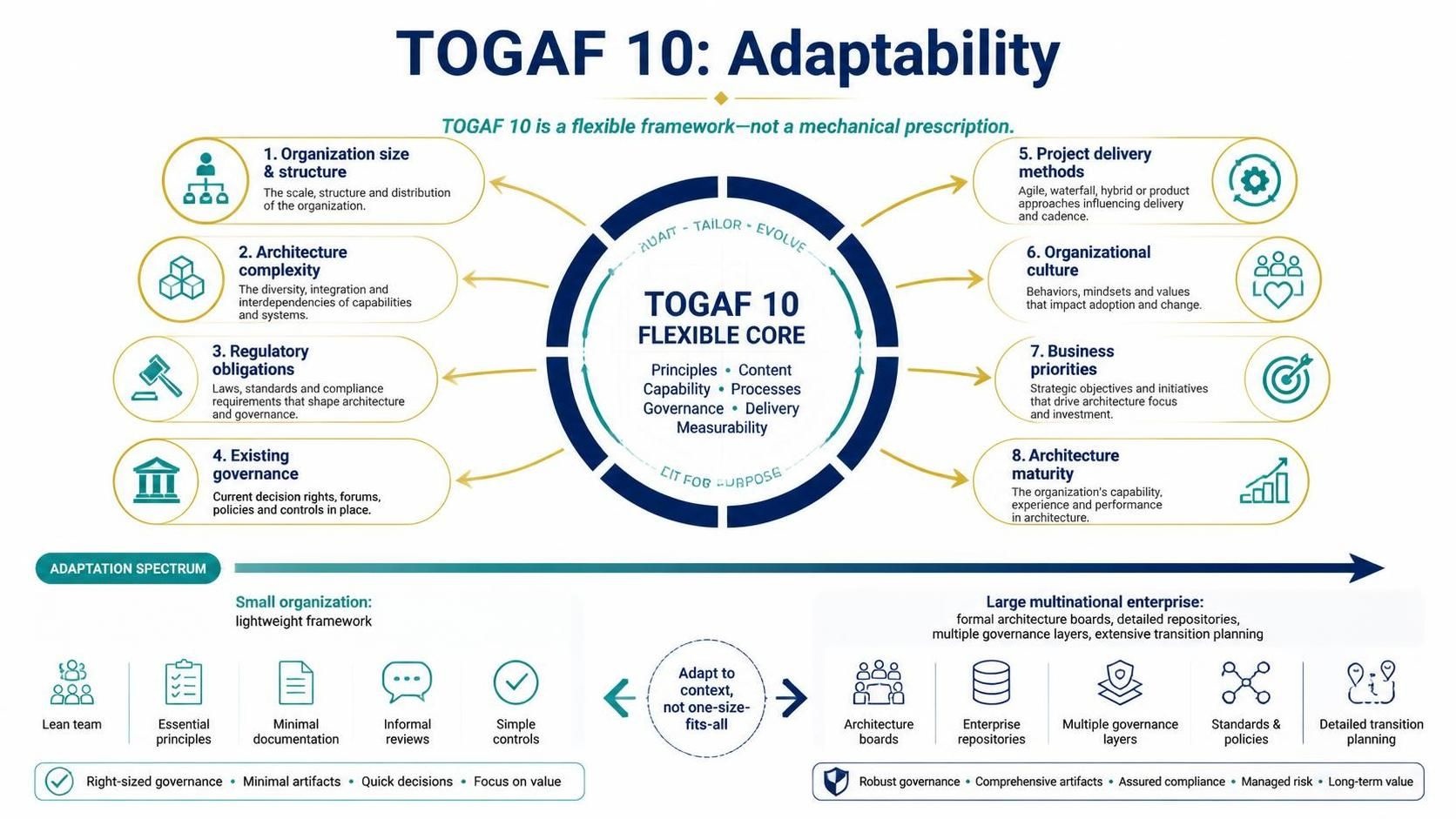 Mastering TOGAF 10 Adaptability: From Concept to Implementation
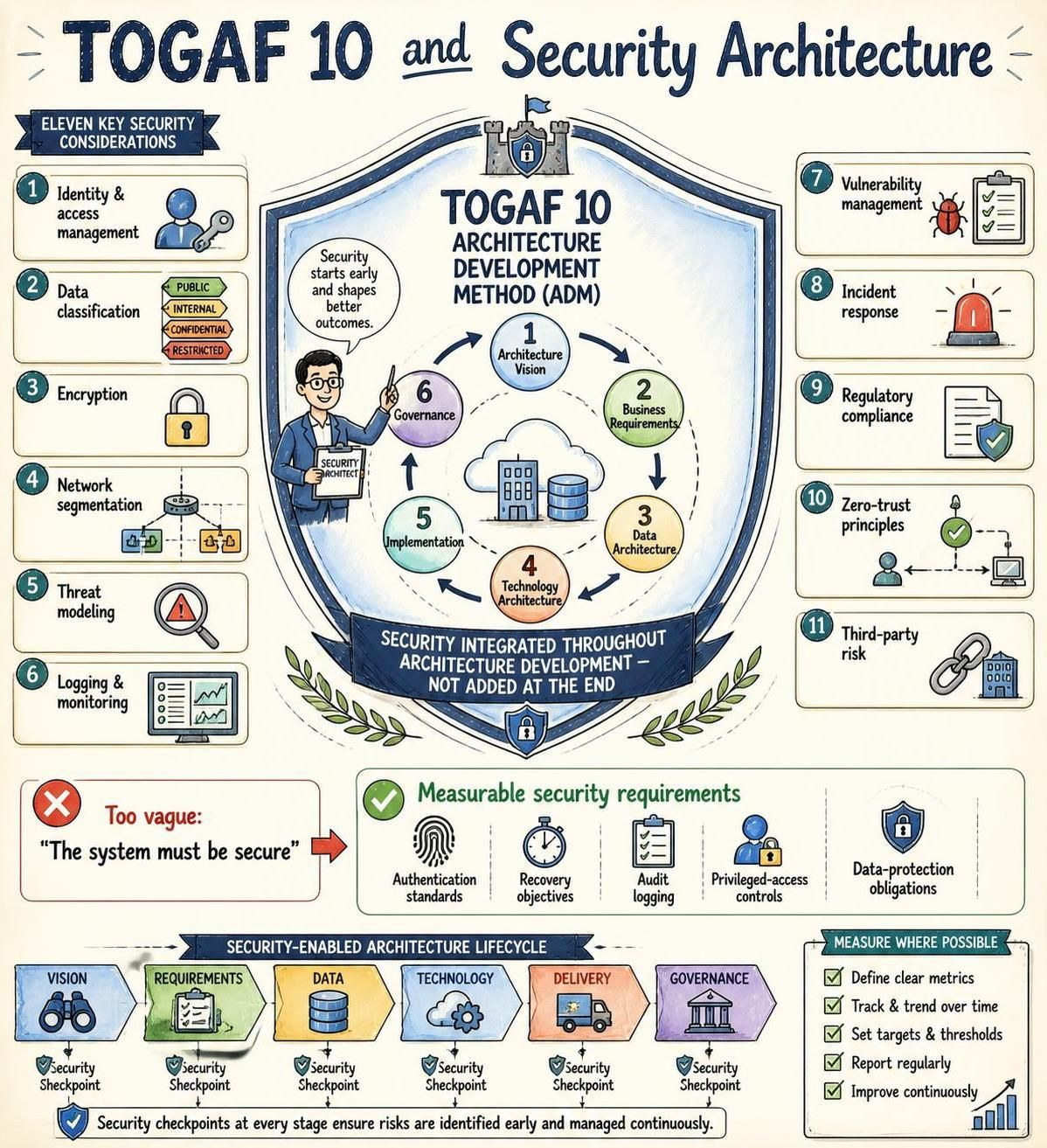 Mastering TOGAF 10 Security Architecture: From Principles to Implementation
 Mastering TOGAF Phase C: A Comprehensive Guide to Information Systems Architecture