Visualizing Your Strategic Roadmap
When we talk about developing a sales strategy, it often feels like a nebulous concept—something that happens in the boardroom without a clear roadmap. However, by translating these business goals into a Business Process Model and Notation (BPMN) diagram, we turn abstract ideas into actionable workflows. Let’s walk through a specific example: the Sales Strategy Development Process.
This workflow illustrates how an organization moves from a high-level planning cycle to a finalized document ready for leadership review. It breaks down the complexity of strategy creation into manageable steps.
Phase 1: The Spark – Planning and Research
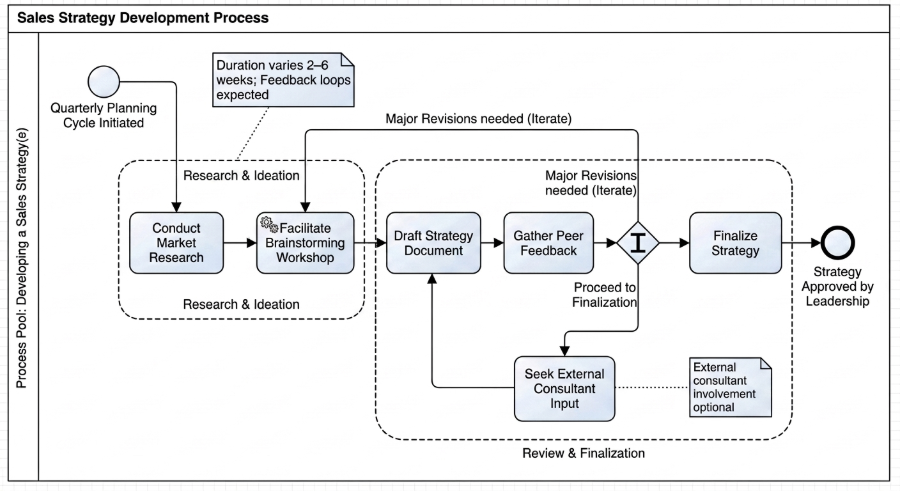
Every great strategy begins with a trigger. In our diagram, this is represented by the circle on the left labeled Quarterly Planning Cycle Initiated. This isn’t just a random start; it signifies a scheduled event where the organization decides it’s time to pivot or plan for the upcoming quarter.
Once triggered, the process immediately dives into the Research & Ideation phase. You’ll notice this entire section is enclosed in a dashed box. In BPMN terms, this is known as a Pooled Activity, grouping related tasks together. Inside this zone, two critical actions occur:
- Conduct Market Research: Gathering data on trends and competitors.
- Facilitate Brainstorming Workshop: Turning that data into potential strategies.
Notice the note attached to the start node? It mentions a duration of 2–6 weeks. This is crucial for project management, setting expectations early on that strategy development takes time and requires feedback loops.
Phase 2: Drafting and Reviewing
After the brainstorming session concludes, the flow moves to the next major block: Review & Finalization. Here, the team transitions from “thinking” to “doing.”
The first step here is to Draft Strategy Document. This is where the ideas generated in the previous phase are formalized into text. But writing the draft is only half the battle. The diagram introduces a loop back to the start if things aren’t quite right, ensuring quality control before moving forward.
Navigating Complexity with Gateways
This is where the diagram gets interesting. After drafting, you must Gather Peer Feedback. Once feedback is collected, the workflow hits a diamond shape. In Visual Paradigm and standard BPMN, this represents a Gateway.
Think of this gateway as a traffic light or a decision point. It asks a simple question: Are there major revisions needed?
- If Yes: The arrow loops back to the “Draft Strategy Document” step. This iterative process ensures the strategy is robust before it ever reaches senior management.
- If No: The path proceeds to finalization.
Handling Exceptions and External Inputs
Real-world processes rarely follow a straight line perfectly. Sometimes, internal peer feedback isn’t enough. The diagram shows a branch leading to Seek External Consultant Input. This is an optional path, indicated by the dotted line connecting to a note saying “External consultant involvement optional.”
This flexibility allows the process to adapt. If the team is stuck or needs a specialized perspective, they can bring in an expert. Once that input is gathered, the workflow feeds back into the drafting stage to incorporate those new insights.
The Finish Line: Leadership Approval
Finally, once the strategy has been refined, peer-reviewed, and potentially vetted by external consultants, the team reaches the Finalize Strategy task. The process then terminates at the thick black circle labeled Strategy Approved by Leadership. This marks the successful completion of the workflow and the handover of authority to the executive team.
Key Takeaways
By mapping out this process visually, we gain several advantages over a static list of instructions:
- Clarity on Iteration: We see clearly that strategy is not linear; it involves revisiting drafts based on feedback.
- Defined Boundaries: Grouping tasks into “Research” and “Review” helps teams understand their specific roles within the larger scope.
- Decision Logic: The gateway ensures that resources aren’t wasted presenting unfinished work to leadership.
Whether you are using Visual Paradigm or another modeling tool, understanding these symbols and flows is essential for building efficient, transparent business processes.