Understanding the Flow of Business
In the world of business operations, few processes are as fundamental as Order-to-Cash (O2C). It is the heartbeat of commerce—transforming a customer’s desire into a completed transaction. But how do we map out this complex interaction so that everyone involved knows exactly what to do?
This is where Business Process Model and Notation (BPMN) shines. By visualizing workflows, tools like Visual Paradigm allow us to see the invisible connections between different parties. Let’s walk through a classic scenario: a collaborative O2C flow involving a Buyer and a Seller.
The Stage: Two Organizations
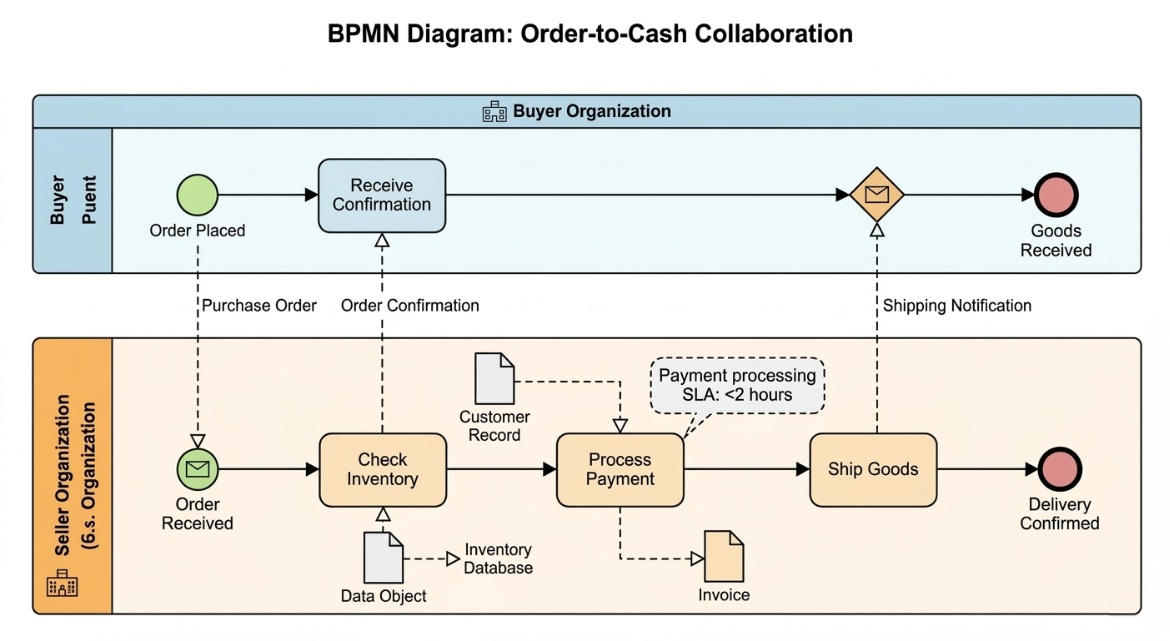
Imagine a diagram divided into two distinct areas, known in BPMN terminology as Pools. In our example, we have:
- Buyer Organization: The entity initiating the purchase.
- Seller Organization: The entity providing goods or services.
These pools represent the boundaries of each organization. Crucially, notice how they don’t interact directly inside their own boxes; instead, they communicate across the boundary lines. These crossing lines are called Lane Swims (or Message Flows), representing the exchange of information.
Step 1: The Purchase Order
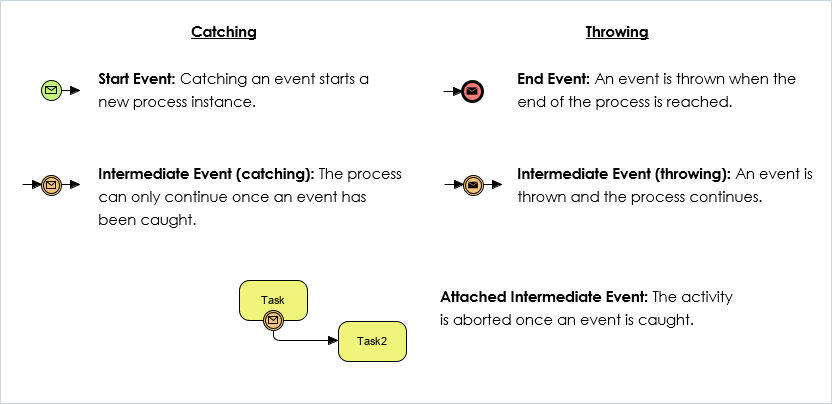
The journey begins on the Buyer side. The process starts with a green circle, which signifies a Start Event. Here, the buyer places an order. Visually, this is often represented by a “Purchase Order” document being sent.
This message travels via a dashed line with an open arrowhead—a standard symbol for a message flow—to the Seller Organization. For the seller, receiving this order isn’t just a thought; it triggers a specific action. We see this with a green envelope icon, indicating that the “Order Received” event has started the seller’s internal workflow.
Step 2: Inventory and Confirmation
Once the Seller receives the order, the first logical step is to verify if they can actually fulfill it. This leads us to the “Check Inventory” task. You might notice a small paper icon labeled “Data Object” pointing to an “Inventory Database.” This detail is vital—it tells us that checking inventory isn’t magic; it requires accessing real-time data records.
If the check is successful, the process moves forward. However, the buyer needs to know that their order was received and accepted. The Seller performs a task called “Receive Confirmation” (from the perspective of the buyer, or rather, sending the confirmation back). A message flows back up to the Buyer Organization, acknowledging the request.
Step 3: Processing Payment
With the order confirmed and inventory checked, the focus shifts to money. The Seller executes the “Process Payment” task. This is where things get interesting regarding efficiency. Notice the little note attached to this box? It mentions an SLA (Service Level Agreement) of less than 2 hours. This annotation reminds us that in real-world modeling, we aren’t just drawing steps; we are defining performance expectations.
During this phase, a new document is created: the Invoice. In BPMN, this is shown as a generated data object, proving that the financial transaction has been formalized.
Step 4: Shipping and Receipt
The final leg of the journey involves physical delivery. Once payment is processed, the Seller performs the “Ship Goods” task. This generates a shipping notification that travels back to the Buyer.
For the Buyer, this arrival acts as a trigger to update their status. They move towards the final red circle, known as the End Event, signifying that the goods have been successfully received and the cycle is complete.
Key Takeaways from the Diagram
By analyzing this diagram, we learn several core concepts about process modeling:
- Collaboration is Key: Real business rarely happens in isolation. BPMN excels at showing how one organization’s output becomes another’s input.
- Data Matters: Don’t forget the documents! Whether it’s an invoice or a database record, data objects give context to your tasks.
- Clarity reduces risk: Using clear symbols for start/end events and message flows ensures that every stakeholder understands their role in the chain.
Whether you are mapping a simple supply chain or a complex enterprise system, understanding these building blocks allows you to design processes that are efficient, transparent, and easy to manage.