


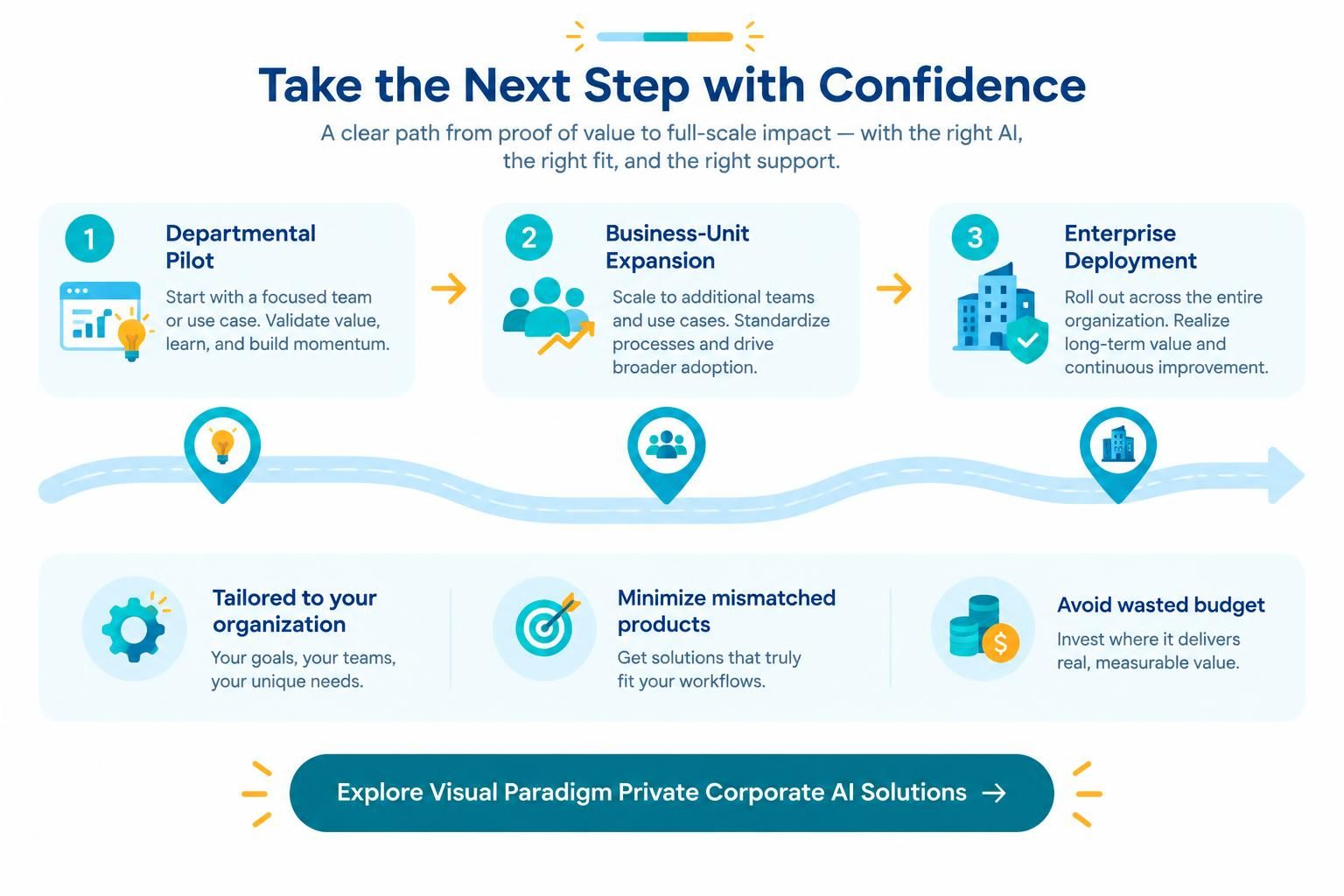
In the rapidly evolving landscape of artificial intelligence, the decision to adopt AI is no longer just about acquiring the latest technology; it is about orchestrating a strategic transformation. Organizations today face a critical challenge: how to scale AI initiatives from a promising idea to a core business competency without destabilizing existing operations or wasting financial resources. Visual Paradigm addresses this challenge through a holistic “Self-Hosted AI Total Solution” designed for the enterprise ecosystem.
This tutorial breaks down the strategic architecture of AI adoption, moving beyond simple product installation to a structured, three-phase deployment model. This approach ensures that your organization builds a foundation of value before scaling, minimizing risk while maximizing impact.
The Philosophy of Strategic Scaling
Traditional IT projects often fail because they are attempted at an enterprise-wide scale too early. This “big bang” approach introduces significant risk: high costs, complex integration issues, and the potential for user resistance. The Visual Paradigm ecosystem advocates for a gradual, iterative approach. This methodology allows teams to validate the utility of AI in controlled environments before committing to organization-wide standardization.
By treating AI deployment as a journey rather than a destination, enterprises can ensure that every dollar spent delivers measurable returns. The architecture of this solution is built on three critical pillars: flexibility, standardization, and value realization.
Phase 1: The Departmental Pilot
The journey begins with the Departmental Pilot. This phase is the “Proof of Value” stage. Instead of a company-wide rollout, the organization identifies a specific, focused team or a singular high-impact use case. The goal here is to validate the technology’s fit within the current workflow.
During this phase, the architecture acts as a sandbox. Teams can experiment with the self-hosted AI capabilities to ensure data privacy and security are maintained locally. The focus is on learning and building momentum. Success in this phase is defined not by the number of users, but by the clarity of the results—proving that the AI tool effectively solves the problem it was designed for.
Phase 2: Business-Unit Expansion
Once the pilot demonstrates success, the architecture shifts to Business-Unit Expansion. This phase bridges the gap between a successful experiment and a standardized enterprise asset. The focus moves from “validation” to “standardization.”
In this stage, the organization scales the solution to additional teams. The self-hosted ecosystem allows for the replication of proven workflows across different departments. Crucially, this phase involves refining the processes. What worked in the pilot is now optimized for broader adoption. The goal is to create a cohesive ecosystem where different teams within a business unit share data and capabilities, driving broader adoption and creating a unified data strategy.
Phase 3: Enterprise Deployment
The final stage is Enterprise Deployment, where the solution is rolled out across the entire organization. This represents the realization of long-term value and continuous improvement. At this level, the AI ecosystem is no longer an add-on but a fundamental part of the enterprise’s infrastructure.
This full-scale deployment relies heavily on the standardization achieved in Phase 2. By the time the solution reaches the enterprise level, the organization has a mature set of processes, a trained workforce, and a clear understanding of the ROI. The architecture supports continuous improvement, allowing the AI models to evolve alongside the changing needs of the business.
Core Architectural Benefits
The Visual Paradigm Private Corporate AI Solution is not just a deployment path; it is an architectural philosophy that ensures specific business outcomes. The ecosystem is designed to address the three most common pitfalls of enterprise AI adoption.
- Tailored to Your Organization: The solution is not a generic “one-size-fits-all” product. It is designed to align with your unique organizational goals, team structures, and specific workflows. This customization ensures that the AI tools integrate seamlessly rather than disrupting existing operations.
- Minimize Mismatched Products: A major source of failure in IT is the integration of tools that do not fit the user’s needs. The Visual Paradigm approach ensures that the technology fits the workflow. By validating the fit in the pilot phase, the organization avoids investing in tools that require complex workarounds or constant friction.
- Avoid Wasted Budget: By following this phased approach, the organization invests only where it delivers real, measurable value. The risk of “wasted budget” on failed enterprise-wide rollouts is significantly reduced. Every dollar spent in the pilot and expansion phases is tied to a proven return on investment.
Conclusion: A Clear Path Forward
The transition to an AI-driven enterprise is a complex architectural undertaking. However, by leveraging a structured, three-stage roadmap—Departmental Pilot, Business-Unit Expansion, and Enterprise Deployment—organizations can navigate this transition with confidence. Visual Paradigm’s Private Corporate AI Solutions provide the necessary tools and ecosystem to guide this journey, ensuring that your organization not only adopts AI but successfully integrates it to drive long-term growth and efficiency.