In the world of business process management (BPM), the gap between a business idea and an executable process model has traditionally been a bottleneck. Creating BPMN (Business Process Model and Notation) diagrams manually is often a tedious exercise in dragging and dropping shapes, a process that is not only time-consuming but highly susceptible to syntax errors. For Agile teams, this friction slows down velocity.
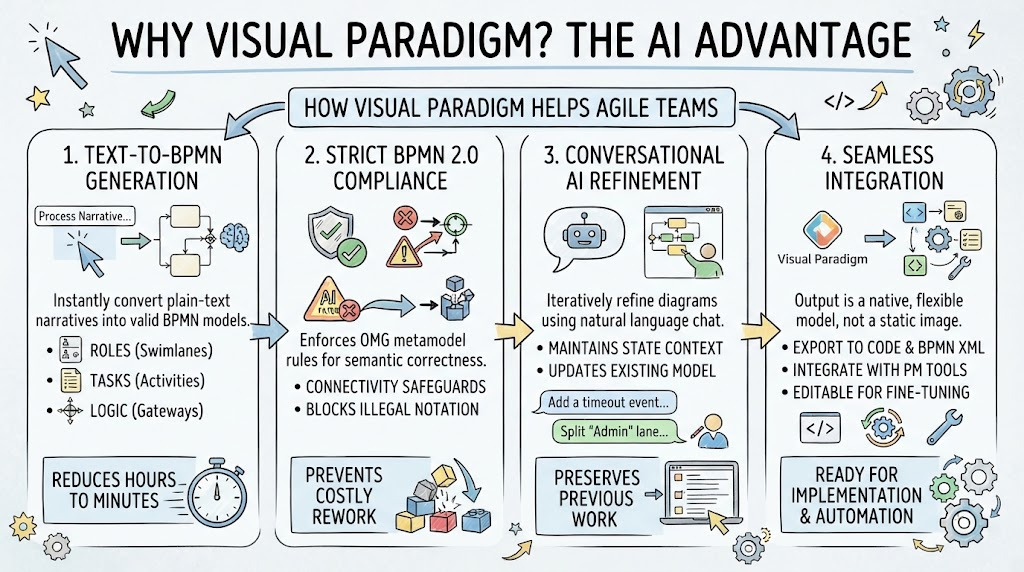
Visual Paradigm has addressed this challenge by integrating an AI-driven architecture that transforms how we build process models. This tutorial breaks down the four-pillar system architecture shown in the infographic, explaining how AI converts text into valid, executable business logic.
1. The Generative Engine: Text-to-BPMN
The foundation of this workflow is the ability to ingest unstructured data. Instead of starting with a blank canvas and wondering where to place a gateway, the user starts with a Process Narrative. The AI engine acts as a parser, analyzing natural language descriptions and mapping them to the strict structural requirements of BPMN.
This step automates the initial modeling phase by identifying three critical components:
- Roles (Swimlanes): The AI identifies who is performing the action (e.g., “The Manager,” “The Customer”).
- Tasks (Activities): It recognizes the specific work items (e.g., “Approve Loan,” “Send Invoice”).
- Logic (Gateways): It infers decision points based on conditional language (e.g., “If approved… then…”).
This capability reduces the modeling time from hours to minutes, allowing teams to focus on the logic of the process rather than the geometry of the diagram.
2. The Compliance Guardrail: Strict BPMN 2.0
One of the biggest risks in AI-generated modeling is “hallucination”—creating shapes that look like a BPMN diagram but are technically invalid. Visual Paradigm solves this with a Compliance Engine.
This system enforces the OMG (Object Management Group) metamodel. It acts as a strict validator in real-time:
- Semantic Correctness: It ensures that connectors follow the rules of the BPMN 2.0 specification. You cannot connect two events with a sequence flow, for example.
- Connectivity Safeguards: The AI understands the topology of the process. It knows that a gateway must have an incoming and outgoing flow.
- Blocking Illegal Notation: If the AI attempts to generate a shape that violates the standard, the system blocks it. This prevents costly rework later when the model is handed off to developers or automation tools.
3. The Conversational Loop: AI Refinement
Modeling is rarely a one-shot process. Requirements change, and details are missed. Visual Paradigm introduces a Conversational AI Refinement layer. This transforms the modeling tool from a static drawing canvas into an interactive partner.
Through a chat interface, users can iteratively refine the diagram using natural language commands. This maintains the state context of the model. For instance, a user can simply type:
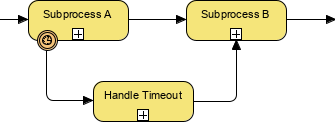
“Add a timeout event to this approval step.”
Or:
“Split the ‘Admin’ lane into ‘Senior Admin’ and ‘Junior Admin’.”
This approach preserves previous work. The AI does not regenerate the diagram from scratch; it updates the existing model intelligently, ensuring the history and context of the process are maintained.
4. The Architecture of Integration: Seamless Output
The final and most critical step is the output format. Many AI diagramming tools output a static image (PNG or JPG), which is useless for automation. Visual Paradigm ensures the output is a native, flexible model.
The system architecture supports:
- BPMN XML Export: The model is saved as standard XML, the universal language of process automation.
- Code Generation: The model can be exported directly into code, bridging the gap between design and development.
- PM Tool Integration: It integrates seamlessly with Project Management tools, allowing for real-time tracking of process changes.
Because the output is editable and structured, it is ready for implementation and automation immediately. It is not just a picture of a process; it is the digital twin of the process itself.