Introduction to Diagram-as-Code
Welcome to this tutorial session. Today, we are diving into a critical challenge that software engineers, system architects, and technical writers face daily: the art of technical documentation. For years, we have been caught in a difficult dichotomy. On one side, we have visual tools that are intuitive but notoriously difficult to manage in a version-controlled environment. On the other, we have text-based scripts that offer perfect version control but come with a steep learning curve and the burden of manual syntax management.
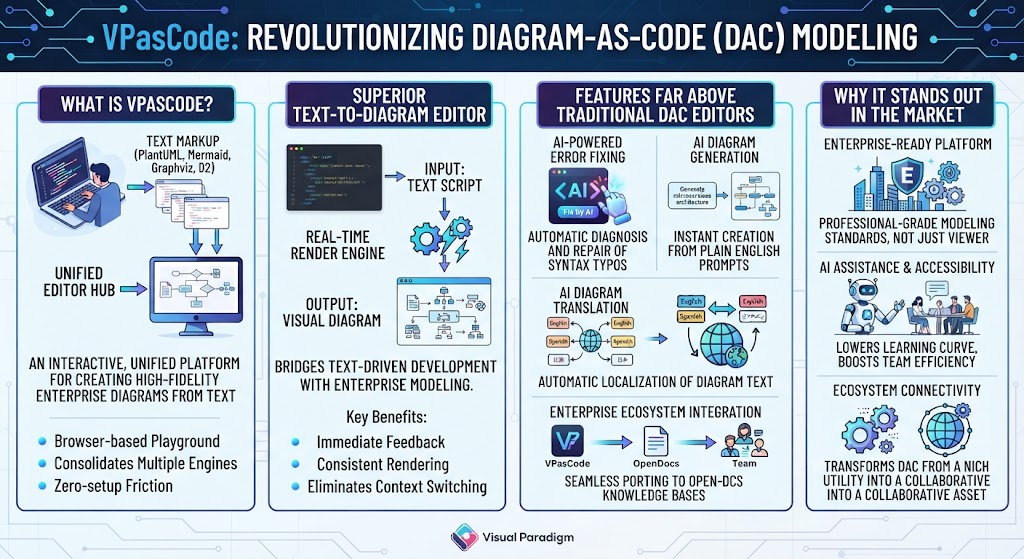
Visual Paradigm is proud to introduce VPasCode, a cloud-native, browser-based Diagram-as-Code (DaC) platform designed to resolve this conflict. By unifying industry-standard syntax engines with advanced artificial intelligence, VPasCode transforms how we create and maintain technical diagrams. Let’s explore how this platform bridges the gap between visual intuition and code-based efficiency.
Understanding the Documentation Dilemma
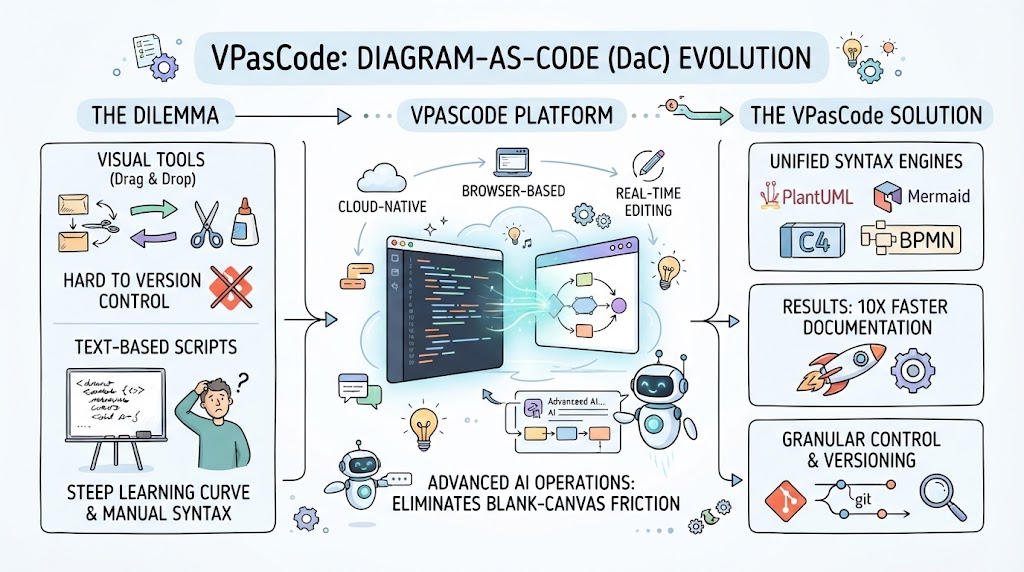
To appreciate the value of VPasCode, we must first understand the pain points it addresses. As illustrated in the evolution of Diagram-as-Code, engineers have historically been forced to choose between two imperfect paths:
- Visual Tools (Drag & Drop): These tools, such as standard drawing applications, allow for rapid, visual creation of diagrams. However, they often result in binary files that are hard to version control. Merging changes between team members is a nightmare, and tracking the history of specific elements is nearly impossible.
- Text-Based Scripts: Tools like raw PlantUML or Mermaid code allow for perfect version control via Git. However, they require a steep learning curve. Engineers must memorize complex syntax, and debugging a broken diagram often requires manual syntax checking.
The VPasCode Platform Architecture
VPasCode acts as the central bridge in this ecosystem. It is built as a cloud-native, browser-based platform, meaning there is no heavy local installation required. This architecture supports real-time editing, allowing teams to collaborate seamlessly.
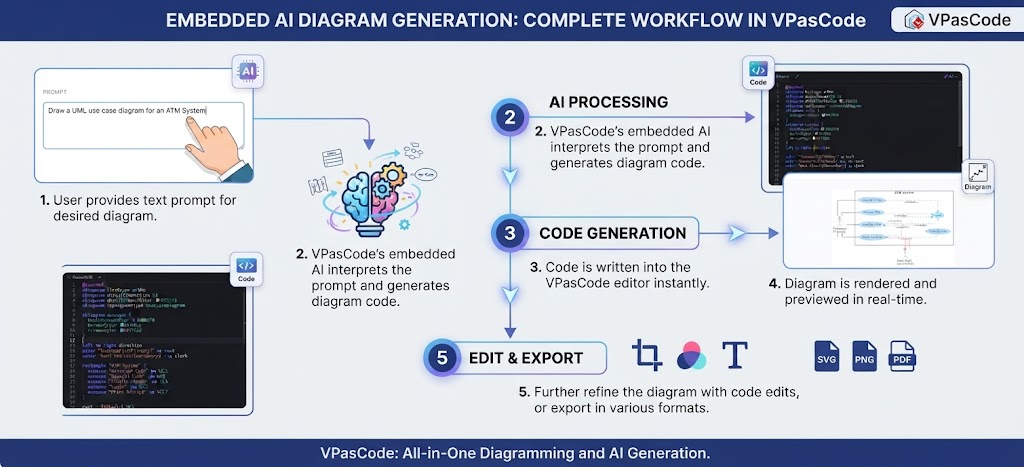
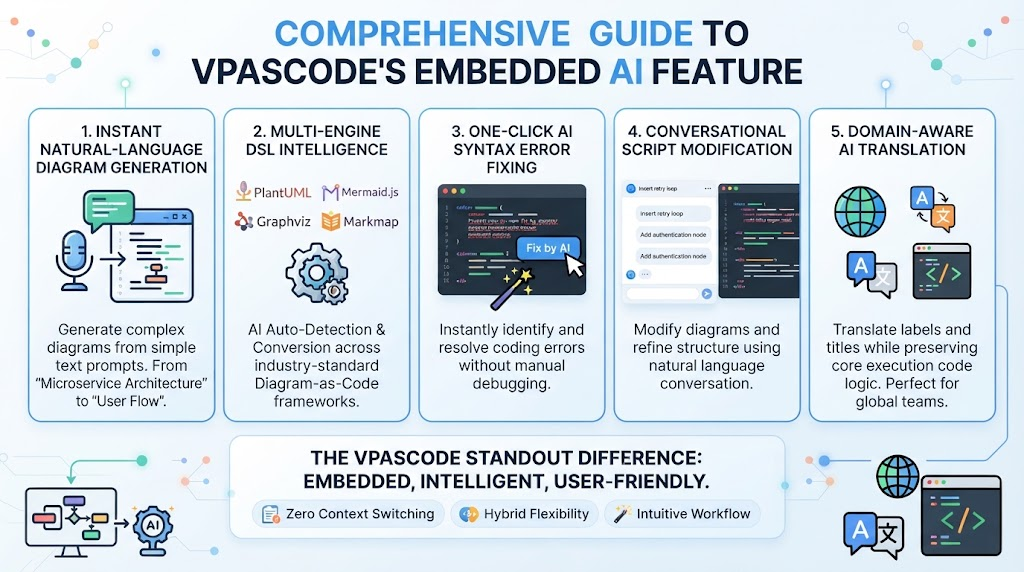
One of the most significant features of this platform is its approach to Advanced AI Operations. A common barrier in coding diagrams is “blank-canvas friction”—the struggle to start typing complex code from scratch. VPasCode utilizes AI to eliminate this friction, helping users generate code snippets and structure diagrams without needing to be a syntax expert.
Unified Syntax Engines and Granular Control
What makes VPasCode truly powerful is its ability to support multiple industry-standard syntax engines within a single interface. You are not locked into one format. The platform integrates:
- PlantUML and Mermaid for general software architecture.
- C4 model for software architecture modeling.
- BPMN for business process modeling.
By unifying these engines, Visual Paradigm ensures that whether you are modeling a high-level system context or a detailed database schema, the tool adapts to your needs. Furthermore, the platform provides granular control and versioning. Because the diagrams are essentially code, they integrate naturally with Git. This means you can track every change, revert to previous states, and merge contributions just like you would with standard source code.
The Result: 10x Faster Documentation
The ultimate goal of VPasCode is efficiency. By removing the friction of syntax management and the difficulties of version control, the platform delivers results that are significantly faster than traditional methods. The data suggests that documentation creation can be up to 10x faster when using this approach.
For organizations using Visual Paradigm, this means a shift in workflow. Instead of spending days manually drawing boxes and connecting lines in a static editor, or wrestling with code syntax, teams can focus on the actual architecture and logic. VPasCode empowers you to design, model, and implement complex systems effectively, ensuring your documentation is as robust and versioned as your actual software.