Introduction: The Universal Language of Business
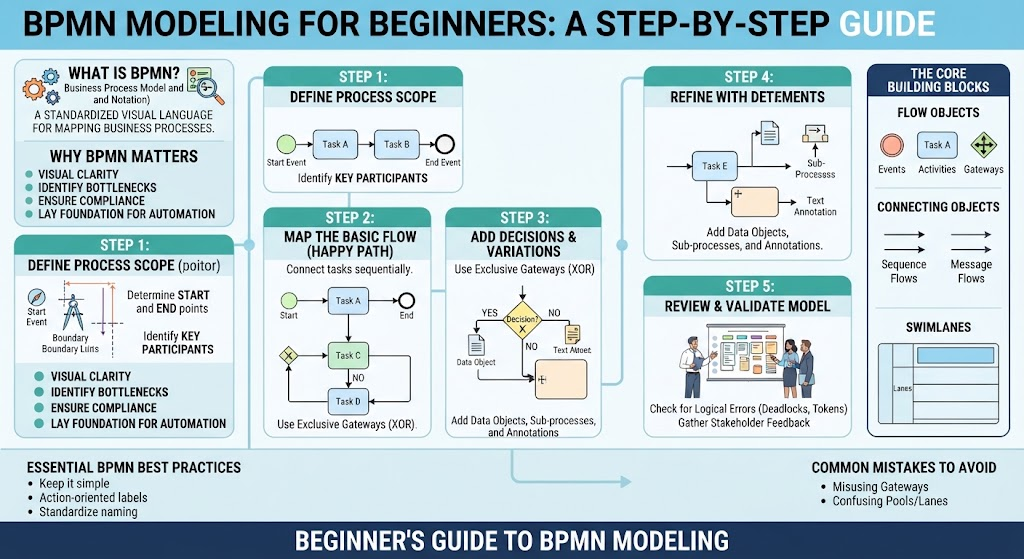
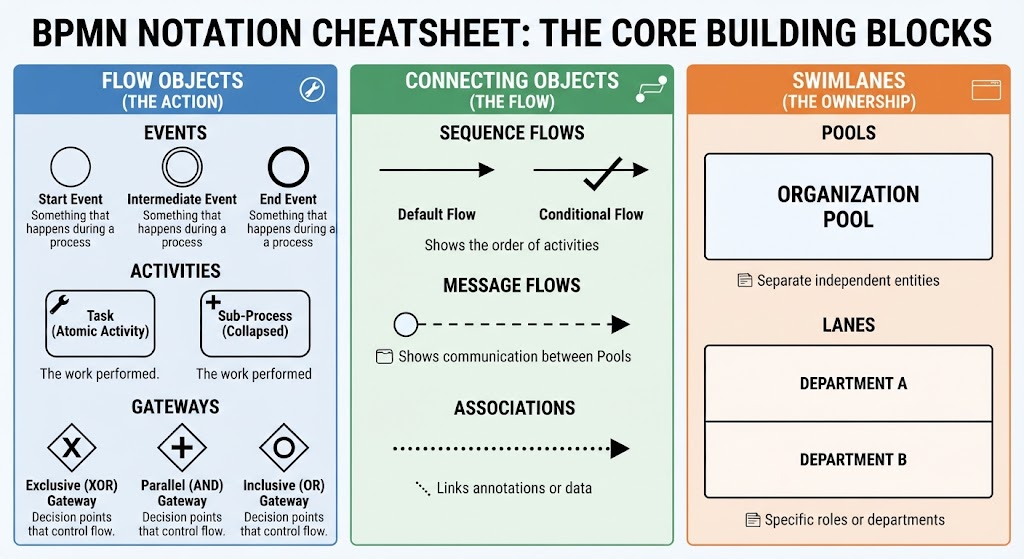
In the modern enterprise, the gap between business strategy and technical implementation is often bridged by a single, critical skill: the ability to visualize complex processes clearly. This is where Business Process Model and Notation (BPMN) 2.0 comes into play. As the global standard for visualizing, documenting, and analyzing business processes, BPMN serves as a universal language that allows stakeholders to speak the same dialect, regardless of whether they are executives, analysts, or developers.
However, mastering this language has traditionally required significant effort. Fortunately, the Visual Paradigm ecosystem has revolutionized this landscape. It is not merely a diagramming tool; it is a comprehensive, collaborative platform for end-to-end process engineering that integrates advanced AI capabilities. This tutorial will explore how Visual Paradigm unifies the modeling world, turning text descriptions into production-ready models instantly.
The Four Pillars of the Visual Paradigm AI Ecosystem
Visual Paradigm creates a unified environment where modeling is seamless, accessible, and intelligent. This ecosystem rests on four distinct but interconnected pillars, each designed to serve a specific phase of the engineering lifecycle.
1. VP Desktop (Visual Model)
The flagship application for deep, offline modeling is VP Desktop. This is where heavy lifting occurs for complex projects. It integrates AI generation with advanced editing capabilities and robust version control. If you are designing a mission-critical enterprise workflow, this is your primary workspace for ensuring precision and compliance.
2. OpenDocs
Knowledge management is often a siloed process, but OpenDocs changes that narrative. It is a platform that embeds live, AI-assisted diagrams directly into your documents. This ensures that your documentation is never static; it evolves alongside your process models, keeping reports and technical specs synchronized with reality.
3. Conversational Co-Pilot (AI Chatbot)
Ideation can be a bottleneck. The Conversational Co-Pilot is an interactive tool designed for rapid ideation. It allows users to generate and refine diagrams through natural language conversation. Instead of struggling with a blank canvas, you can simply describe your process, and the AI helps you structure it immediately.
4. Web Apps (Guided Tools)
Accessibility is key for collaboration. The Web Apps provide browser-based tools for step-by-step modeling. These guided tools allow teams to collaborate on process engineering without the friction of installing desktop software, making it easy to onboard new team members or work remotely.
From Text to Model: Solving the BPMN Challenge
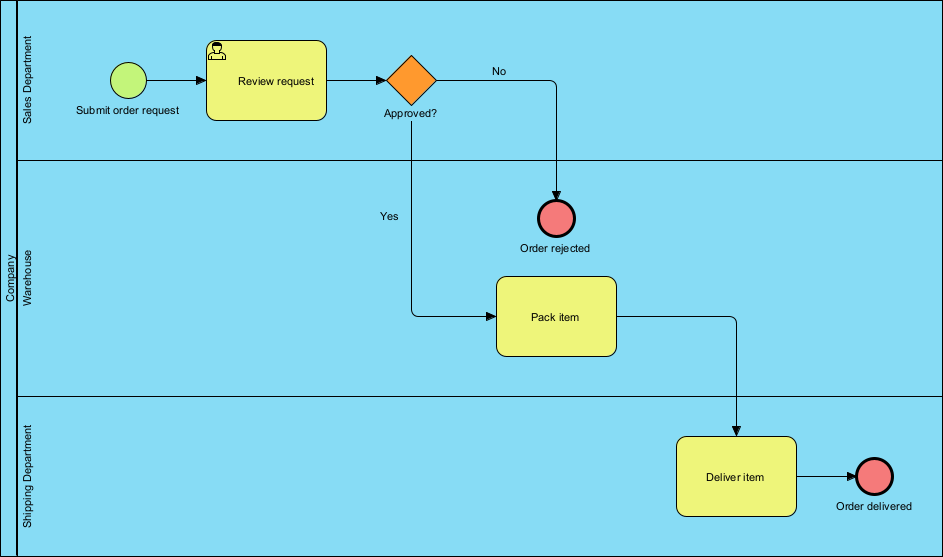
Why is traditional BPMN modeling so difficult? The challenge lies in the manual effort required to drag and drop elements, align swimlanes, and connect sequence flows. This process is often slow, prone to inconsistencies, and demands significant expertise to ensure compliance with BPMN 2.0 standards. Furthermore, standard text-to-diagram tools often fail with BPMN because they cannot handle the complex geometric constraints of swimlanes or the strict matrix routing required for enterprise-grade processes.
Visual Paradigm’s AI engine uses Natural Language Processing (NLP) to overcome these barriers. By allowing users to provide plain-English procedural descriptions, the AI transforms simple text into sophisticated visual models.
How the AI Engine Works
When you engage with the AI within the Visual Paradigm ecosystem, the process is intelligent and semantic. The engine performs the following critical tasks:
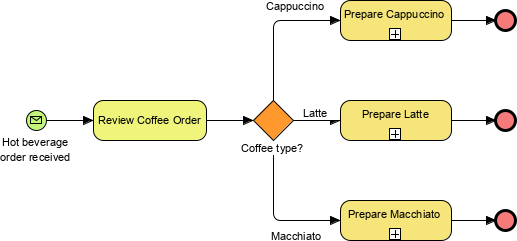
- Extracts Semantics: It identifies organizational entities (pools and lanes), actions (tasks), and decisions (gateways) directly from your text.
- Generates Objects: It instantiates explicit modeling objects within the editor rather than drawing flat shapes. This means you get a true BPMN model, not just a picture.
- Optimizes Layout: It applies smart routing rules to minimize line crossings and ensures swimlanes are geometrically contained, adhering to professional design standards automatically.
- Creates Interactive Models: The output is a fully editable BPMN 2.0 diagram. You can immediately refine, edit, and extend the model, bridging the gap between “rapid ideation” and “professional modeling.”
Connecting the Ecosystem
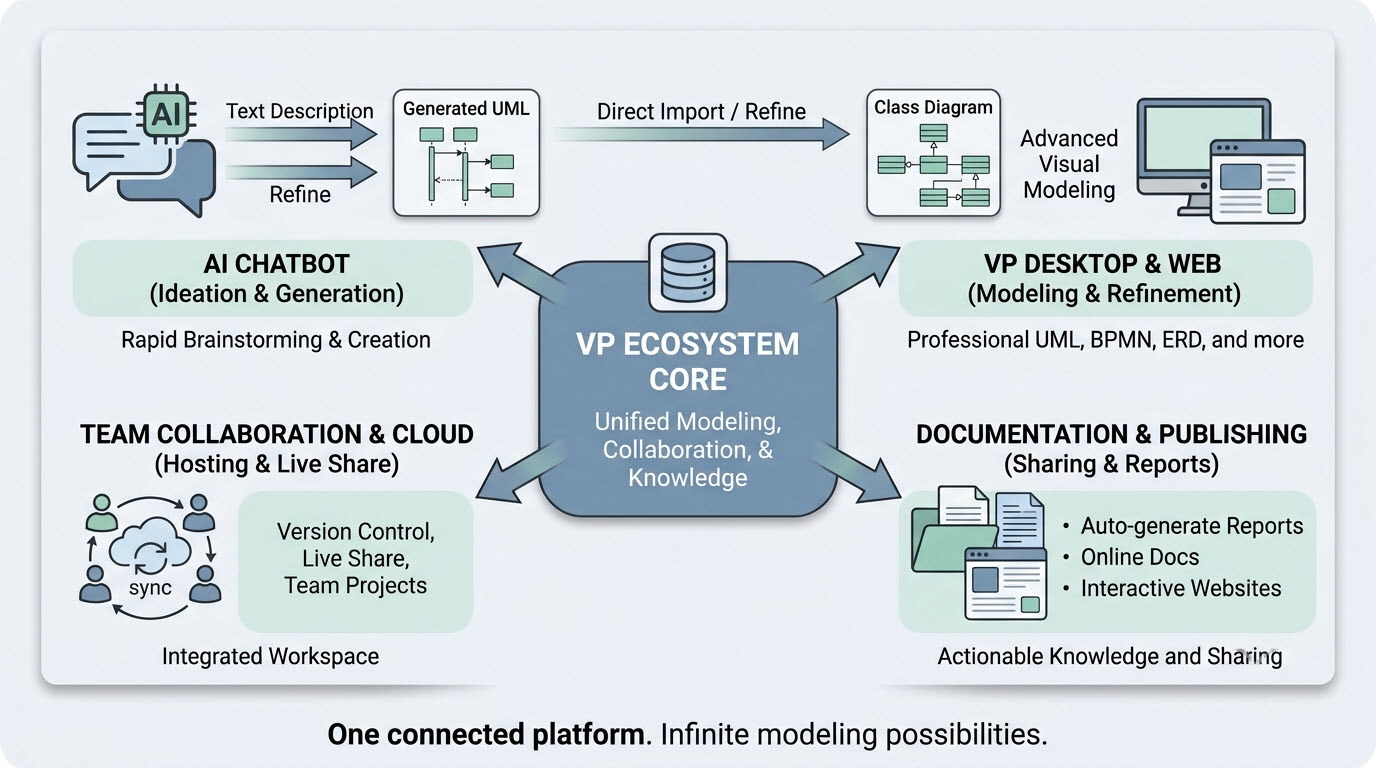
The power of this approach is visible in the workflow of the Visual Paradigm ecosystem. It begins with the AI Chatbot for rapid brainstorming and creation, allowing you to generate a UML or BPMN structure from a simple text description. This model can then be imported directly into VP Desktop & Web for advanced visual modeling and refinement.
Once the model is refined, it moves to the Documentation & Publishing stage, where you can auto-generate reports, create online docs, or build interactive websites to share your work. Finally, the entire process is supported by Team Collaboration & Cloud, ensuring version control, live sharing, and a unified workspace for the entire team.
Ultimately, the Visual Paradigm ecosystem represents a one-connected platform where infinite modeling possibilities exist. By unifying modeling, collaboration, and knowledge under a single core, Visual Paradigm empowers you to move from a simple idea to a production-ready implementation with unprecedented speed and accuracy.