


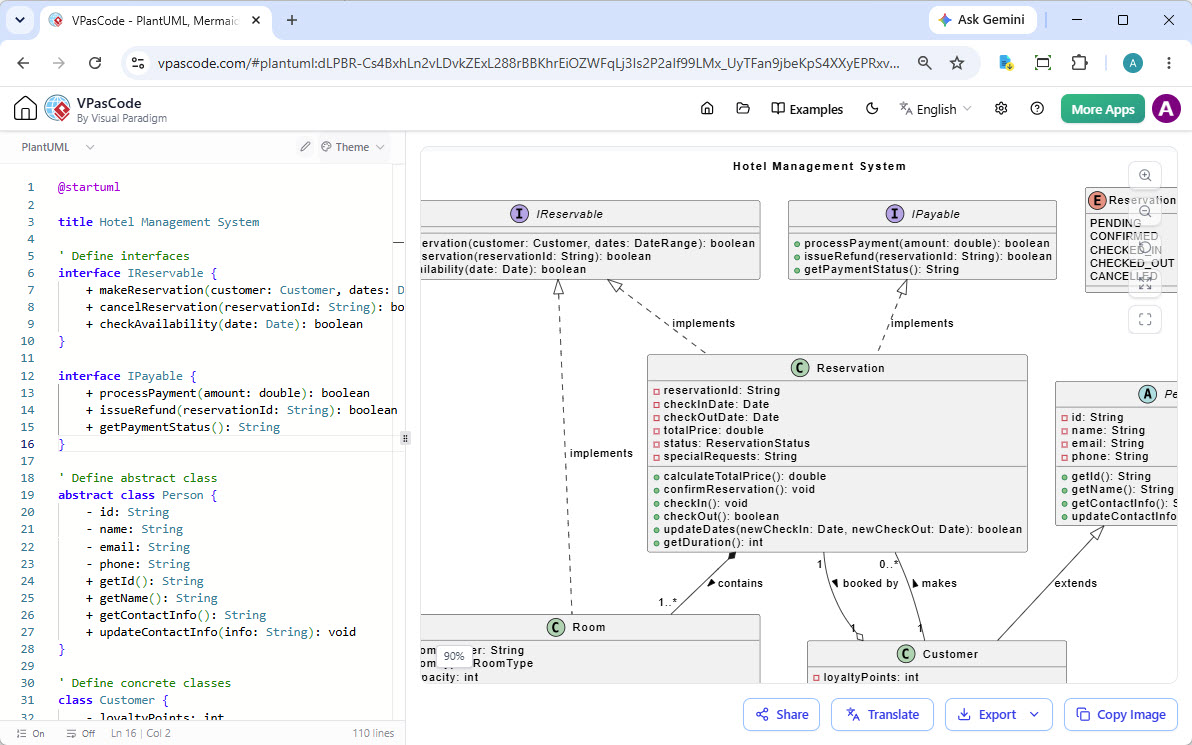
Designing complex software systems requires more than just writing code; it requires a clear architectural blueprint. In the world of Object-Oriented Design, the Class Diagram is the most fundamental model. It describes the static structure of a system by defining classes, their attributes, methods, and the relationships between them.
Visual Paradigm’s VPasCode platform bridges the gap between abstract textual definitions and concrete visual models. By leveraging the power of PlantUML, developers can architect robust systems like the Hotel Management System shown in our examples, ensuring that the logic is sound before a single line of implementation code is written.
Modeling Interfaces: The Contract of Behavior
In a hotel management system, flexibility is key. Different entities need to perform specific actions, such as making a reservation or processing a payment. In object-oriented design, we achieve this flexibility using Interfaces. An interface defines a contract: it specifies what a class can do without dictating exactly how it does it.
In the VPasCode editor, we define interfaces using the interface keyword. Let’s look at how we model the IReservable and IPayable interfaces in the code:
@startuml
title Hotel Management System

' Define interfaces
interface IReservable {
    + makeReservation(customer: Customer, dates: DateRange): boolean
    + cancelReservation(reservationId: String): boolean
    + checkAvailability(date: Date): boolean
}

interface IPayable {
    + processPayment(amount: double): boolean
    + issueRefund(reservationId: String): boolean
    + getPaymentStatus(): String
}
@enduml
Notice the use of the + symbol. In UML notation, this represents public visibility. Any class in the system can invoke these methods. By separating these behaviors into interfaces, we prepare the ground for the Strategy Pattern, allowing different payment providers or reservation engines to be swapped out without breaking the core system.
Abstracting Entities: The Power of Abstract Classes
While interfaces define behavior, Abstract Classes are used to define common state and behavior for a group of related classes. In our hotel system, we have a concept of a Person. However, we cannot have a “generic” person; we must have specific types like Customers or Employees.
This is where the abstract class Person comes in. It captures the shared attributes (like ID, name, and contact info) and common behaviors (like getId or updateContactInfo). By marking it as abstract, we signal to the compiler (and the developer) that this class cannot be instantiated directly. It exists only to be extended.
' Define abstract class
abstract class Person {
    - id: String
    - name: String
    - email: String
    - phone: String
    + getId(): String
    + getName(): String
    + getContactInfo(): String
    + updateContactInfo(info: String): void
}
The - symbol in front of attributes like id and name indicates private visibility. This is a crucial modeling concept known as Data Encapsulation. It ensures that the internal state of a Person cannot be modified directly by external code, preserving data integrity.
Implementing Concrete Behavior
The true power of the Class Diagram emerges when concrete classes implement the interfaces and extend the abstract classes. The Reservation class in the diagram is a perfect example. It is a concrete entity that implements both IReservable and IPayable.
By implementing these interfaces, the Reservation class promises to provide the specific logic for processPayment and makeReservation. This creates a cohesive system where a Reservation is not just a data object, but an active agent capable of managing its own lifecycle.
Visualizing Relationships: Composition and Association
Once classes are defined, the architecture is defined by their relationships. The diagram illustrates three critical relationships:
- Implements (Dashed Line with Hollow Arrow): The
Reservationclass implements theIReservableandIPayableinterfaces. This is a dependency relationship indicating thatReservationadheres to the contracts defined in the interfaces. - Composition (Filled Diamond): The relationship between
ReservationandRoomis a Composition (1..* contains). The filled diamond signifies “strong ownership.” A Room cannot exist independently of a Reservation in this specific context; if the Reservation is deleted, the specific instance of the Room booking is effectively dissolved. - Association (Solid Line): The line connecting
ReservationandCustomerindicates an Association. The labels “booked by” and “makes” clarify the semantic direction of the relationship.
Conclusion
By using VPasCode to model the Hotel Management System, we move beyond simple syntax and embrace true architectural thinking. We define contracts with interfaces, abstract commonalities with abstract classes, and visualize complex interactions through composition and association. This text-based approach allows developers to iterate rapidly on the system’s design, ensuring that the final code is robust, modular, and scalable.