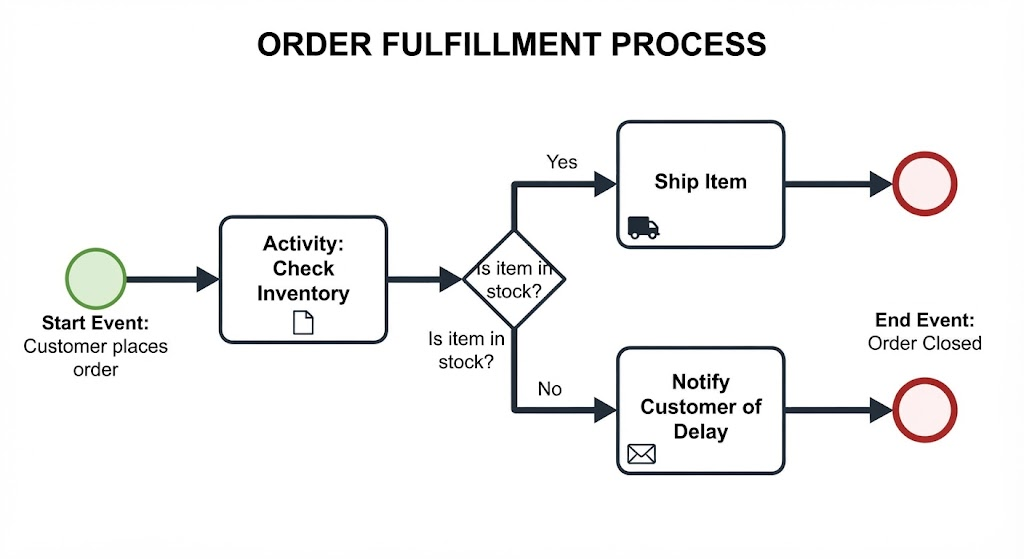
BPMN

Foundations of Process Improvement: Analyzing the As-Is State

Foundations of Process Improvement: Analyzing the As-Is State

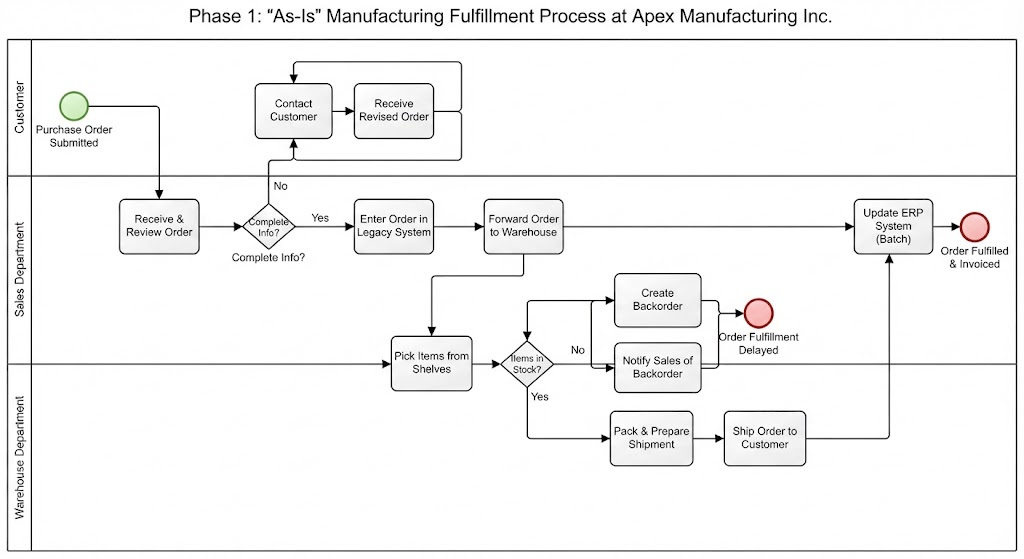
Phase 1: Visualizing the Current State (As-Is) The first step in any process improvement initiative is documenting the current reality. The diagram below illustrates the “As-Is” process at Apex Manufacturing. Notice the heavy reliance on manual tasks (rectangles) and the linear, sequential nature of the workflow. Analysis of the As-Is State: Manual Submission: The customer submits a purchase order, which enters the Sales Department lane without pre-validation. Reactive Error Handling: If information is incomplete (“Complete Info? -> No”), a sales representative must manually “Contact Customer.” This creates a delay loop that halts the process until the customer responds. Siloed Warehouse Operations: The Warehouse Department checks inventory manually. If items are missing, a backorder is created, and sales is notified via a separate, likely non-integrated channel. Delayed ERP Updates: The “Update ERP System” task occurs late in the cycle, meaning financial and inventory data may be out of sync during the picking and packing phases. Phase 2: Identifying the Gaps A detailed gap analysis reveals four critical areas for improvement: Order Submission & Data Validation: Gap: Sales relies on manual review to catch missing info, wasting skilled labor on administrative checks. Impact: Increased cycle time and higher risk of human error. Customer Exception Handling: Gap: Follow-up on incomplete orders is manual and slow. Impact: Customer frustration and delayed revenue recognition. Inventory and Backorder Management: Gap: Inventory checks are discrete events rather than continuous monitoring; backorder notifications are not instantaneous. Impact: Sales teams may sell stock that isn’t available, or fail to communicate delays proactively. Warehouse Fulfillment & ERP Synchronization: Gap: Picking, packing, and shipping are manual touches disconnected from the central ERP until the end of the process. Impact: Lack of real-time visibility into order status and potential shipping errors
Understanding Gap Analysis: Bridging the Divide Between Current Reality and Future Goals

Understanding Gap Analysis: Bridging the Divide Between Current Reality and Future Goals

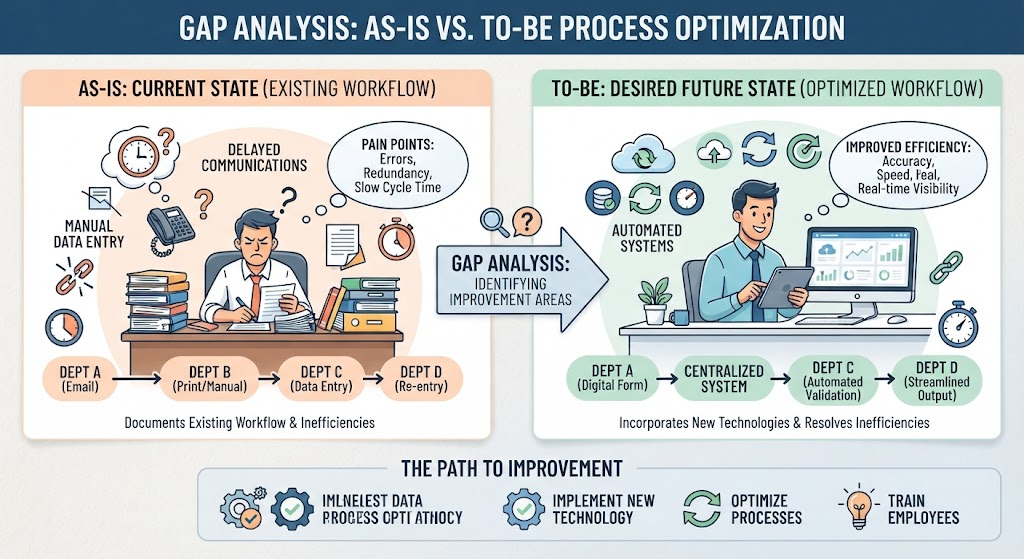
Gap Analysis (As-Is vs. To-Be) Gap analysis involves identifying the current state (“As-Is”), defining the desired future state (“To-Be”), and analyzing the gaps between them to implement improvements. As-Is Process: Documents the existing workflow, often highlighting pain points like manual data entry or delayed communications. To-Be Process: Illustrates the optimized workflow incorporating new technologies or methodologies to resolve identified inefficiencies.

Navigating the Strategic Transition: From Manual Chaos to Optimized Efficiency

Navigating the Strategic Transition: From Manual Chaos to Optimized Efficiency

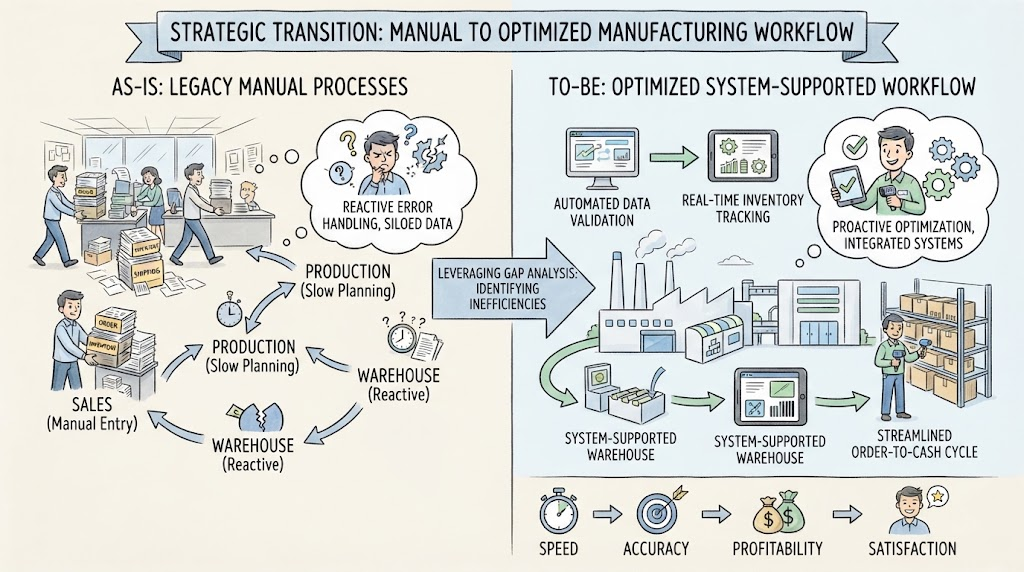
In the modern manufacturing landscape, the speed and accuracy of order fulfillment are critical determinants of customer satisfaction and operational profitability. However, many organizations, like the fictional Apex Manufacturing Inc., rely on legacy “As-Is” processes characterized by manual handoffs, siloed departments, and reactive error handling. This guide explores the strategic transition from a manual workflow to an optimized “To-Be” state. By leveraging Gap Analysis—a method of comparing current operating conditions against a target state to determine how to bridge the difference—businesses can identify inefficiencies in their order-to-cash cycles. We will examine how integrating automated data validation, real-time inventory tracking, and system-supported warehouse operations can eliminate bottlenecks and streamline the path from purchase order to delivery. Key Concepts 1. Business Process Model and Notation (BPMN) BPMN is a standard for business process modeling that provides a graphical notation for specifying business processes in a Business Process Diagram. In the context of Apex Manufacturing, BPMN is used to visualize the flow of tasks between the Customer, Sales Department, and Warehouse Department. Pools and Lanes: These represent the different participants (e.g., Sales vs. Warehouse) and help identify where handoffs occur. Gateways: The diamond shapes (X) represent decision points, such as “Complete Info?” or “Items Available?”, which dictate the process path. 2. Gap Analysis (As-Is vs. To-Be) Gap analysis involves identifying the current state (“As-Is”), defining the desired future state (“To-Be”), and analyzing the gaps between them to implement improvements. As-Is Process: Documents the existing workflow, often highlighting pain points like manual data entry or delayed communications. To-Be Process: Illustrates the optimized workflow incorporating new technologies or methodologies to resolve identified inefficiencies.

Understanding the Language of Business: A Guide to BPMN

Understanding the Language of Business: A Guide to BPMN

Overview of BPMN
Knowing how the business operates is the first and the most critical step of business process improvement. Business Process Model and Notation (BPMN), provides a graphical representation of business workflows that anyone, from business analyst to stakeholder, can easily understand; aiding in business process analysis and business process improvements.

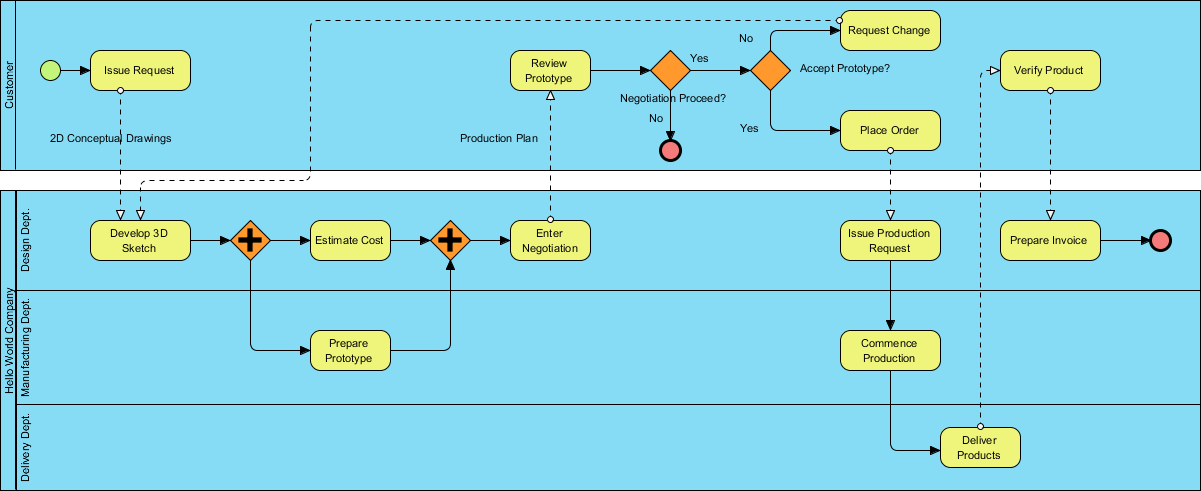
Any process described with BPMN is represented as a number of steps (activities) that are performed consequently or at the same time according to certain business rules. Take a look at the “Place Order online” process which can be used in an on-line store that place orders on the web.

Mastering BPMN Compensation: Handling Post-Success Failures in E-Commerce

Mastering BPMN Compensation: Handling Post-Success Failures in E-Commerce

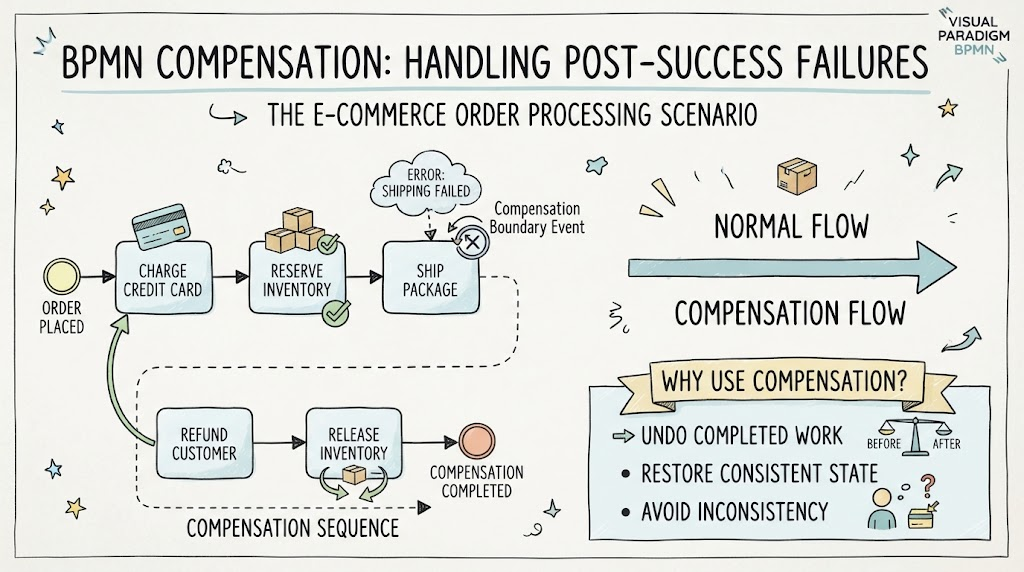
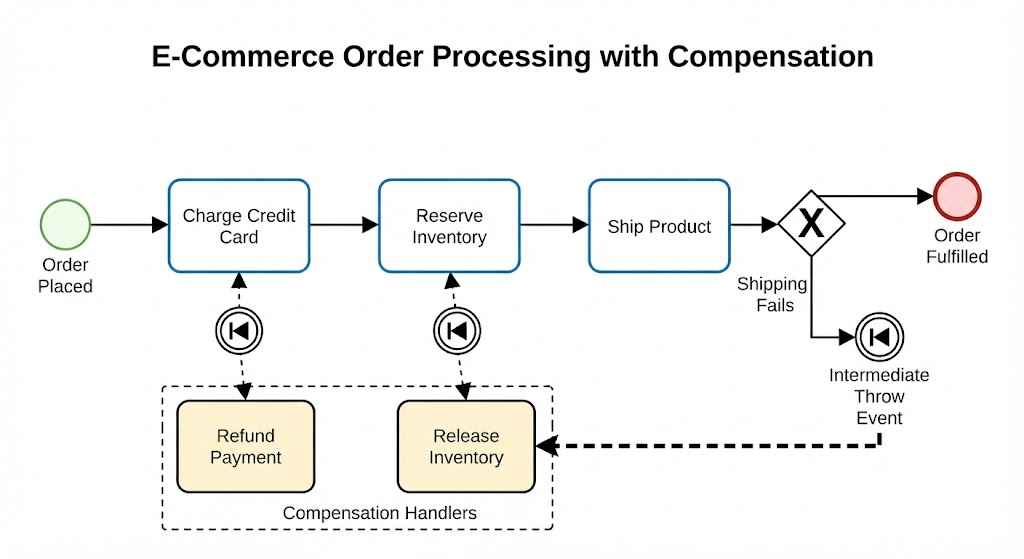
BPMN diagram illustrating compensation handling for post-success failures in an e-commerce order processing scenario. The visual distinguishes between normal flow (charge card, reserve inventory, ship package) and the compensation sequence (refund customer, release inventory) triggered by shipping failure, explaining that compensation serves to undo completed work, restore consistent state, and avoid inconsistency.

Mastering BPMN 2.0.2: A Guide to Essential Process Markers

Mastering BPMN 2.0.2: A Guide to Essential Process Markers

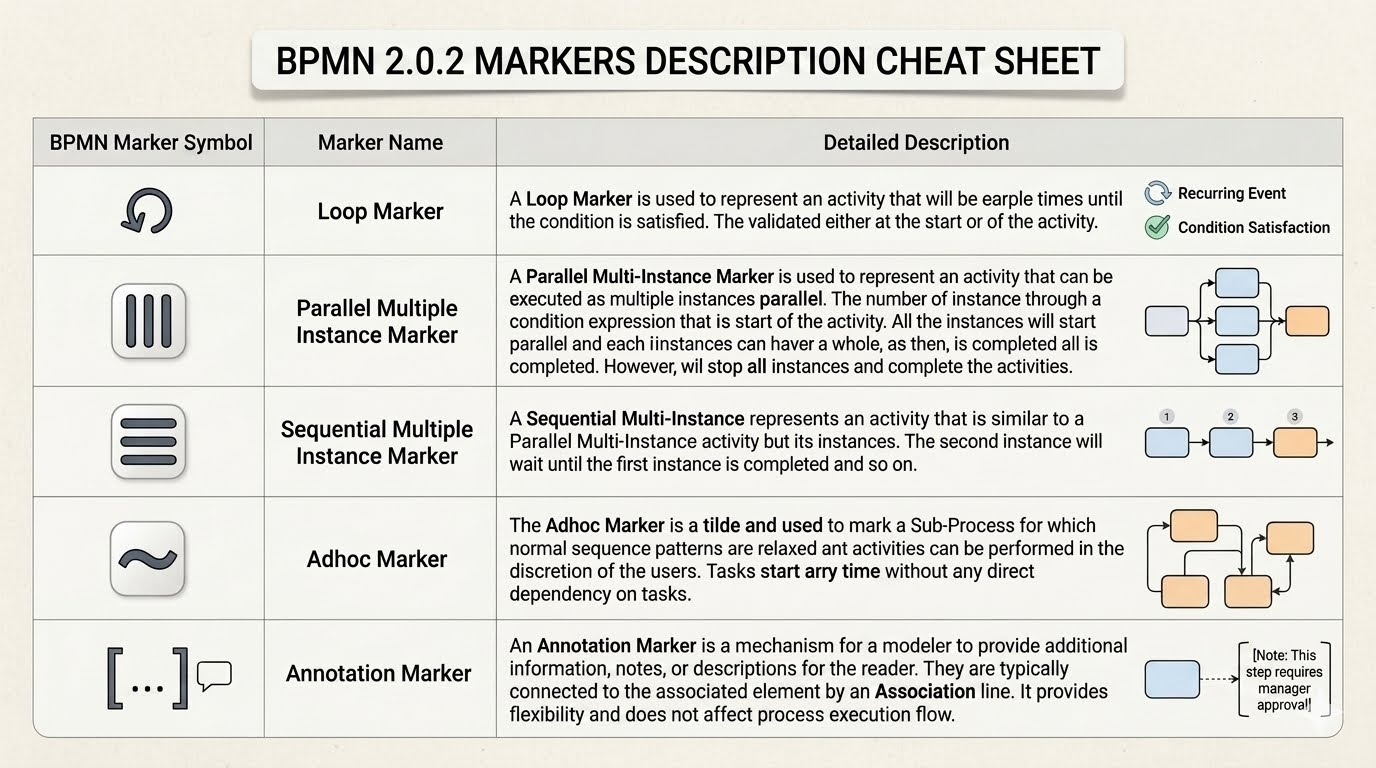
The BPMN 2.0.2 Markers Description Cheat Sheet provides a comprehensive table detailing the symbols, names, and descriptions of five essential BPMN markers used to modify process elements. It illustrates the Loop, Parallel Multiple Instance, Sequential Multiple Instance, Adhoc, and Annotation markers, explaining their specific functions and visual representations in business process modeling.

Mastering BPMN: The Global Standard for Business Process Modeling

Mastering BPMN: The Global Standard for Business Process Modeling

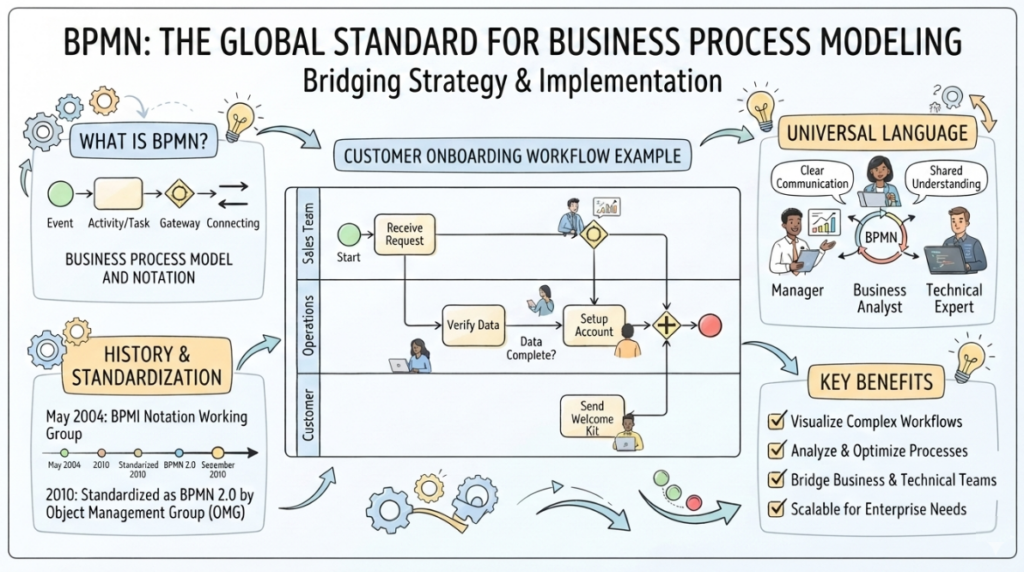
This BPMN diagram illustrates business process modeling standards and includes a detailed “Customer Onboarding Workflow Example” with swimlanes for Sales Team, Operations, and Customer. The infographic also explains key BPMN concepts, history, universal language benefits, and key advantages like workflow visualization and process optimization.

返回頂端