Introduction: Taming the Complexity of Business Processes
Welcome to this tutorial session on Business Process Model and Notation (BPMN). As we delve into process modeling, we often encounter a common challenge: complexity. When a workflow becomes too intricate, the diagram can turn into a tangled web of lines and shapes that are difficult to read or maintain. Today, we are going to explore the solution to this problem: Sub-processes.
The Power of Process Abstraction
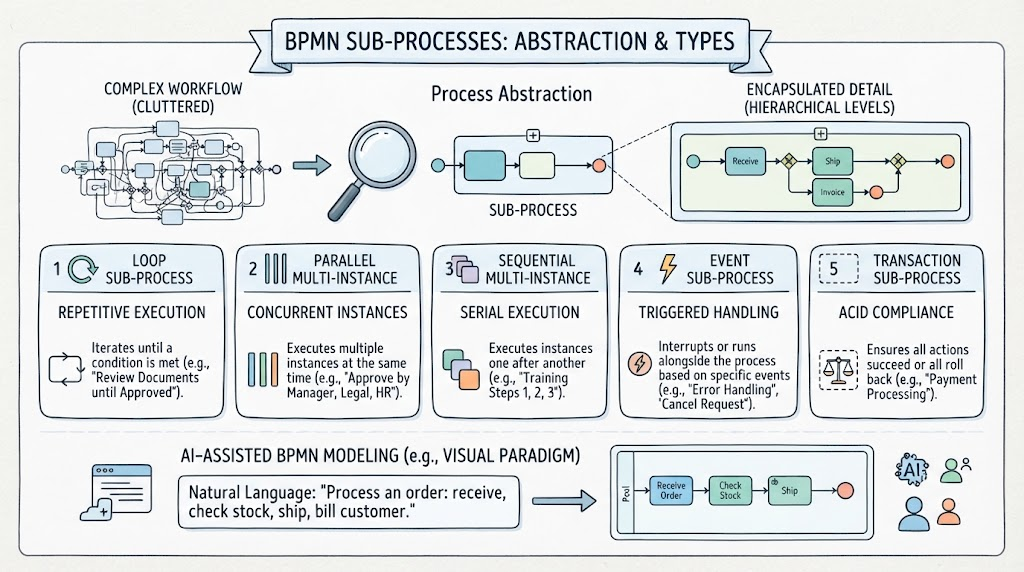
Imagine you are looking at a map of a city. If you zoomed out to see the whole country, you would only see major highways. But if you zoom in to a specific neighborhood, you see every single street. In BPMN, we use a similar concept called Process Abstraction.
When a workflow is cluttered with too many details, it obscures the main flow. By encapsulating that detail into a single “Sub-process” block, we create a cleaner, hierarchical view. Think of a sub-process as a container. You can see the container on the main diagram, but when you “zoom in” or drill down, you reveal the specific steps inside—like receiving a package, shipping it, and invoicing the customer. This allows stakeholders to understand the high-level flow without getting lost in the weeds.
Deep Dive: The Five Types of Sub-processes
Not all sub-processes are created equal. Depending on the logic required, BPMN offers five specific types of sub-processes. Let’s break them down one by one.
1. Loop Sub-Process (Repetitive Execution)
First, consider a scenario where a task needs to happen repeatedly until a specific condition is met. This is a Loop Sub-process. Imagine a document review process. You don’t just review it once; you review it, send it back for changes, and review it again until it is finally approved. The loop sub-process captures this iterative nature, ensuring the flow continues until the “Approved” condition is satisfied.
2. Parallel Multi-Instance (Concurrent Instances)
Next, let’s look at efficiency. Sometimes, a task needs to happen for multiple items simultaneously. This is the Parallel Multi-Instance sub-process. For example, consider an approval workflow where a document needs to be signed by three different departments: Manager, Legal, and HR. Instead of waiting for Legal to finish before starting HR, the system can execute these instances concurrently. It creates multiple copies of the sub-process to handle the workload in parallel.
3. Sequential Multi-Instance (Serial Execution)
Conversely, sometimes tasks must happen one after another. This is the Sequential Multi-Instance sub-process. A classic example is a training module. You cannot take Step 2 until Step 1 is finished. The system executes the instances serially, moving from Step 1 to Step 2 to Step 3, ensuring a strict order of operations.
4. Event Sub-Process (Triggered Handling)
What happens when things go wrong? Processes rarely go exactly as planned. The Event Sub-process is designed to handle interruptions. It runs alongside the main process, triggered by specific events. For instance, if an error occurs during a transaction, or if a customer cancels a request, an event sub-process kicks in to handle the “Error Handling” or “Cancel Request” logic without stopping the entire main flow.
5. Transaction Sub-Process (ACID Compliance)
Finally, we have the Transaction Sub-process, which is critical for financial or legal integrity. This type ensures ACID compliance (Atomicity, Consistency, Isolation, Durability). Think of a payment processing system. Either the payment goes through and the order is confirmed, or the entire transaction rolls back if something fails. You cannot have half a payment; the transaction sub-process guarantees that all actions succeed together or none of them do.
The Future: AI-Assisted BPMN Modeling
We are now moving into the cutting edge of process modeling. Traditionally, creating these diagrams required manual drawing and deep technical knowledge. However, the future is here with AI-Assisted BPMN Modeling.
Imagine being able to type a simple sentence in natural language, such as: “Process an order: receive, check stock, ship, bill customer.” An AI tool can instantly translate that text into a structured BPMN diagram. This democratizes process modeling, allowing business analysts to focus on the logic rather than the syntax of the diagramming tool.
Conclusion
By mastering sub-processes, you gain the ability to manage complexity, handle repetitive tasks, and ensure data integrity. Whether you are looping through approvals, running parallel tasks, or utilizing AI to generate your models, these tools empower you to create robust, clear, and efficient business processes.