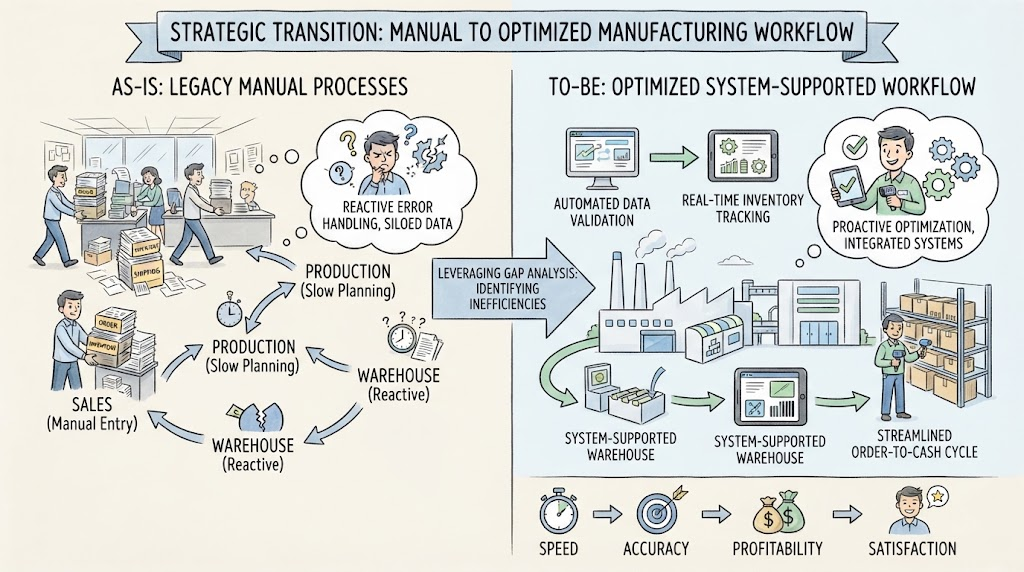
Welcome to this tutorial session. Today, we are diving deep into the world of business process improvement, using a compelling scenario from the manufacturing sector. Imagine you are a consultant for Apex Manufacturing Inc., a company struggling to keep up with modern demands. In the current landscape, the speed and accuracy of order fulfillment are not just nice-to-haves; they are critical determinants of customer satisfaction and operational profitability. However, Apex is currently relying on legacy “As-Is” processes that are fraught with inefficiencies.
Our goal is to guide you through the strategic transition from a manual workflow to an optimized “To-Be” state. We will explore how tools like Gap Analysis and BPMN (Business Process Model and Notation) serve as the blueprint for this transformation.
Understanding the “As-Is” State: The Legacy Burden
Let’s first look at the reality of the current workflow. In the “As-Is” scenario, we see a classic example of siloed operations. The process is characterized by manual handoffs and reactive error handling. For instance, the Sales Department likely relies on manual data entry, creating a bottleneck before the order even reaches the warehouse. The Warehouse Department operates in a reactive mode, dealing with delays and inventory discrepancies rather than anticipating needs. This disconnect leads to slow planning in production and a fragmented flow of information.
This manual approach creates a vicious cycle where errors are discovered too late, leading to frustration and delayed deliveries. The visual representation of this state highlights the pain points: disconnected departments, manual intervention at every turn, and a lack of real-time visibility.
Envisioning the “To-Be” State: The Optimized Workflow
Now, let’s pivot to the future state. The “To-Be” process illustrates what happens when we introduce modern technology and streamlined methodologies. The goal is a system-supported workflow that eliminates the bottlenecks found in the legacy model. Instead of manual entry, we utilize automated data validation to ensure order accuracy from the start. Real-time inventory tracking allows the warehouse to know exactly what is available, preventing overselling or stockouts.
In this optimized state, the Warehouse Department becomes a hub of efficiency rather than a reactive fire-fighting unit. The entire order-to-cash cycle is streamlined, leading to a clear path from the initial purchase order to final delivery. The result is a significant boost in speed, accuracy, profitability, and ultimately, customer satisfaction.
The Bridge: Leveraging Gap Analysis
How do we get from the chaotic manual process to the streamlined digital workflow? The answer lies in Gap Analysis. This is a fundamental method for comparing current operating conditions against a target state to determine how to bridge the difference. By documenting the “As-Is” process and defining the “To-Be” process, businesses can pinpoint exactly where the inefficiencies lie.
Gap analysis is not just about identifying problems; it is about finding the solution. In our Apex Manufacturing scenario, the “gap” is the lack of automation and integration. By analyzing this difference, we can implement specific improvements such as system-supported warehouse operations and integrated data systems.
Modeling the Transformation with BPMN
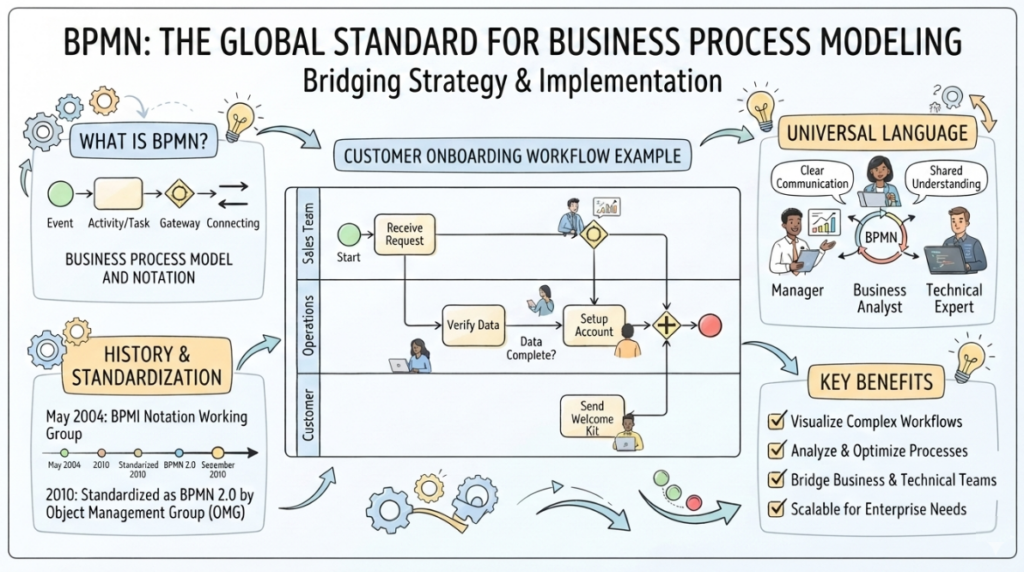
To effectively communicate and implement these changes, we need a standard language. This is where Business Process Model and Notation (BPMN) comes into play. BPMN provides a graphical notation for specifying business processes, making it easier for stakeholders to understand complex workflows.
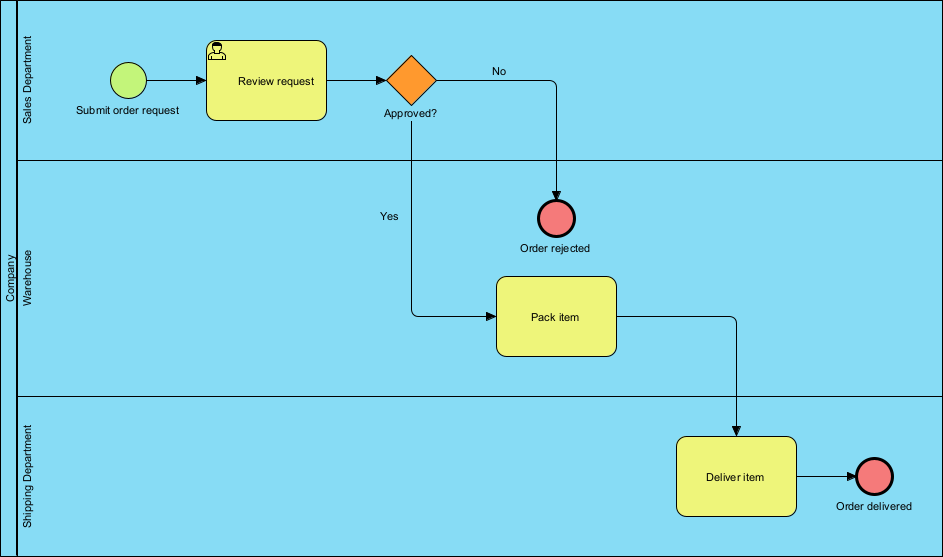
Using BPMN, we can visualize the flow of tasks between different participants, such as the Customer, Sales Department, and Warehouse Department. Here is how the notation breaks down in our context:
- Pools and Lanes: These represent the different participants. In our diagram, distinct lanes would separate the Sales team from the Warehouse team, helping us identify exactly where handoffs occur and where delays happen.
- Gateways: These are the diamond shapes that represent decision points. For example, a gateway might ask, “Complete Info?” or “Items Available?”. These decision points dictate the process path, ensuring that an order only moves forward if specific criteria are met.
Facilitating the Process with Visual Paradigm
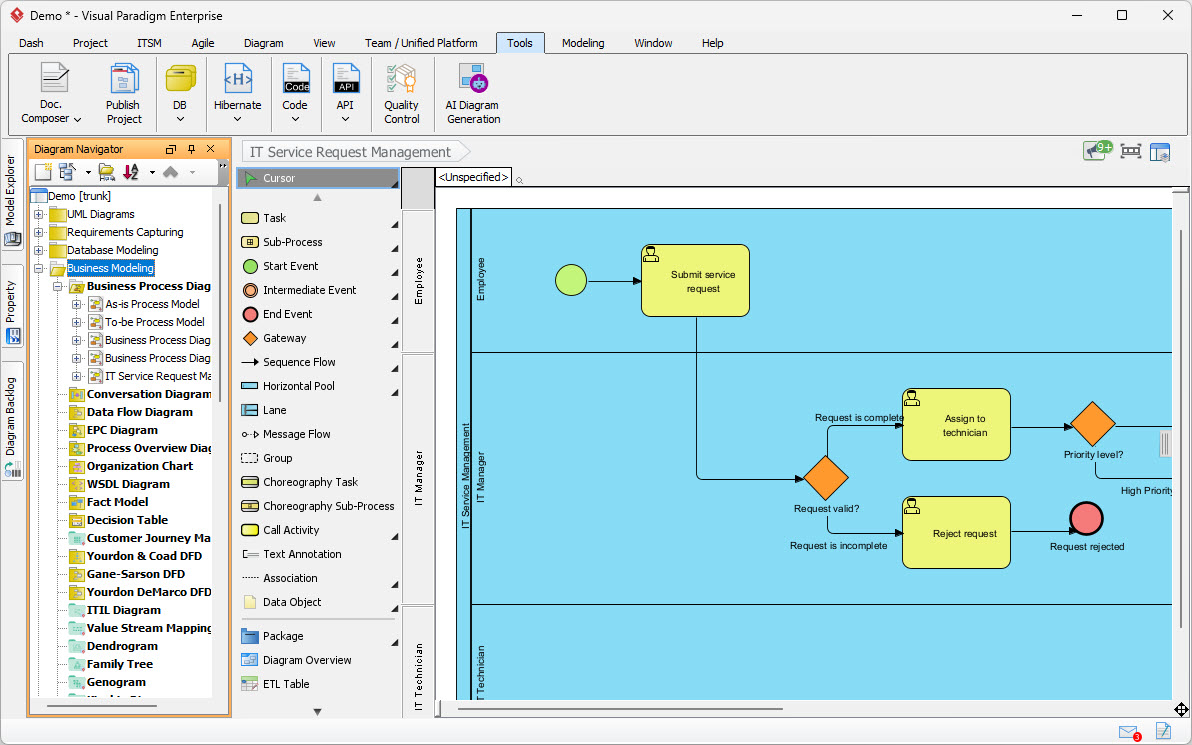
While understanding the theory is crucial, implementing it requires the right tools. This is where Visual Paradigm shines as an essential asset for business analysts and process designers. Visual Paradigm facilitates the entire lifecycle of process improvement.
First, Visual Paradigm provides a robust environment for creating BPMN diagrams. You can drag and drop elements to create pools and lanes, representing the Sales and Warehouse departments. You can easily add gateways to model decision logic, such as validating inventory levels before confirming an order. The software’s intuitive interface allows you to design the “To-Be” process with precision, ensuring that the new workflow is logical and compliant with industry standards.
Furthermore, Visual Paradigm supports the visualization of Gap Analysis. You can create side-by-side diagrams to clearly demonstrate the “As-Is” versus the “To-Be” states, making it easier to present your findings to stakeholders. By using these tools, you transform abstract concepts into concrete, actionable plans that drive operational excellence.
Conclusion: The Path Forward
By leveraging Gap Analysis and BPMN within a powerful platform like Visual Paradigm, organizations like Apex Manufacturing can successfully navigate the transition from manual chaos to optimized efficiency. The journey involves identifying the pain points of the legacy system, designing a robust future state, and using standard modeling techniques to bring that vision to life. The ultimate payoff is a streamlined order-to-cash cycle that delivers speed, accuracy, and satisfaction to the customer.