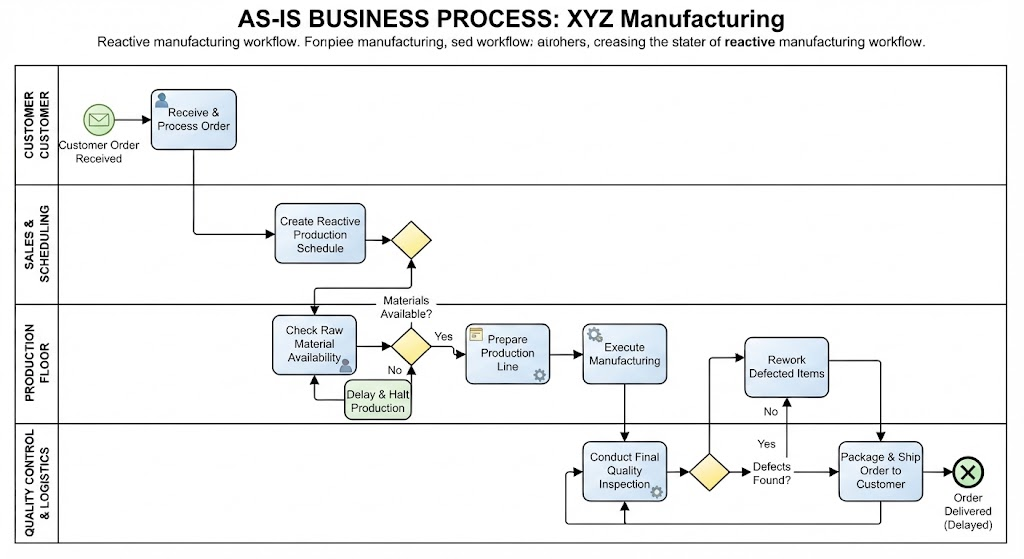
In the realm of Business Process Improvement (BPI), the first and most critical step is understanding the “As-Is” state. Before we can build a better future, we must rigorously analyze the current reality. The diagram provided illustrates the As-Is Business Process for XYZ Manufacturing, a mid-sized automotive parts supplier currently struggling with inefficiencies. This tutorial will guide you through the technical architecture of this workflow, analyzing the swimlanes, decision logic, and the systemic bottlenecks that lead to customer dissatisfaction.
1. Understanding the Process Architecture
The diagram is a classic Swimlane Flowchart (also known as a Cross-Functional Flowchart). This modeling technique is essential for visualizing complex processes where multiple departments interact. The horizontal rows, or “swimlanes,” represent distinct functional areas, while the vertical flow represents the progression of an order over time.
The Functional Swimlanes
- Customer: The external trigger of the process, initiating the workflow with an order.
- Sales & Scheduling: The planning hub responsible for translating customer needs into production directives.
- Production Floor: The physical execution layer where raw materials are transformed into finished goods.
- Quality Control & Logistics: The final gatekeepers responsible for ensuring product integrity and managing delivery.
2. Step-by-Step Process Analysis
Let us walk through the lifecycle of a single order as it traverses the “As-Is” system.
Phase 1: Order Intake & Reactive Planning
The process begins when a Customer Order is received. This triggers the Receive & Process Order activity. In this specific workflow, notice the transition to the Sales & Scheduling lane. The critical flaw here is identified as Create Reactive Production Schedule.
Technical Insight: The term “Reactive” implies that the system is demand-driven only after the fact, rather than using predictive analytics. This lack of foresight is the root cause of the delays mentioned in the case study.
Phase 2: Material Availability Check (The Bottleneck)
Once a schedule is created, the process moves to the Production Floor for the Check Raw Material Availability step. Here, the workflow encounters its first major decision diamond:
Decision Point: Materials Available?
- Path A (Yes): The process moves forward to Prepare Production Line.
- Path B (No): The process enters a negative feedback loop. The system triggers Delay & Halt Production. The flow then loops back to the material check. This represents a “deadlock” in the system where work cannot proceed, leading to idle machinery and missed deadlines.
Phase 3: Execution and Rework Loops
If materials are available, the workflow proceeds to Execute Manufacturing. The system then transitions to Quality Control for the Conduct Final Quality Inspection.
Here, we see a second decision diamond: Defects Found?
- Path A (Yes): If defects are detected, the workflow branches to Rework Defected Items. Crucially, this loop feeds back into the inspection or manufacturing phase, consuming time and resources without adding value to the customer.
- Path B (No): The product passes inspection and moves to Package & Ship Order to Customer.
3. Identifying Systemic Inefficiencies
By analyzing the topology of this diagram, we can pinpoint exactly where the “As-Is” process fails XYZ Manufacturing.
The Communication Silo
Notice the linear progression of the arrows. The Sales & Scheduling team makes a decision, passes it to Production, which then passes to Quality. There is no evidence in the diagram of a feedback loop where Quality or Production can immediately alert Sales to a delay. This confirms the “Communication Silos” mentioned in the case study.
The Cost of Rework
The loop created by the Rework Defected Items box is a direct representation of “Costly Rework.” In a well-designed “To-Be” process, we would expect to see quality checks integrated earlier in the process (like the “Real-Time QMS” mentioned in the objectives) to prevent this loop entirely.
4. Conclusion
This diagram serves as a perfect blueprint for a Business Process Improvement initiative. It clearly highlights that the inefficiencies are not random but are structural. The Reactive Scheduling creates a dependency on material availability that causes halts, and the lack of preventative quality checks creates a rework loop.
The “To-Be” design described in the case study addresses these specific architectural flaws by introducing proactive tools, JIT inventory management, and real-time communication platforms. Understanding this current map is the first step toward navigating a path to a more efficient, customer-centric manufacturing process.