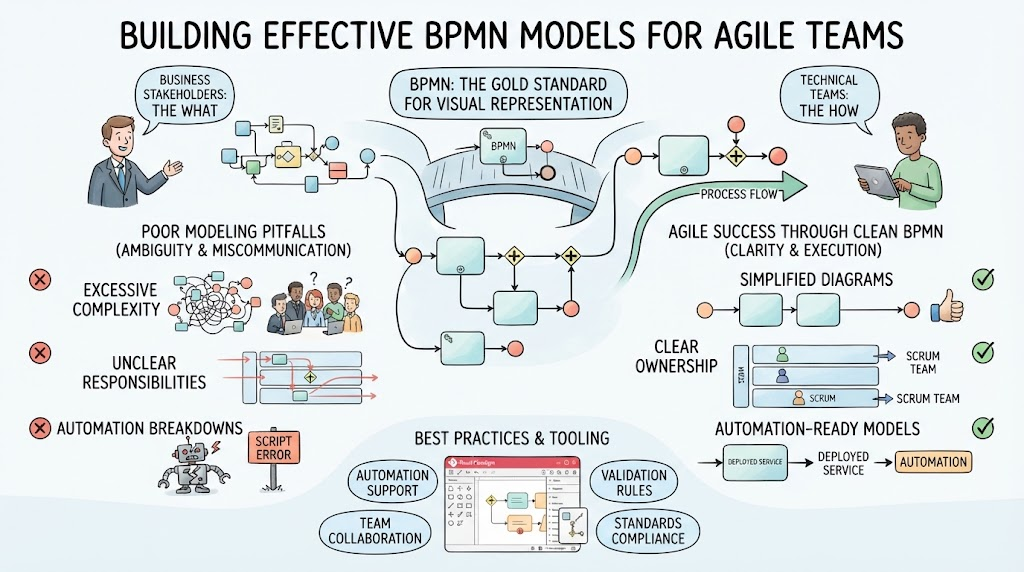
In the fast-paced environment of Agile development, communication is the lifeblood of success. Yet, a significant gap often exists between business stakeholders, who understand the “what,” and technical teams, who must implement the “how.” This guide explores how Business Process Model and Notation (BPMN) serves as the essential bridge between these two worlds, ensuring that your process models are not just visual artifacts, but actionable blueprints for automation.
The Role of BPMN in Bridging the Gap
BPMN is widely considered the gold standard for visual representation of business processes. Its primary value lies in its ability to translate complex business requirements into a standardized language that is both readable by non-technical stakeholders and precise enough for developers.
- The Business Perspective: Stakeholders focus on the “what”—the goals, the outcomes, and the high-level logic of the business.
- The Technical Perspective: Developers focus on the “how”—the implementation details, system integrations, and specific logic flows.
A well-constructed BPMN diagram sits at the intersection of these needs. It acts as a visual contract, preventing the miscommunication that often leads to scope creep or stalled sprints.
Identifying Common Modeling Pitfalls
Despite its potential, poor modeling practices can lead to disastrous outcomes. When BPMN diagrams are ambiguous, they become a source of friction rather than clarity. The infographic highlights three critical failures that Agile teams must avoid:
1. Excessive Complexity
One of the most common errors is creating overly convoluted diagrams. When a model attempts to capture every single detail or uses a “spaghetti” layout of connectors, it becomes unreadable. Agile teams need to see the “big picture” quickly; a tangled web of logic obscures the actual process flow and confuses developers during sprint planning.
2. Unclear Responsibilities
Process models must clearly define who or what is responsible for each step. In a matrix or swimlane context, unclear responsibilities lead to confusion about ownership. If a diagram does not explicitly show which team (e.g., Marketing vs. Development) owns a specific task, tasks may fall through the cracks or duplicate efforts.
3. Automation Breakdowns
The ultimate goal of modern BPMN is often automation. However, if a model is not structured correctly, it cannot be executed by a workflow engine. A “script error” or a broken automation pipeline often stems from a diagram that looks good visually but lacks the logical rigor required for code generation. A diagram that is merely a drawing is not a functional process.
The Anatomy of Agile Success with BPMN
To achieve “Agile Success,” models must be transformed from complex drawings into simplified, executable assets. This involves adhering to specific design principles and tooling standards.
Simplified Diagrams for Clarity
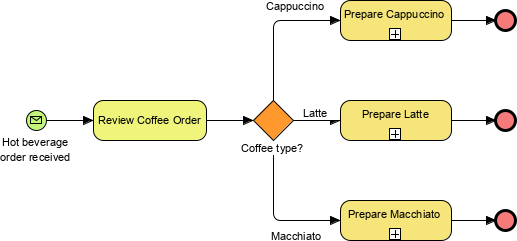
Agile teams thrive on simplicity. A successful model strips away unnecessary noise, focusing on the linear flow of value. By using clear start and end events, and logical gateways, the path from initiation to completion becomes obvious. This clarity reduces the cognitive load on the team and accelerates decision-making.
Clear Ownership and Collaboration
Effective modeling explicitly maps processes to Scrum teams or specific roles. By visualizing the “handoffs” between different teams (e.g., from a “Marketing” lane to a “Development” lane), the model clarifies dependencies. This ensures that the team responsible for a specific user story knows exactly what input they need and what output they must deliver.
Leveraging Tooling for Automation-Ready Models
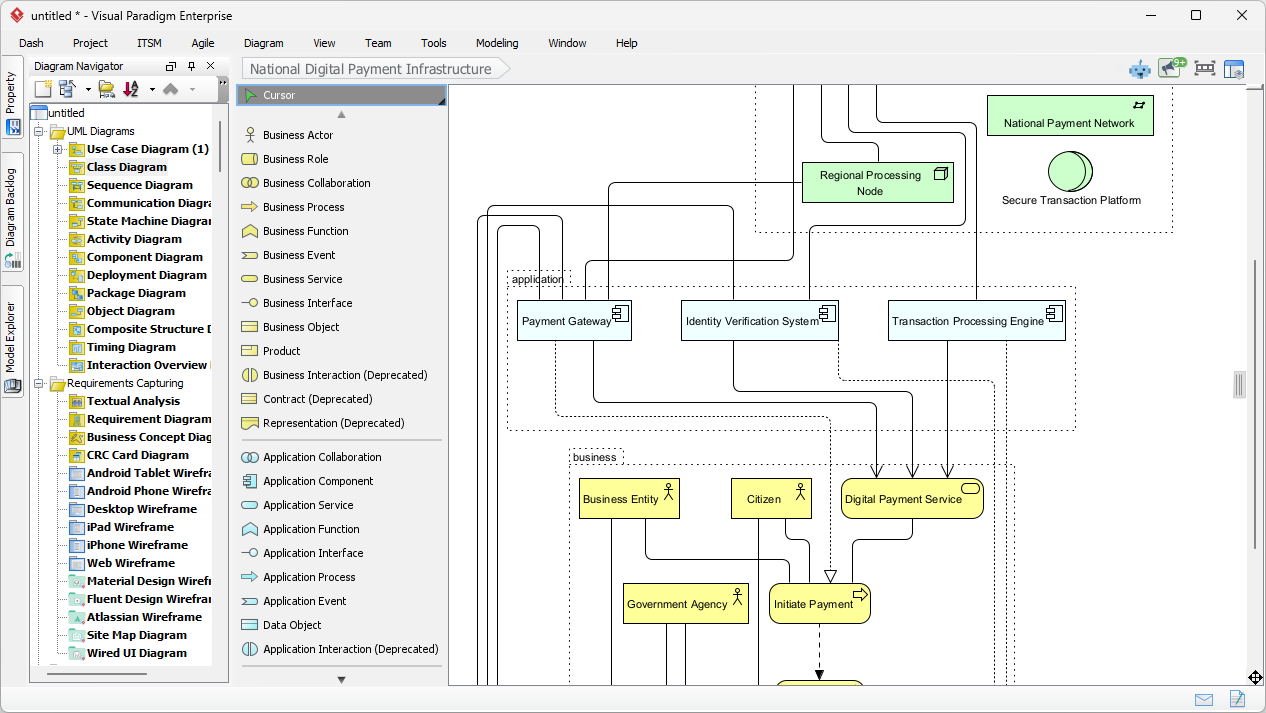
Creating a diagram that is both human-readable and machine-executable requires more than just drawing tools; it requires intelligent modeling software like Visual Paradigm. The right tooling enforces the discipline needed to bridge the gap between design and deployment.
Key Features for Success
- Automation Support: Advanced tools allow you to deploy a service directly from the diagram, ensuring that the logic in the model matches the code in the system.
- Validation Rules: Automated validation checks ensure that your diagram adheres to BPMN standards, catching logical errors (like missing gateways) before they become bugs.
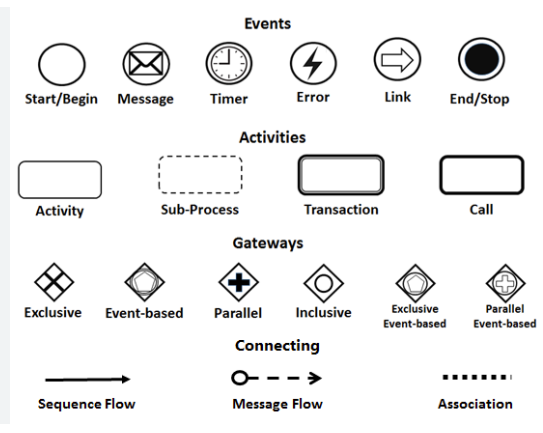
- Standards Compliance: Following industry standards ensures that your models can be understood by any developer or stakeholder, regardless of the organization.
From Model to Automation
The journey from a static diagram to a deployed service is streamlined when using the right ecosystem. By ensuring your model is “automation-ready,” you enable a seamless flow where the diagram is the specification. This eliminates the translation errors that often occur when developers try to interpret a poorly drawn process.
By mastering these concepts—avoiding complexity, clarifying ownership, and utilizing robust tooling—Agile teams can turn BPMN into a powerful engine for efficiency, ensuring that the “what” is perfectly aligned with the “how.”