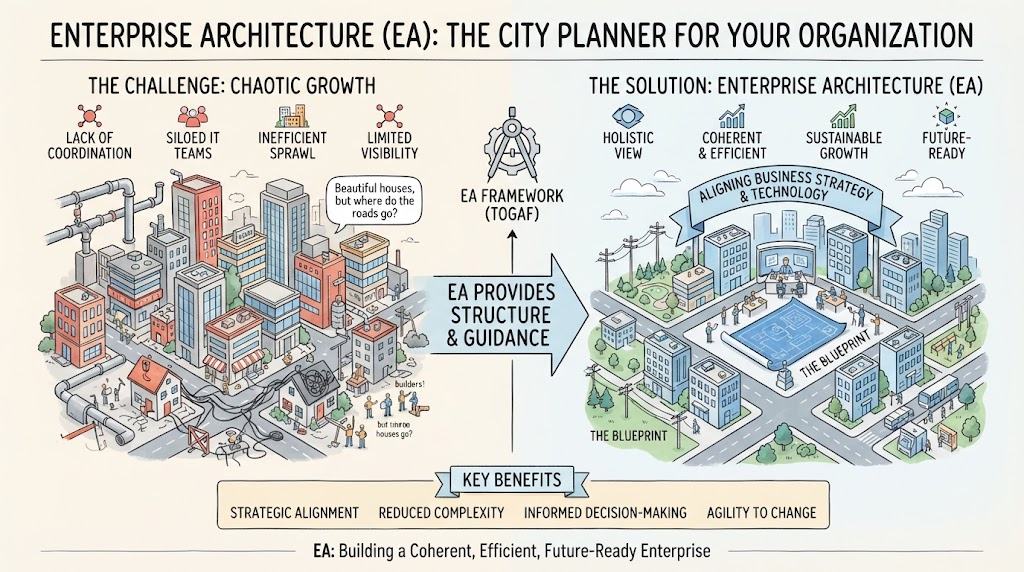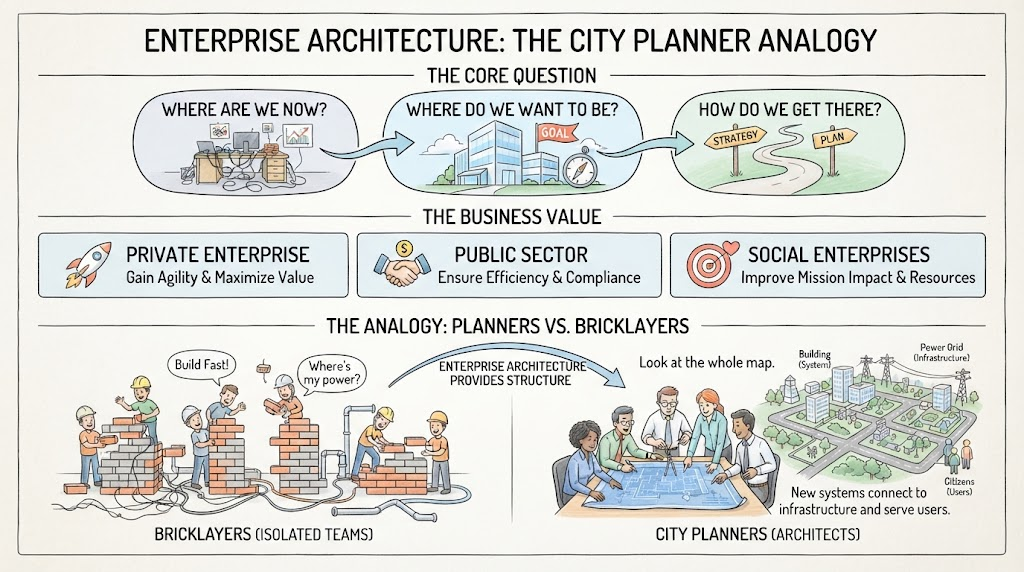
In the rapidly evolving landscape of enterprise technology, navigating the complexity of system architecture can feel overwhelming. Enter the TOGAF Standard (The Open Group Architecture Framework). While often perceived as a rigid set of bureaucratic rules, a closer look reveals that TOGAF is actually a flexible, scalable toolkit designed to help organizations build consistent and effective architectures.
This tutorial breaks down the core concepts of TOGAF, tracing its evolution and exploring its unique three-tier structure to help you understand how to apply it effectively in your projects.
1. What is TOGAF?
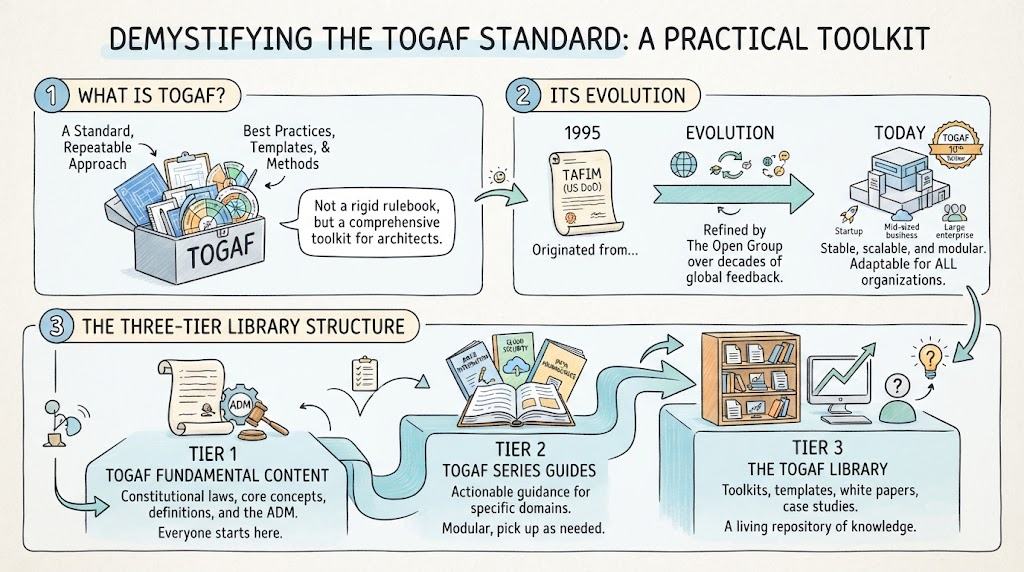
At its heart, TOGAF is not a rigid rulebook. Instead, it is a standard, repeatable approach for developing, using, and maintaining Enterprise Architectures. Think of it as a comprehensive toolbox for architects.
- Best Practices: It provides proven methods that have been tested over decades.
- Templates & Methods: It offers the necessary “blueprints” to ensure consistency across an organization.
- Flexibility: Unlike a strict rulebook, it acts as a guide, allowing architects to adapt the framework to their specific organizational needs.
2. Its Evolution: From Defense to Digital
The history of TOGAF is a testament to its practicality. It didn’t start as a commercial software product but evolved from government needs:
- 1995 (Origin): The framework originated from the US Department of Defense’s TAFIM (Technical Architecture Framework for Information Management).
- Evolution: Over the decades, The Open Group took the torch, refining the framework by incorporating feedback from thousands of global organizations.
- Today (The 10th Edition): The current standard represents a stable, scalable, and modular set of best practices. It is no longer just for massive government entities; it is fully adaptable for digital-native startups and mid-sized enterprises alike.
3. The Three-Tier Library Structure
To prevent architects from feeling overwhelmed by the sheer volume of documentation, TOGAF 10 is organized into three accessible tiers. This structure allows users to “start small” and expand as needed.
Tier 1: TOGAF Fundamental Content
Think of this as the “Constitutional Laws” of the framework. This tier contains:
- Universally applicable core concepts and definitions.
- The Architecture Development Method (ADM).
Note: Everyone starts here. This provides the foundational knowledge required to understand the rest of the framework.
Tier 2: TOGAF Series Guides
Once the fundamentals are understood, architects can move to actionable guidance for specific domains. These guides are modular, meaning you only pick up the ones you need. Whether you need to:
- Integrate Agile methodologies?
- Secure your Cloud infrastructure?
- Manage Data Architecture?
There is a specific guide for that.
Tier 3: The TOGAF Library
This tier serves as the “Toolkits” and repository of community knowledge. It includes:
- Practical templates.
- White papers and case studies.
- Emerging trends in the industry.
This is a living repository, ensuring that the framework stays relevant to current market trends.
Recommended Tooling: Visual Paradigm TOGAF ADM Tool
Understanding the theory is only half the battle; applying it requires robust tooling. To effectively model the Architecture Development Method (ADM) described in Tier 1, we recommend using the Visual Paradigm TOGAF ADM Tool.
This tool helps architects visualize the complex flows of the ADM cycle, manage stakeholders, and generate the necessary documentation defined in the TOGAF Standard. By integrating Visual Paradigm with the TOGAF structure, you can turn abstract concepts into actionable architectural blueprints.