Welcome to your comprehensive guide on The Open Group Architecture Framework (TOGAF). If you are new to enterprise architecture, the terminology can feel overwhelming. This tutorial breaks down the three most critical concepts shown in standard TOGAF diagrams: The Architecture Development Method (ADM), the Work Product Hierarchy, and the Enterprise Continuum.
1. The Heart of TOGAF: The ADM Cycle
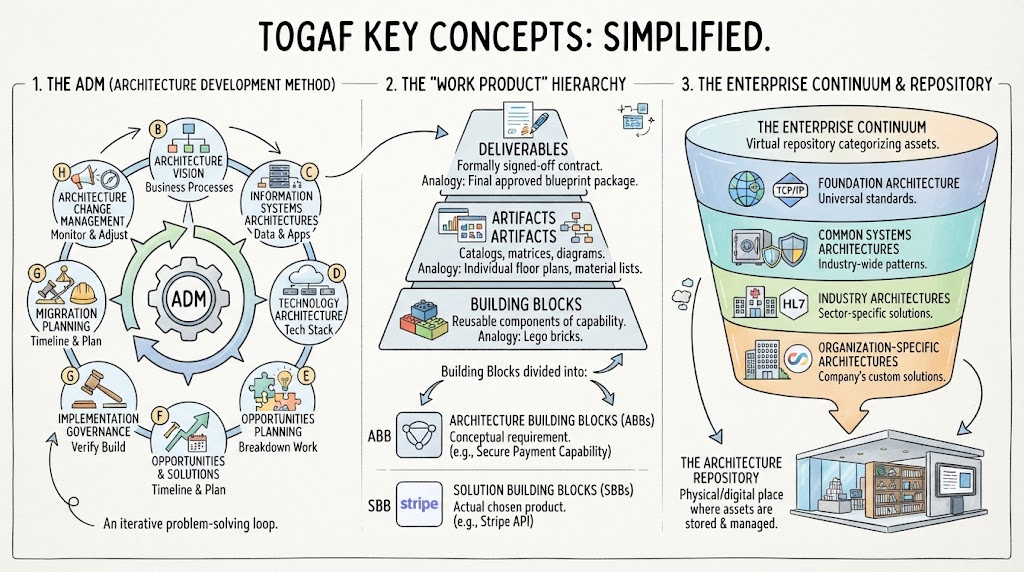
At the core of the TOGAF framework is the Architecture Development Method (ADM). Think of this not as a linear checklist, but as a problem-solving loop. It is a repeatable, iterative process that guides you from defining a high-level vision to managing change over the long term.
Here is the breakdown of the eight phases, moving clockwise through the cycle:
Phase A: Architecture Vision
The Starting Point. Before building anything, we must define the scope. We identify stakeholders and set high-level goals. This answers the fundamental question: “What problem are we solving?”
Phase B: Business Architecture
Understanding the Organization. We map out the business processes, capabilities, and organizational structure. This phase answers: “How does the business work?”
Phase C: Information Systems Architectures
The Data and Applications. This phase is divided into Data and Application architectures. We design what data needs to be stored and what applications are required to process it. This answers: “What data and apps do we need?”
Phase D: Technology Architecture
The Infrastructure. Here, we define the hardware, software, and network infrastructure. This answers: “What tech stack supports this?”
Phase E: Opportunities & Solutions
Planning the Move. We identify potential solutions to bridge the gap between the current state and the future state. We group these solutions into work packages. This answers: “How do we break this down?”
Phase F: Migration Planning
The Roadmap. This phase creates a detailed timeline and transition plan. We decide the sequence of events. This answers: “When do we do what?”
Phase G: Implementation Governance
Quality Control. During the actual build, we ensure the solution matches the design. This answers: “Are we building it right?”
Phase H: Architecture Change Management
Monitoring & Adjustment. Architecture is never “finished.” We monitor changes to the environment and trigger new cycles if necessary. This answers: “Do we need to adjust?”
Note on Iteration: You do not have to go linearly from Phase A to H. You can cycle back or skip phases based on the specific context of your project.
2. The “Work Product” Hierarchy
Beginners often confuse deliverables, artifacts, and building blocks. To master TOGAF, you must understand the difference between the final package, the contents of that package, and the reusable components used to build it.
Deliverables vs. Artifacts
- Deliverables: These are the formally signed-off contract results specified by stakeholders.
- Analogy: The final approved blueprint package handed to the construction crew.
- Artifacts: These are the catalogs, matrices, and diagrams contained inside the deliverables.
- Analogy: The individual floor plans, electrical diagrams, and material lists within the blueprint.
Building Blocks: The Reusable Components
Think of Building Blocks as the Lego bricks of architecture. They are reusable components of capability that you can use across different projects.
We divide these into two distinct categories:
- Architecture Building Blocks (ABBs):
These are the conceptual requirements. They define what the capability needs to do without specifying the product.
Example: “We need a secure payment processing capability.”
- Solution Building Blocks (SBBs):
These are the actual chosen products or services that satisfy the requirement.
Example: “We will use Stripe API v3.”
3. The Enterprise Continuum & Repository
How do you store and reuse all this knowledge? The framework provides a structure called the Enterprise Continuum and a physical storage mechanism called the Architecture Repository.
The Enterprise Continuum
The Continuum is a virtual repository that categorizes architectural assets from the most generic to the most specific. It flows from top to bottom:
- Foundation Architecture: Universal standards applicable to almost any organization (e.g., TCP/IP).
- Common Systems Architectures: Industry-wide patterns shared across sectors (e.g., Banking security models).
- Industry Architectures: Sector-specific solutions (e.g., Healthcare HL7 standards).
- Organization-Specific Architectures: Your company’s custom-fit solutions.
The Architecture Repository
This is the physical or digital place where these assets (models, patterns, standards) are stored and managed for easy retrieval. It is the library where your organization keeps its architectural “blueprints.”
Recommended Tooling
To effectively manage the complexity of the ADM cycle and the hierarchy of work products, you need robust modeling software. For visualizing these complex relationships, we recommend using Visual Paradigm TOGAF ADM Tool. It streamlines the creation of diagrams and ensures your documentation aligns with industry standards.