


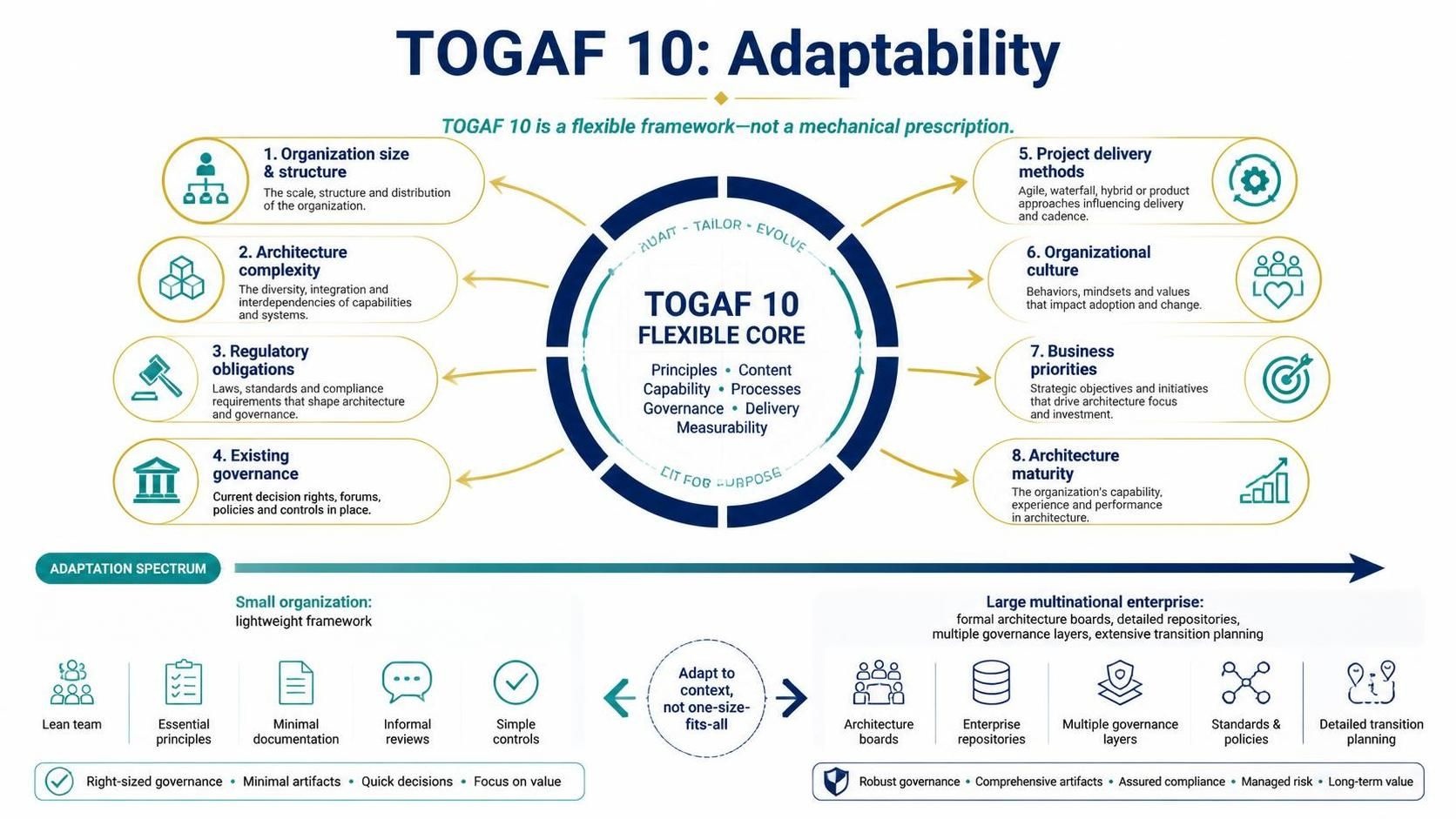
In the rapidly evolving landscape of enterprise architecture, a “one-size-fits-all” approach is often a recipe for failure. This is the core philosophy behind TOGAF 10. Unlike previous iterations that were sometimes criticized for being too rigid, TOGAF 10 introduces a Flexible Core designed to be adapted to the unique context of the organization.
This tutorial explores the concept of Adaptability within TOGAF 10. We will break down the eight critical dimensions of adaptation, understand the spectrum from small to large enterprises, and discuss how to practically apply these concepts using modern modeling tools.
The Core Concept: TOGAF is Not a Mechanical Prescription
At the heart of the TOGAF 10 methodology lies the Flexible Core. This core is not a static set of rules but a dynamic set of Principles, Content, Capability, Processes, Governance, and Delivery mechanisms.
The guiding principle is that TOGAF 10 must be tailored. It is intended to be “adapt, tailor, and evolve” based on the specific needs of the business. As illustrated in the diagram, there are eight key factors that dictate how an organization should adapt the framework.
The 8 Dimensions of Adaptability
To successfully implement TOGAF 10, an organization must analyze and adapt to the following eight areas:
1. Organization Size & Structure
The scale of the organization dictates the complexity of the architecture. A flat organization may require a less hierarchical approach compared to a complex matrix structure. The distribution of the organization globally and locally influences how architecture artifacts are stored and accessed.
2. Architecture Complexity
This refers to the diversity, integration, and interdependencies of capabilities and systems. A company with a monolithic legacy system has different architectural needs than a cloud-native microservices environment. The framework must be scaled to match this technical complexity.
3. Regulatory Obligations
Laws, standards, and compliance requirements shape the architecture and governance. For example, a healthcare provider must adapt TOGAF processes to ensure HIPAA or GDPR compliance, necessitating specific governance controls and audit trails.
4. Existing Governance
Organizations rarely start with a blank slate. You must consider current decision rights, forums, policies, and controls. Adapting TOGAF means integrating with existing governance bodies rather than creating a parallel, disconnected structure.
5. Project Delivery Methods
The way the organization builds software matters. Are you using Agile, Waterfall, Hybrid, or Product approaches? TOGAF 10 adapts to these delivery methods. For instance, in an Agile environment, architecture documentation might be lighter and more iterative compared to the heavy documentation required for Waterfall.
6. Organizational Culture
Behaviors, mindsets, and values impact adoption. If the culture is highly collaborative and informal, a rigid, bureaucratic governance model will fail. The framework must align with the cultural norms to ensure it is embraced by the workforce.
7. Business Priorities
Strategic objectives drive architecture focus. If the business priority is speed-to-market, the architecture process should be streamlined to support rapid delivery. If the priority is cost optimization, the focus shifts to consolidation and standardization.
8. Architecture Maturity
This measures the organization’s capability, experience, and performance in architecture. A mature organization can handle complex governance layers, while a startup may just need basic guidance. The framework evolves alongside the organization’s maturity.
The Adaptation Spectrum: Small vs. Large
The image provides a visual spectrum of how these factors manifest in different types of organizations. The goal is “Right-sized governance”—ensuring the framework is neither too heavy nor too light.
The Small Organization
For a small organization, the focus is on agility and value. They typically utilize a lightweight framework. Key characteristics include:
- Lean Team: Architecture is often a role held by senior developers or a small team rather than a large department.
- Essential Principles: Focus only on the most critical rules that guide decision-making.
- Minimal Documentation: Documentation is kept concise and accessible.
- Informal Reviews: Governance is achieved through discussion and consensus rather than formal boards.
The Large Multinational Enterprise
For a large enterprise, the focus is on control, compliance, and long-term value. They require a robust governance structure. Key characteristics include:
- Formal Architecture Boards: Dedicated committees to review and approve major architectural decisions.
- Detailed Repositories: Centralized, secure systems to store vast amounts of architectural data.
- Multiple Governance Layers: Different levels of approval for different types of changes.
- Extensive Transition Planning: Detailed roadmaps for moving from current to future states across the entire enterprise.
Implementing Adaptability with Visual Paradigm
How do architects actually implement this adaptability? The key is in the tooling. You need a tool that can handle both the lightweight needs of a small team and the complex modeling requirements of a multinational.
This is where Visual Paradigm (VP) becomes an essential asset. It acts as the digital canvas for the TOGAF 10 Flexible Core.
- Dynamic Modeling: VP allows you to create diagrams ranging from simple context diagrams for small projects to complex layered architecture views for large enterprises.
- Customization: You can tailor the TOGAF metamodel within the tool. If your organization only cares about “Business Architecture” and “Application Architecture,” you can configure the tool to focus on those specific views, ignoring the rest.
- Collaboration: VP supports both informal reviews (comments, chat features) and formal governance (version control, workflow approvals), fitting the spectrum from small to large.
In conclusion, TOGAF 10 is not about following a rigid checklist. It is about understanding your organization’s unique context—its size, culture, and maturity—and adapting the framework to fit. By leveraging the eight dimensions of adaptability and utilizing flexible tooling like Visual Paradigm, organizations can ensure their architecture strategy drives real business value.
Related posts:
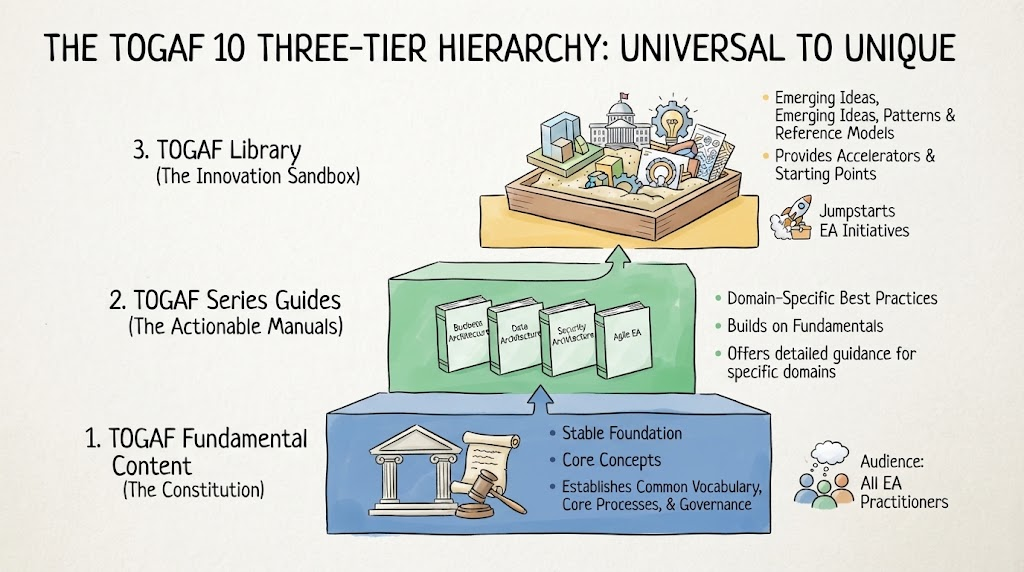 Navigating TOGAF 10: A Deep Dive into the Three-Tier Hierarchy System
 Accelerating TOGAF ADM with Visual Paradigm: A Guide to AI-Assisted Impact Analysis
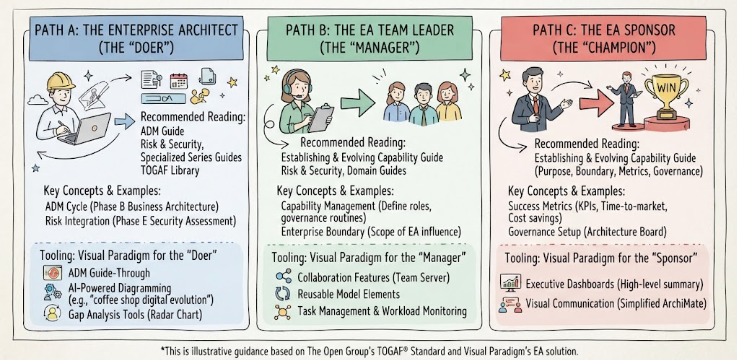 Navigating the TOGAF Enterprise Architecture Journey: A Role-Based Guide to ADM, ArchiMate, and Visual Paradigm
 Mastering Flexible Enterprise Architecture: How Visual Paradigm Empowers the TOGAF 10 Modular Approach