


In the complex world of Enterprise Architecture, clarity is currency. For years, the TOGAF (The Open Group Architecture Framework) standard was a monolithic document, often overwhelming practitioners with every possible technique and concept lumped together. However, the release of TOGAF 10 marked a paradigm shift. It restructured the framework into a modular system, distinguishing between what is strictly necessary to practice architecture and what is optional or specialized.
This tutorial breaks down the structural changes in TOGAF 10, specifically focusing on the diagrammatic representation of “The Fundamental Content” versus “The Series Guides.” By understanding this separation, architects can navigate the standard with greater precision.
The Core Philosophy: The Building Block Analogy
Imagine you are building a house. You cannot build without a foundation, walls, and a roof. These are the essentials. However, once you have the structure, you might want to add specialized features like solar panels, a smart home security system, or a specific landscaping design.
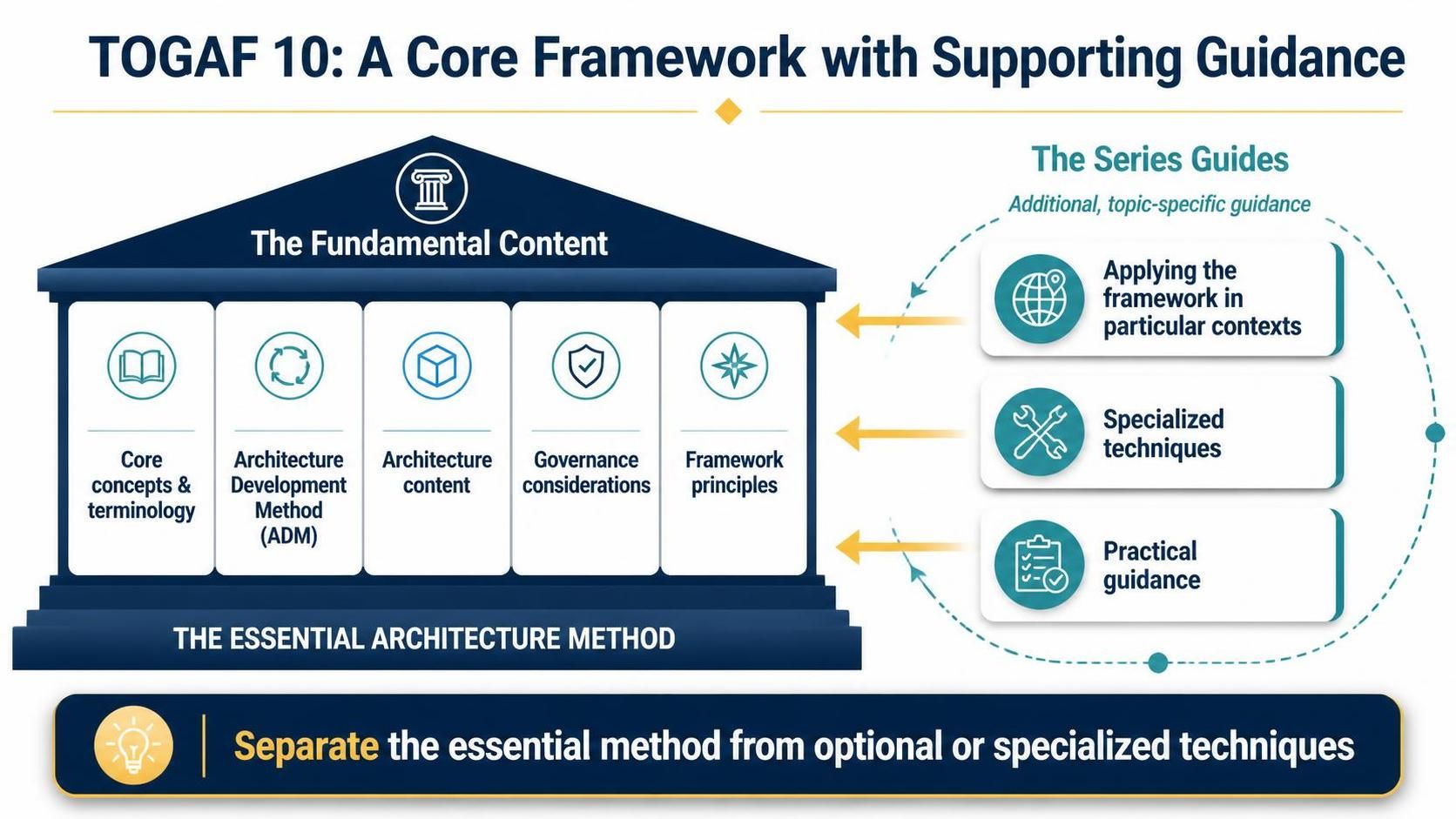
TOGAF 10 applies this logic to enterprise architecture. The framework is visually represented as a classical building structure (often referred to as the “temple” of architecture). This visual metaphor helps us categorize the framework’s components into two distinct areas: the Essential Architecture Method and the Supporting Guidance.
Part 1: The Fundamental Content (The Essential Method)
The left side of the diagram depicts the “Fundamental Content.” This is the heart of TOGAF 10, represented as the structural pillars of a building. This section contains the Essential Architecture Method. If you are an architect, this is the non-negotiable core that you must understand to function effectively.
This core section is divided into five critical pillars:
- Core Concepts & Terminology: Every field has its language. This pillar establishes the universal definitions and vocabulary that all stakeholders must agree upon to ensure clear communication.
- Architecture Development Method (ADM): This is the engine of TOGAF. The ADM is a cyclical process that guides you from the initial vision of a project to its implementation and transition. It is the step-by-step methodology that makes architecture actionable.
- Architecture Content: This refers to the tangible outputs and deliverables—such as models, matrices, and diagrams—that you create during the ADM process. It defines the “what” that is being built.
- Governance Considerations: Architecture does not happen in a vacuum. This pillar addresses the oversight, compliance, and decision-making structures required to ensure the architecture aligns with business goals.
- Framework Principles: These are the fundamental rules and guidelines that govern the architecture development process, ensuring consistency and adherence to best practices.
Key Takeaway: These five pillars are the “Essential Architecture Method.” They are the foundation upon which all other activities are built.
Part 2: The Series Guides (Supporting Guidance)
The right side of the diagram illustrates “The Series Guides.” These are the additional, topic-specific guidance modules that surround the core. They are designed to help architects apply the fundamental content in particular contexts or to solve specific problems.
These guides are represented by three specific categories:
- Applying the framework in particular contexts: Enterprise Architecture is not one-size-fits-all. These guides help you adapt the core method for specific industries, organizational sizes, or regulatory environments.
- Specialized techniques: Sometimes, the standard ADM needs a boost. This section offers advanced techniques for specific domains, such as security architecture, data architecture, or business architecture.
- Practical guidance: This includes checklists, templates, and implementation advice to help practitioners put theory into practice efficiently.
The Power of Separation
The most significant insight from the TOGAF 10 structure is the explicit separation of the essential method from the optional or specialized techniques. In the diagram, arrows point from the “Series Guides” toward the “Fundamental Content,” indicating that these guides support and inform the core, but the core stands independently.
Why is this separation important?
- Flexibility: You can adopt the core TOGAF methodology without being forced to learn every specialized technique immediately. You can start with the essentials and expand your toolkit as your needs grow.
- Focus: It reduces cognitive load. Instead of reading a massive manual covering everything from basics to niche techniques, you can focus on the fundamental method first.
- Modularity: It allows the framework to evolve. New specialized guides can be added to the “Series Guides” section without altering the core “Fundamental Content.”
Conclusion
TOGAF 10 represents a maturation of the framework, moving away from a rigid, monolithic standard to a flexible, modular ecosystem. By visualizing the framework as a building with a solid foundation (The Fundamental Content) and specialized extensions (The Series Guides), architects can better understand their role.
Remember the golden rule of TOGAF 10: Separate the essential method from optional or specialized techniques. Master the core pillars of the ADM, terminology, and content first, and then selectively integrate the supporting guides to address your specific organizational challenges.
Related posts:
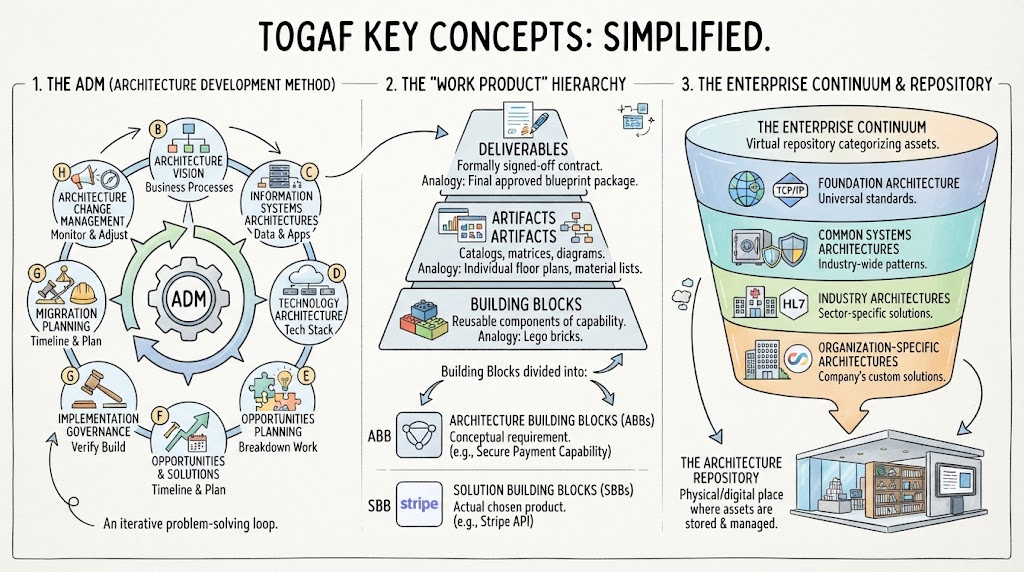 Mastering TOGAF: A Step-by-Step Guide to the ADM Cycle and Enterprise Architecture
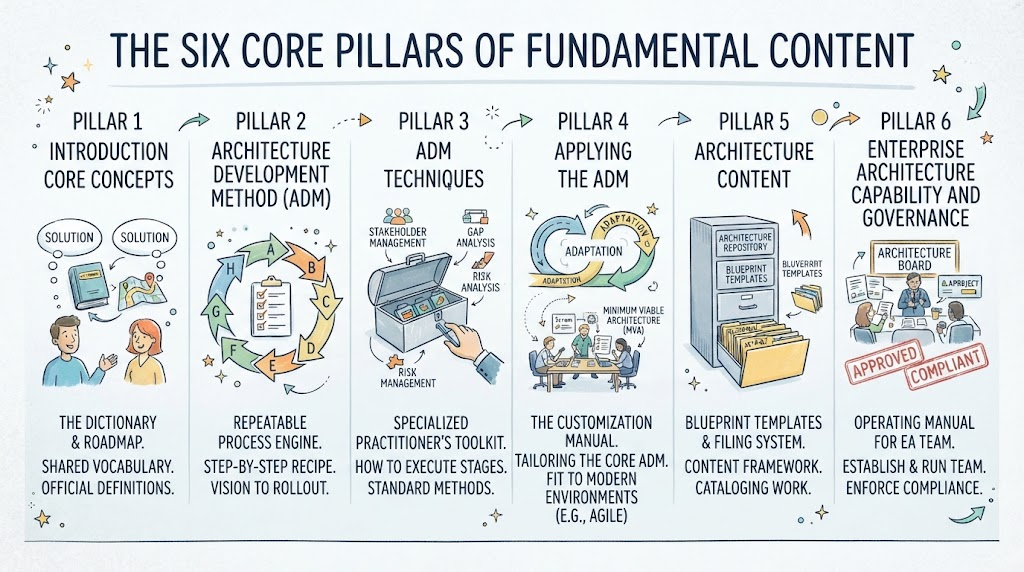 Mastering Enterprise Architecture: A Step-by-Step Guide to the Six Core Pillars of TOGAF
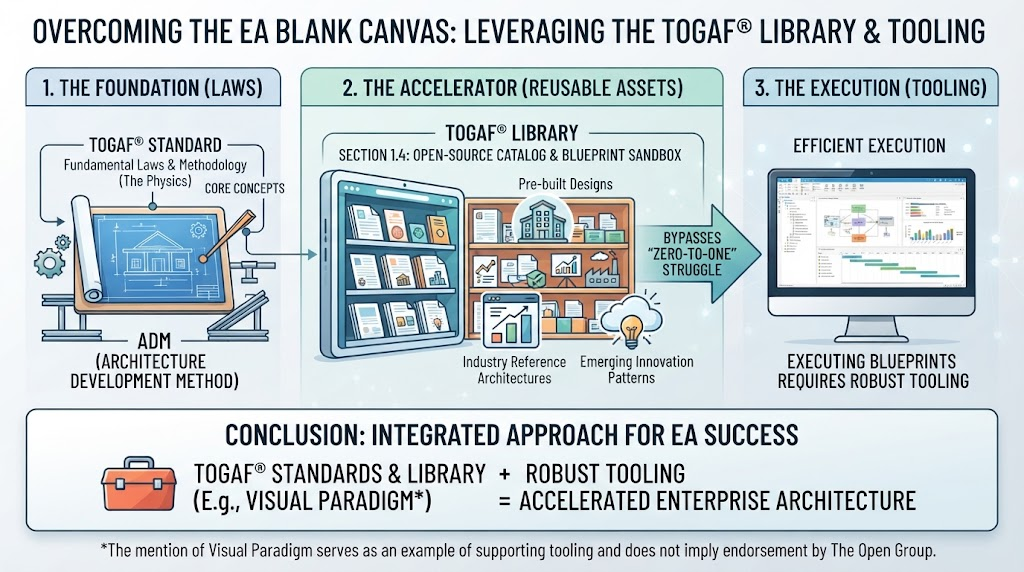 Overcoming the EA Blank Canvas: Leveraging the TOGAF Library & Tooling
 Mastering Phase E: Opportunities & Solutions in Enterprise Architecture