In the rapidly evolving landscape of digital transformation, the traditional “waterfall” approach to Enterprise Architecture (EA) often struggles to keep pace with market demands. Historically, architecture programs were criticized for producing massive volumes of documentation before any value was delivered. However, TOGAF 10 marks a paradigm shift, introducing a robust framework for Agile Enterprise Architecture. This tutorial will guide you through the conceptual shift from “define everything upfront” to “just enough architecture, refined continuously,” and explore how modern tools like Visual Paradigm facilitate this transition.
The Core Philosophy: From Waterfall to Agile
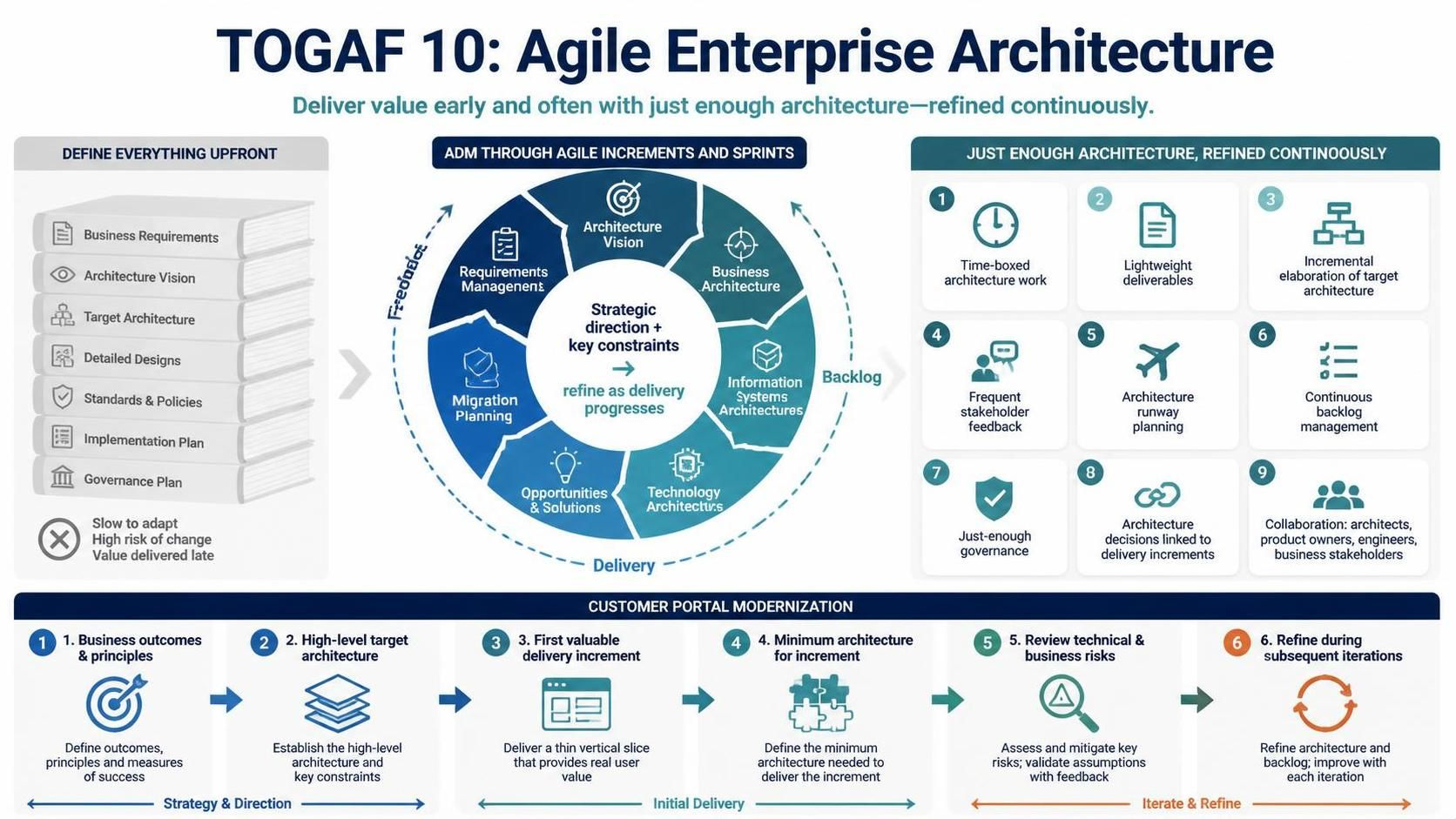
The infographic illustrates a clear contrast between traditional and modern architectural approaches. On one side, we see the “Define Everything Upfront” model. This traditional method relies on heavy documentation—Business Requirements, Target Architecture, Detailed Designs, and Implementation Plans—all created before delivery begins. While thorough, this approach is often slow to adapt and carries a high risk of change.
TOGAF 10 proposes a different path. Instead of attempting to define every detail of the future state immediately, the organization defines the strategic direction and key constraints, then refines the architecture as delivery progresses. This is the essence of Agile Architecture: deliver value early and often.
Deconstructing the Agile ADM
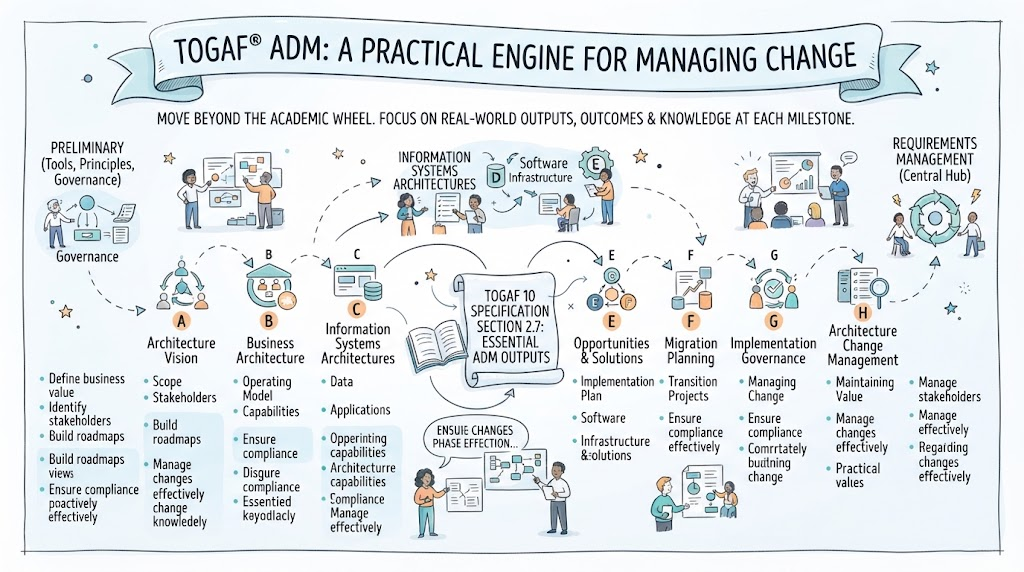
At the heart of this transformation is the TOGAF Architecture Development Method (ADM). The central diagram in the provided material visualizes the ADM not as a linear process, but as a cycle that feeds into delivery increments and sprints. This is often referred to as the “Agile ADM.”
1. The Feedback Loop
The traditional ADM is a straight line or a large circle. In the Agile context, the ADM is broken down to support rapid feedback. The diagram highlights a “Feedback” loop connecting the ADM phases back to the delivery process. This ensures that the architecture evolves based on real-world usage and stakeholder input, rather than theoretical assumptions.
2. Key Agile Practices
TOGAF 10 outlines specific practices that distinguish Agile Architecture from traditional methods. These include:
- Time-boxed architecture work: Architecture activities are constrained by time, forcing prioritization and focus.
- Lightweight deliverables: Instead of massive documents, architects produce minimal viable artifacts that convey necessary information.
- Incremental elaboration: The target architecture is not a finished product at the start; it is a living document that grows in detail with each sprint.
- Just-enough governance: Governance is applied only where necessary to ensure compliance and risk management, rather than as a bureaucratic hurdle.
- Architecture decisions linked to delivery increments: Decisions are made in the context of the immediate delivery sprint, ensuring relevance.
Practical Application: The Customer Portal Modernization
To understand how this works in practice, let’s walk through the Customer Portal Modernization example provided in the text. This scenario demonstrates a “thin vertical slice” approach, where the team delivers a functional part of the system rather than waiting for the whole platform to be built.
- Define Business Outcomes & Principles: The journey begins not with diagrams, but with strategy. The team defines the business outcomes and the principles that will guide their decisions.
- Establish High-Level Target Architecture: A broad view of the target state is created, focusing on key constraints and strategic direction.
- Identify the First Valuable Delivery Increment: The team identifies the specific piece of functionality that will provide immediate value to the customer. This is the “minimum architecture needed.”
- Review Risks: Technical and business risks are assessed for this specific increment.
- Refine During Iterations: As the increment is delivered, the architecture is refined. This is an iterative process where the backlog is managed continuously.
Recommended Tooling: Visual Paradigm TOGAF ADM Tool
Implementing this Agile ADM approach requires a tool that can handle both high-level modeling and iterative refinement. Visual Paradigm stands out as a leading recommendation for this purpose.
Visual Paradigm is a comprehensive CASE (Computer-Aided Software Engineering) tool that supports the full lifecycle of the TOGAF ADM. Its specific advantages for Agile Architecture include:
- Iterative Modeling: Visual Paradigm allows architects to model systems at a high level and then drill down into specific components as the project progresses, aligning perfectly with the “incremental elaboration” principle.
- Agile Integration: The tool integrates with Agile project management workflows, enabling the management of architecture backlogs and linking architectural decisions directly to user stories and sprints.
- Collaboration: It facilitates the collaboration between architects, product owners, and engineers mentioned in the text, providing a shared visual language for the enterprise.
- Lightweight Deliverables: Users can generate reports and diagrams on demand, creating lightweight artifacts that are sufficient for stakeholder feedback without the overhead of massive documentation.
Conclusion
The transition to Agile Enterprise Architecture is not about abandoning structure; it is about making that structure more flexible and responsive. By adopting the TOGAF 10 approach, organizations can avoid the pitfalls of “analysis paralysis” and instead focus on delivering value incrementally. The shift from defining everything upfront to refining architecture continuously—supported by tools like Visual Paradigm—ensures that your enterprise architecture remains a dynamic enabler of business success rather than a static documentation exercise.