


In the modern enterprise landscape, the gap between business strategy and IT execution is often the most critical challenge organizations face. TOGAF 10 (The Open Group Architecture Framework) addresses this by introducing a robust framework for digital transformation. This tutorial explores how Enterprise Architecture (EA) acts as the structural bridge connecting business model changes to measurable business outcomes, moving beyond simple IT infrastructure to encompass organizational culture and operating models.
1. The Core Concept: EA as a Bridge
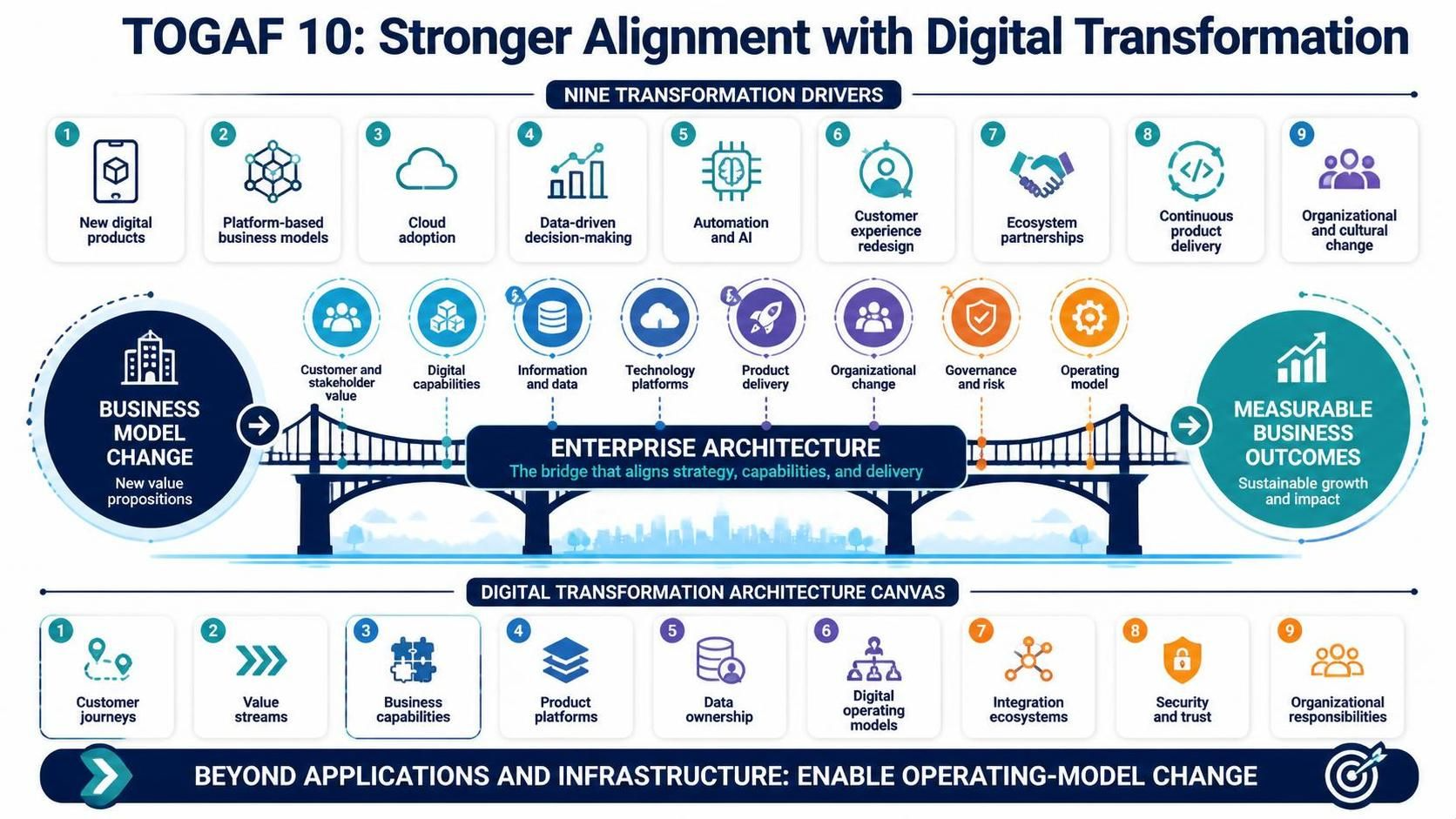
Imagine Enterprise Architecture not as a static blueprint, but as a dynamic bridge. On one side lies Business Model Change—the need for new value propositions. On the other side lies Measurable Business Outcomes—sustainable growth and impact. The “Enterprise Architecture” bridge spans the gap, ensuring that the strategy is actually deliverable.
The infographic visualizes this by positioning EA in the center, supported by pillars that connect specific business needs to technical capabilities. The goal is to help architects connect:
- Business Model Change: How we create value.
- Customer and Stakeholder Value: Who we serve.
- Digital Capabilities: What we can do.
- Information and Data: The fuel for our decisions.
- Technology Platforms: The foundation we build on.
- Product Delivery: How we ship value.
- Organizational Change: The people and culture required.
- Governance and Risk: The controls for safety.
2. The Nine Transformation Drivers
Before diving into the architecture, we must understand the forces driving the transformation. The framework identifies nine specific drivers that digital enterprises must address. These are not just IT tasks; they are business imperatives.
- New Digital Products: Moving beyond physical goods to digital-first offerings.
- Platform-based Business Models: Creating ecosystems rather than just linear supply chains.
- Cloud Adoption: Leveraging scalable infrastructure for agility.
- Data-driven Decision-making: Using analytics to guide strategy.
- Automation and Artificial Intelligence: Enhancing efficiency and intelligence.
- Customer Experience Redesign: Prioritizing the end-user journey.
- Ecosystem Partnerships: Collaborating with external entities.
- Continuous Product Delivery: Agile methodologies for faster time-to-market.
- Organizational and Cultural Change: Shifting mindsets to be more adaptive.
3. The Digital Transformation Architecture Canvas
A digital transformation architecture should address more than just applications and infrastructure. It requires a holistic view. The “Digital Transformation Architecture Canvas” details the specific artifacts that must be modeled and managed.
Strategic & Operational Layers
- Customer Journeys: Mapping the user experience from start to finish.
- Value Streams: Identifying the series of steps that create value for the customer.
- Business Capabilities: Defining what the business needs to be able to do (e.g., “Process Payments”).
- Product Platforms: Designing reusable platforms that support multiple products.
Data & Governance Layers
- Data Ownership: Clearly defining who owns, manages, and governs data assets.
- Digital Operating Models: The new ways of working required to sustain digital initiatives.
- Integration Ecosystems: How systems connect internally and externally.
- Security and Trust: Ensuring privacy and resilience in a digital world.
- Organizational Responsibilities: Assigning accountability for digital success.
4. Practical Implementation with Visual Paradigm
Implementing these complex concepts requires a powerful modeling tool. To effectively visualize these architecture layers, the Recommended tooling is Visual Paradigm TOGAF ADM Tool.
Visual Paradigm allows architects to:
- Visualize the Bridge: Create diagrams that explicitly link “Business Model Change” to “Measurable Outcomes” using the TOGAF 10 templates.
- Manage the Canvas: Use specific TOGAF 10 artifacts to document the “Digital Transformation Architecture Canvas” elements like Value Streams and Operating Models.
- Trace Requirements: Ensure that every transformation driver (like Cloud Adoption) is traced back to a business capability and forward to a technology platform.
Conclusion
The shift to TOGAF 10 represents a maturation of Enterprise Architecture. It moves the discipline from being a gatekeeper of IT systems to a strategic partner in business transformation. By focusing on the bridge between business model change and measurable outcomes, and by utilizing the Digital Transformation Architecture Canvas, organizations can ensure that their technology serves their strategy. To successfully navigate this complexity, leveraging the Visual Paradigm TOGAF ADM Tool provides the necessary structure to model, document, and govern these critical architectural changes.
Related posts:
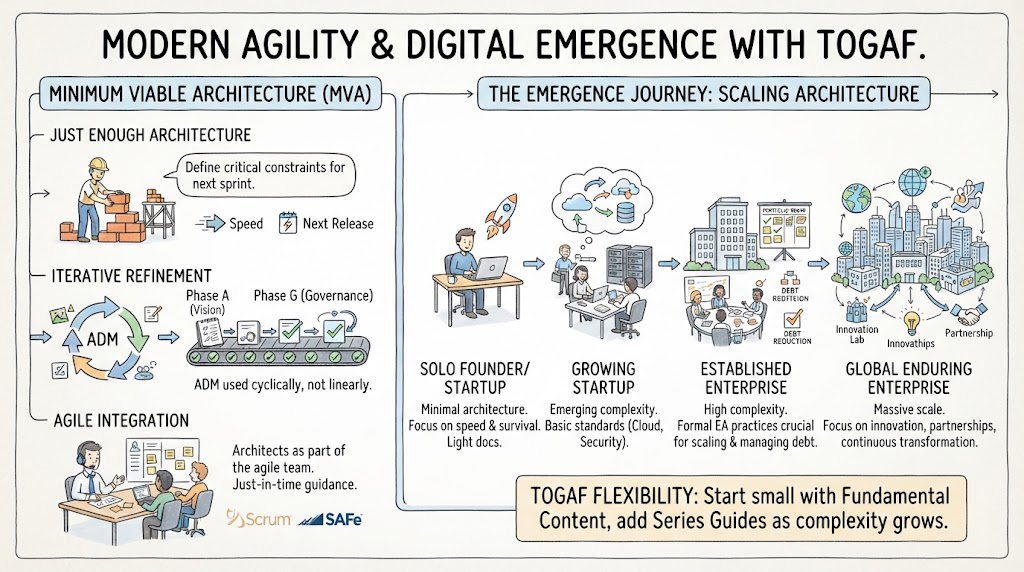 Mastering Modern Agility: A Tutorial on Minimum Viable Architecture and the Digital Emergence Journey
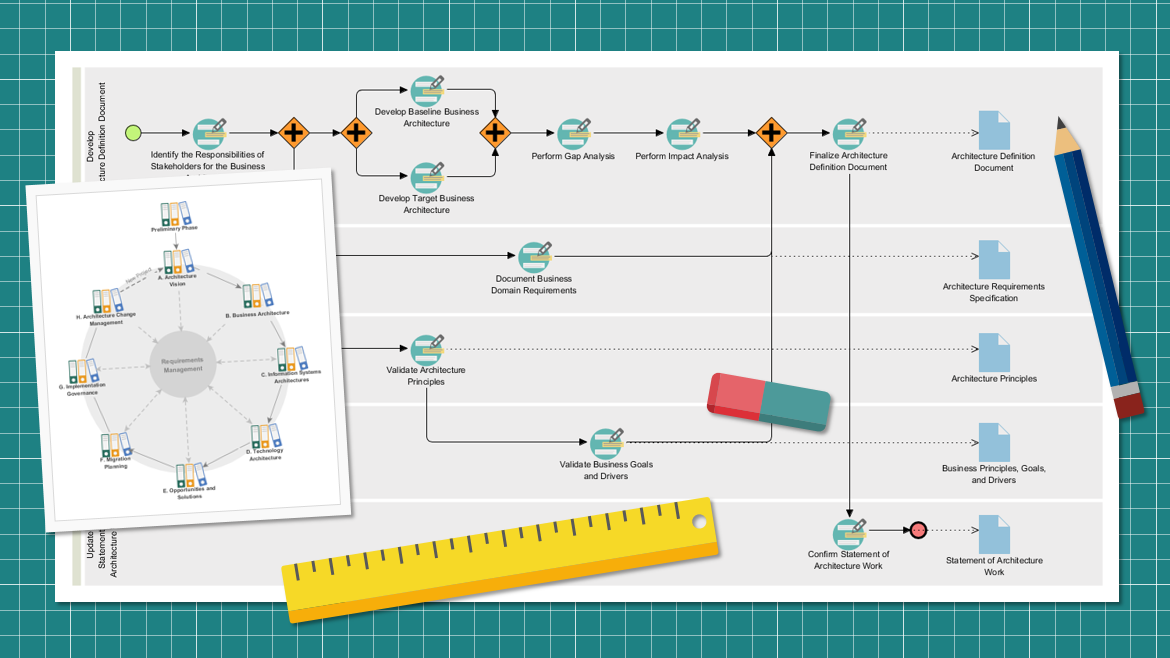 Mastering the TOGAF ADM Cycle: A Visual Guide to Enterprise Architecture Modeling
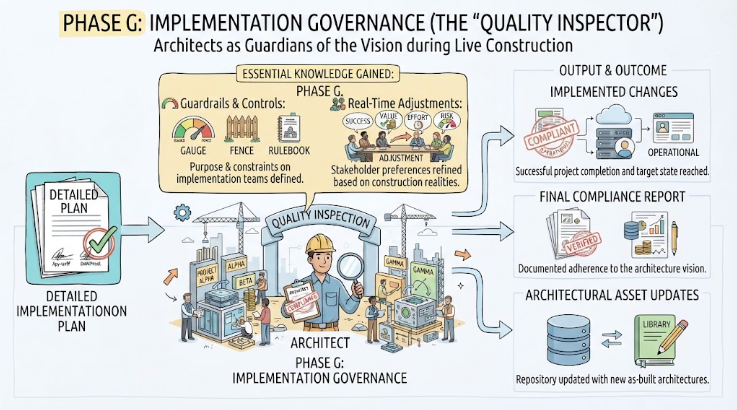 Mastering TOGAF Phase G: Implementation Governance with Visual Paradigm & ArchiMate
 Demystifying the TOGAF Foundation: A Comprehensive Guide to Fundamental Content