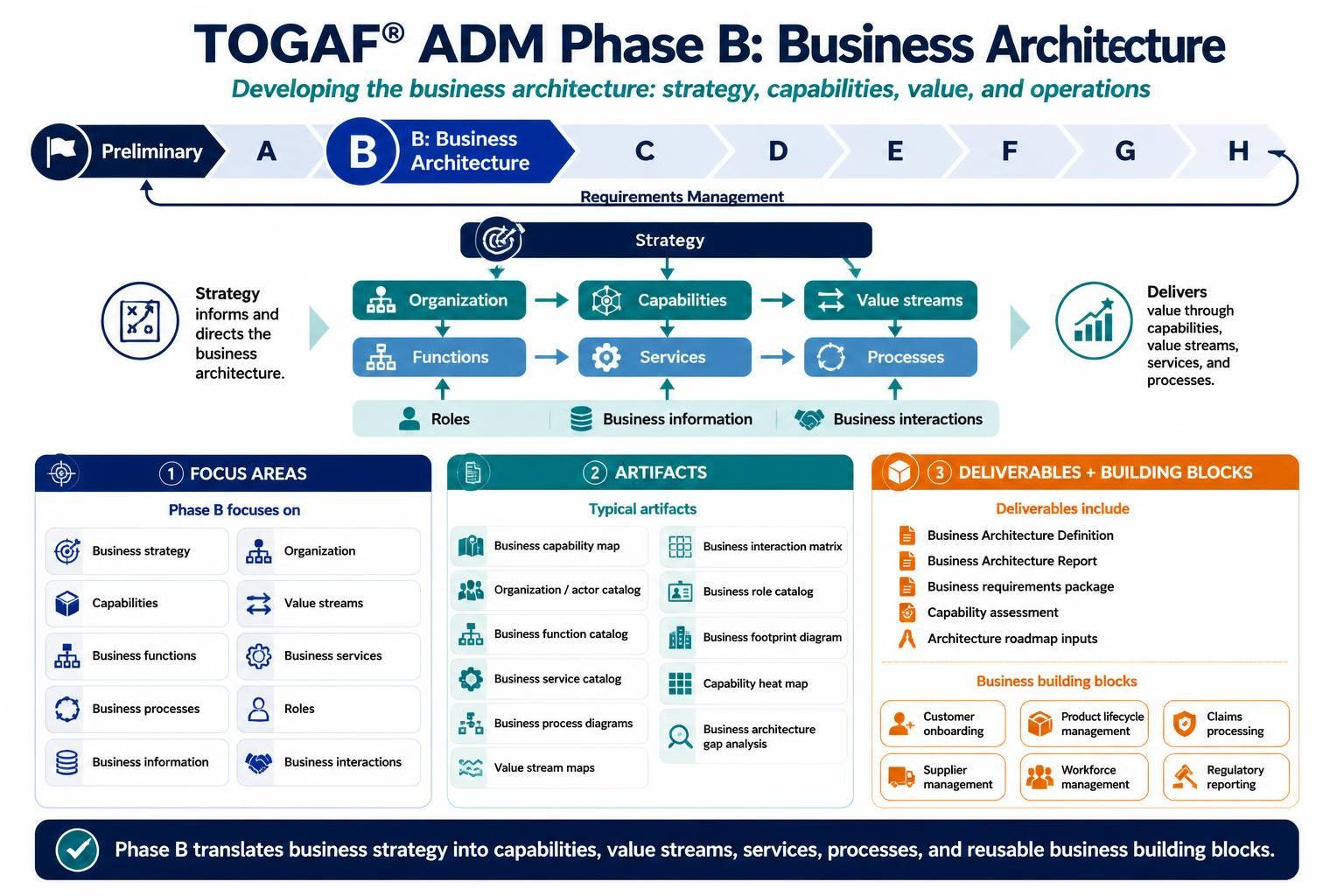
In the realm of enterprise architecture, few steps are as critical as defining the business foundation upon which all IT systems rest. TOGAF (The Open Group Architecture Framework) Phase B, known as Business Architecture, serves exactly this purpose. It is the phase where abstract business strategies are translated into concrete capabilities, value streams, and operational processes.
Whether you are an aspiring enterprise architect or a technical consultant, understanding the flow from strategy to execution is vital. This tutorial will guide you through the core concepts, the modeling relationships, and the practical artifacts required to successfully execute Phase B.
1. The Strategic Context
The process does not begin in a vacuum. As illustrated in the diagram, Phase B is heavily influenced by the Strategy component. The primary directive is that “Strategy informs and directs the business architecture.”
Before drawing a single diagram, you must understand the business goals. Phase B acts as the bridge, taking these high-level strategic goals and decomposing them into the “how” of the organization. The ultimate goal of this phase is to deliver value through a cohesive set of capabilities, value streams, services, and processes.
2. The Core Modeling Concepts: Focus Areas
The heart of Phase B is the definition of the business structure. The diagram highlights ten specific focus areas that must be modeled. These are not isolated items; they are interconnected layers of the organization.
- Business Strategy: The high-level direction and goals.
- Organization: The structure of the company, including departments and units.
- Capabilities: What the business does (e.g., “Ability to process claims”).
- Value Streams: The series of steps that create value for a specific customer or stakeholder.
- Business Functions: Logical groupings of activities that support capabilities.
- Business Services: The interface through which the business offers value.
- Business Processes: The detailed step-by-step execution of work.
- Roles: The specific responsibilities assigned to individuals.
- Business Information: The data required to run the business.
- Business Interactions: How different parts of the business or external partners interact.
3. Understanding the Architecture Relationships
One of the most important aspects of the diagram is the flow of relationships. Notice the directional arrows connecting the upper and lower rows of boxes. This represents the decomposition and realization hierarchy:
- From Strategy to Organization: Strategy dictates how the organization should be structured.
- From Organization to Capabilities: The organization is responsible for specific capabilities.
- From Capabilities to Value Streams: Capabilities enable the value streams to function.
- Decomposition: Similarly, Functions are realized through Services, which are executed via Processes.
At the bottom of this flow, we see the supporting elements: Roles, Business Information, and Business Interactions. These act as the foundation, feeding into and supporting the higher-level functions and processes.
4. Practical Application: Typical Artifacts
To model these concepts, architects rely on specific artifacts. These documents and diagrams are the tangible output of your work in Phase B. Key artifacts include:
- Business Capability Map: A hierarchical view of what the business is capable of doing.
- Value Stream Maps: Visualizations of the end-to-end flow of value.
- Business Process Diagrams: Detailed flowcharts showing the steps of a process.
- Business Interaction Matrix: A grid showing how different business units interact with one another.
- Capability Heat Map: A visual analysis showing which capabilities are mature and which are weak or in need of investment.
5. Deliverables and Building Blocks
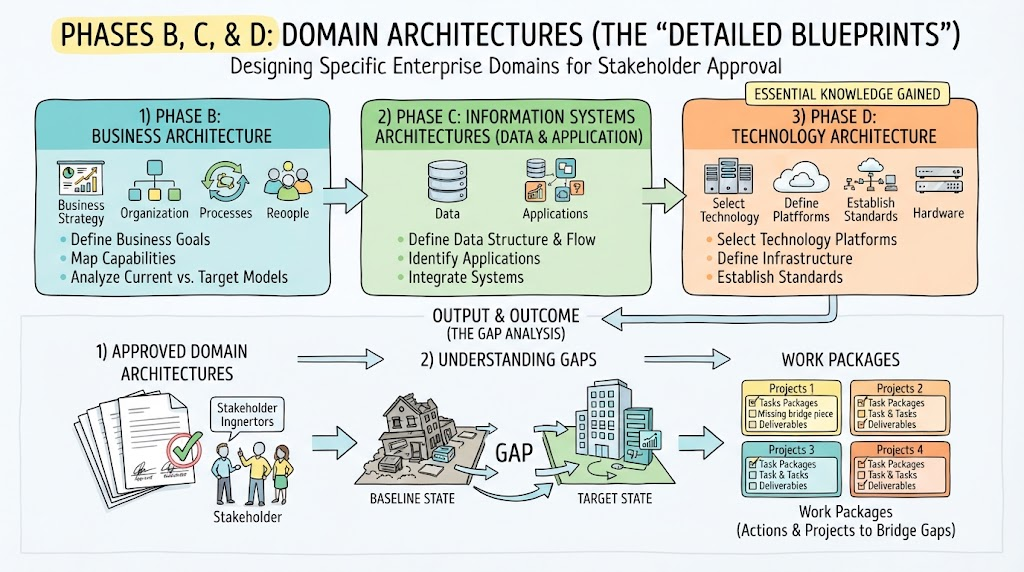
The output of this phase is more than just diagrams; it includes the Business Architecture Definition and a Business Requirements Package. These deliverables feed into subsequent phases, such as Information Systems Architecture (Phase C) and Technology Architecture (Phase D).
Furthermore, Phase B identifies Business Building Blocks (BBBs). These are reusable components of the business architecture. Examples provided in the context include:
- Customer onboarding
- Product lifecycle management
- Claims processing
- Supplier management
Conclusion
Mastering TOGAF Phase B is about translating the “why” (strategy) into the “what” (business architecture). By systematically mapping capabilities, value streams, and processes, you create a blueprint that ensures IT investments align perfectly with business goals.
To execute this complex modeling effectively, precision and visualization are key. For architects looking to streamline this process, we recommend the use of Visual Paradigm TOGAF ADM Tool. This comprehensive tooling suite allows you to model the intricate relationships between capabilities and processes, generate standard artifacts automatically, and ensure your Business Architecture is robust, consistent, and ready for implementation.