


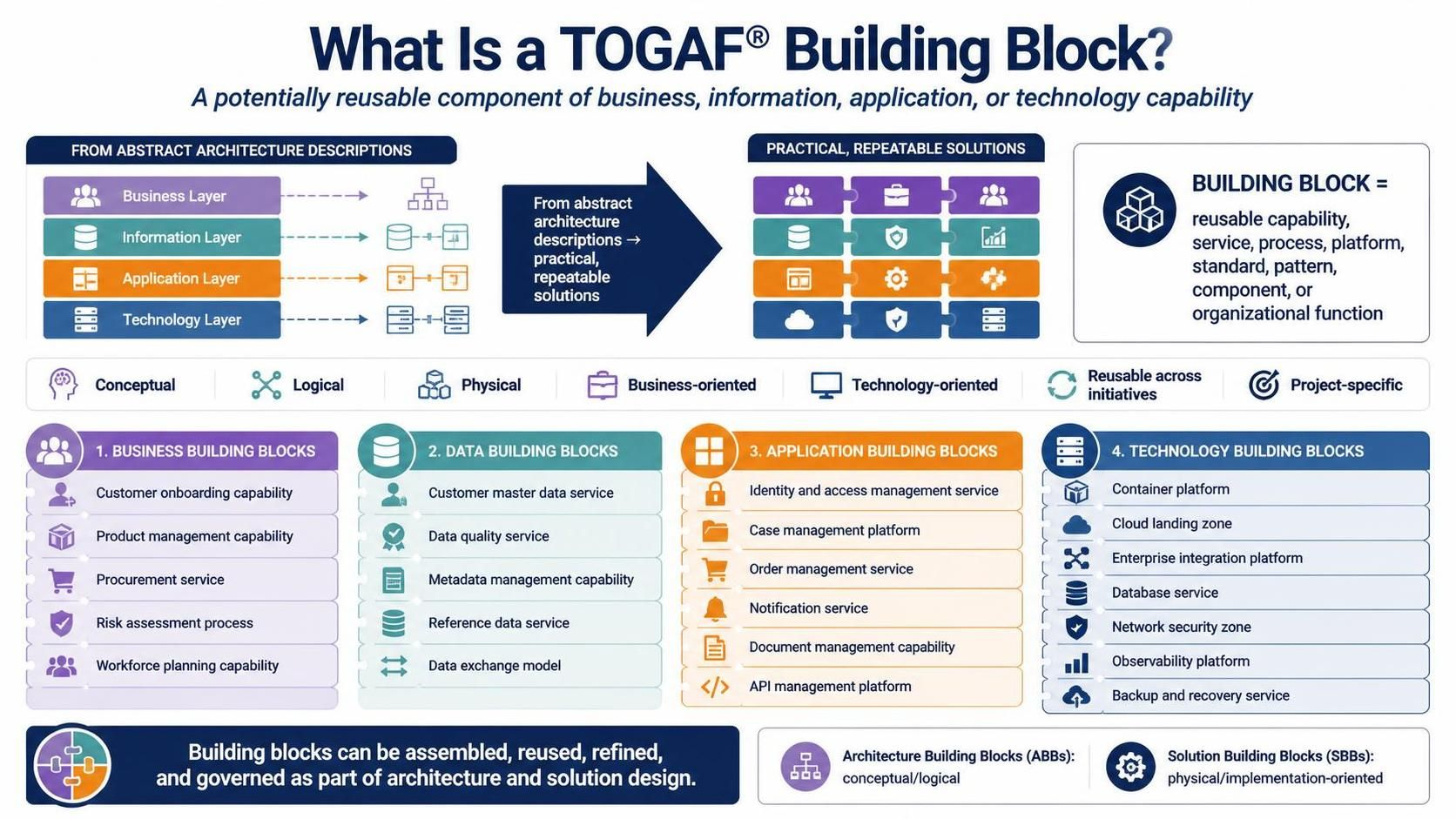
In the world of Enterprise Architecture (EA), consistency is the key to success. When an organization defines its architecture, it relies on reusable components known as Building Blocks. However, a building block is only as useful as the documentation that surrounds it. This tutorial dives deep into the concept of Building Block Specifications, explaining how to structure, categorize, and document these critical artifacts effectively.
Why Standardization Matters
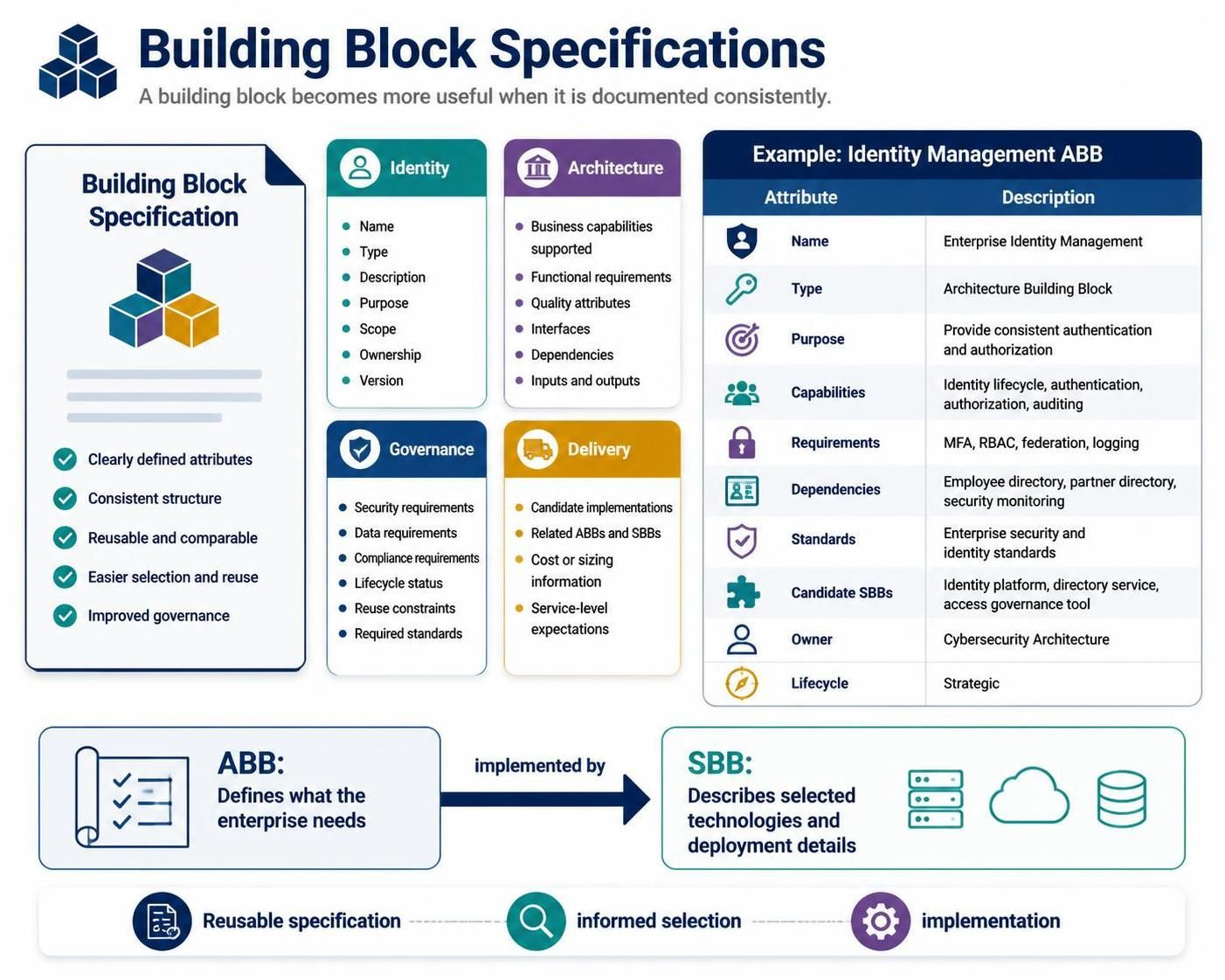
Before we look at the specific attributes, it is important to understand the philosophy behind the diagram. A building block becomes significantly more useful when it is documented consistently. By enforcing a standardized format, architects ensure that:
- Attributes are clearly defined: There is no ambiguity about what is required.
- Structure is consistent: Different architects can read and understand the same document.
- Selection is easier: Comparing different building blocks becomes a straightforward task.
- Reuse is enabled: Standardized blocks can be easily plugged into different solutions.
- Governance is improved: Compliance and ownership are clearly tracked.
Breaking Down the Specification Attributes
To create a comprehensive Building Block Specification, you must document a wide range of details. The infographic categorizes these attributes into specific functional areas. Let’s explore what each category entails.
1. Identity & Architecture (The Basics)
Every building block must start with a solid foundation. These attributes define the “What” and “Who” of the block:
- Name: A clear, unique identifier for the block.
- Type: Distinguishes between an Architecture Building Block (ABB) and a Software Building Block (SBB).
- Description: A high-level summary of the block’s function.
- Purpose: Why does this block exist? What business problem does it solve?
- Scope: What boundaries does the block operate within?
- Ownership: Who is responsible for maintaining this block?
- Version: Essential for tracking changes over time.
2. Business & Functional Context
How does this block fit into the larger enterprise? This section bridges the gap between technical implementation and business goals.
- Business Capabilities Supported: Which business capabilities (e.g., “Process Payments” or “Manage Identity”) does this block enable?
- Functional Requirements: Specific behaviors the system must exhibit.
- Quality Attributes: Non-functional requirements like performance, scalability, and reliability.
- Interfaces: How does the block communicate with others? (APIs, data formats).
- Dependencies: What other blocks or systems does this block rely upon?
- Inputs and Outputs: The data flows entering and leaving the block.
3. Governance & Security
Enterprise architecture requires strict adherence to rules. This section ensures the block is secure and compliant.
- Security Requirements: Authentication, authorization, and encryption needs.
- Data Requirements: Data classification, retention policies, and storage needs.
- Compliance Requirements: Adherence to regulations like GDPR, HIPAA, or PCI-DSS.
- Reuse Constraints: Are there rules preventing this block from being reused in certain contexts?
- Required Standards: Specific technical standards the block must follow (e.g., REST, JSON).
4. Delivery & Implementation
This section focuses on the “How” and the future state of the block.
- Candidate Implementations: Specific technologies that could be used to build this block.
- Related ABBs and SBBs: Connections to other architecture components.
- Cost or Sizing Information: Estimates on resources and budget.
- Service-Level Expectations: SLAs defining availability and response times.
- Lifecycle Status: Where is the block in its lifecycle? (e.g., Draft, Approved, Active, Retired).
Real-World Example: Identity Management
To visualize this, let’s look at the example provided in the diagram: Enterprise Identity Management. This is defined as an Architecture Building Block (ABB).
What is an ABB? An ABB defines what the enterprise needs in terms of functionality and standards, without prescribing specific vendor technologies. It is the “What” not the “How.”
- Purpose: Provide consistent authentication and authorization.
- Capabilities: Identity lifecycle, authentication, authorization, auditing.
- Requirements: Multi-Factor Authentication (MFA), Role-Based Access Control (RBAC), federation, logging.
- Dependencies: Employee directory, partner directory, security monitoring.
- Candidate SBBs: Identity platform, directory service, access governance tool.
From ABB to SBB: The Implementation Path
The diagram illustrates a crucial workflow: ABB to SBB.
- The ABB (Architecture Building Block): Defines the functional requirements (e.g., “We need Identity Management”).
- The SBB (Software Building Block): Describes the selected technologies and deployment details (e.g., “We are implementing Okta using Azure Active Directory”).
This distinction allows architects to design the solution first, and then select the best technology to implement it later.
Conclusion
Building Block Specifications are the backbone of effective Enterprise Architecture. By documenting these blocks with the detailed attributes outlined above, organizations ensure that their architecture is not just a theoretical concept, but a practical, reusable, and governable asset. Whether you are defining a security protocol or a data storage solution, a standardized specification is essential for informed selection and successful implementation.
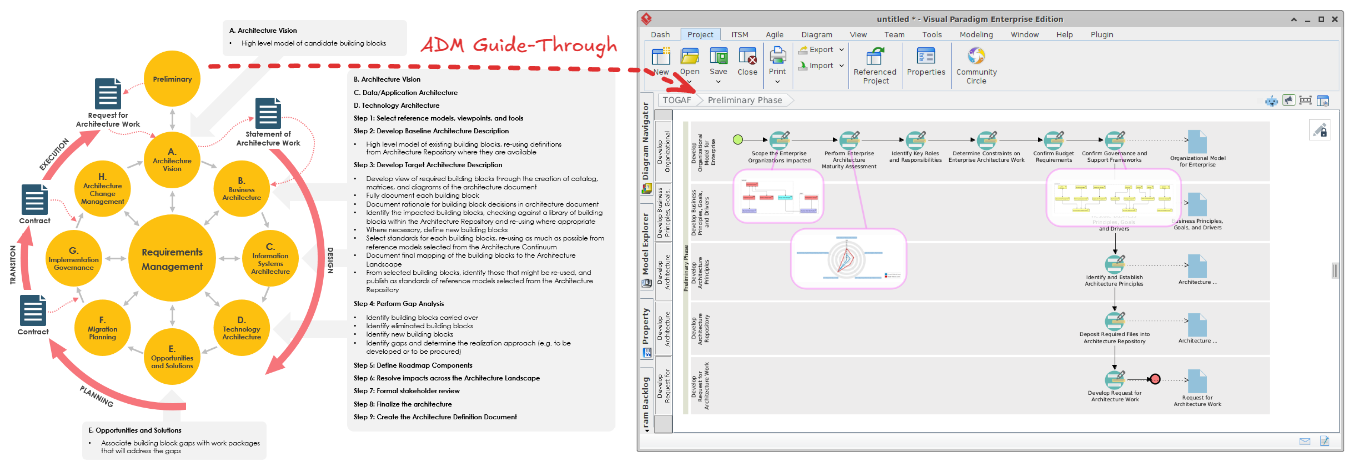
Recommended Tooling: To effectively manage these specifications and the Architecture Development Method (ADM) lifecycle, it is highly recommended to utilize Visual Paradigm TOGAF ADM Tool. This tool provides the necessary framework to document, visualize, and maintain these building blocks throughout the architecture process.
Related posts:
 Mastering the TOGAF ADM: A Visual Paradigm Step-by-Step Guide
 Mastering TOGAF Architecture Governance: A Comprehensive Guide to Roles, Principles, and Decision Rights
 Mastering the TOGAF ADM: A Comprehensive Guide to Enterprise Architecture Development
 Mastering TOGAF Building Blocks: From Abstract Architecture to Practical Implementation