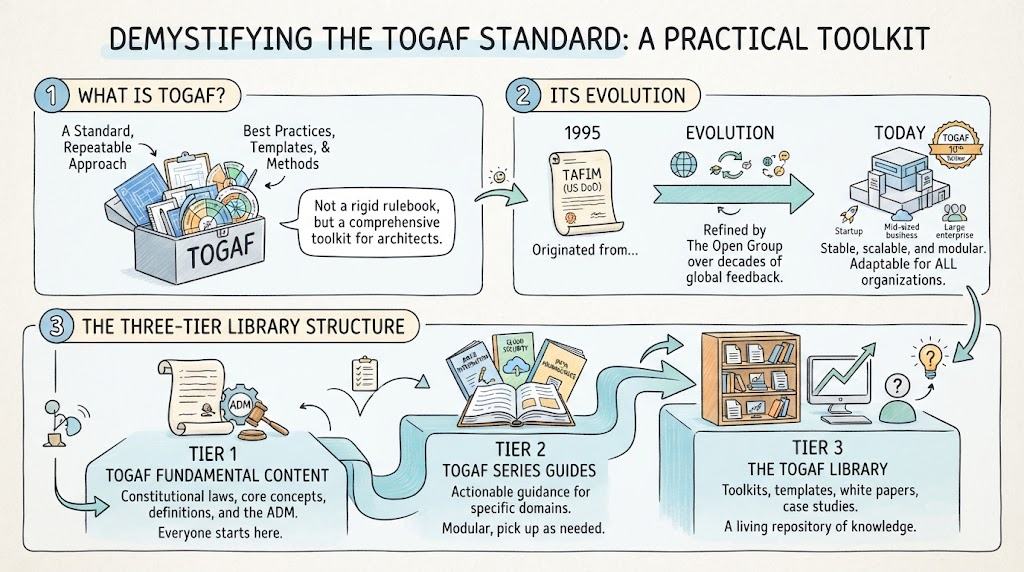
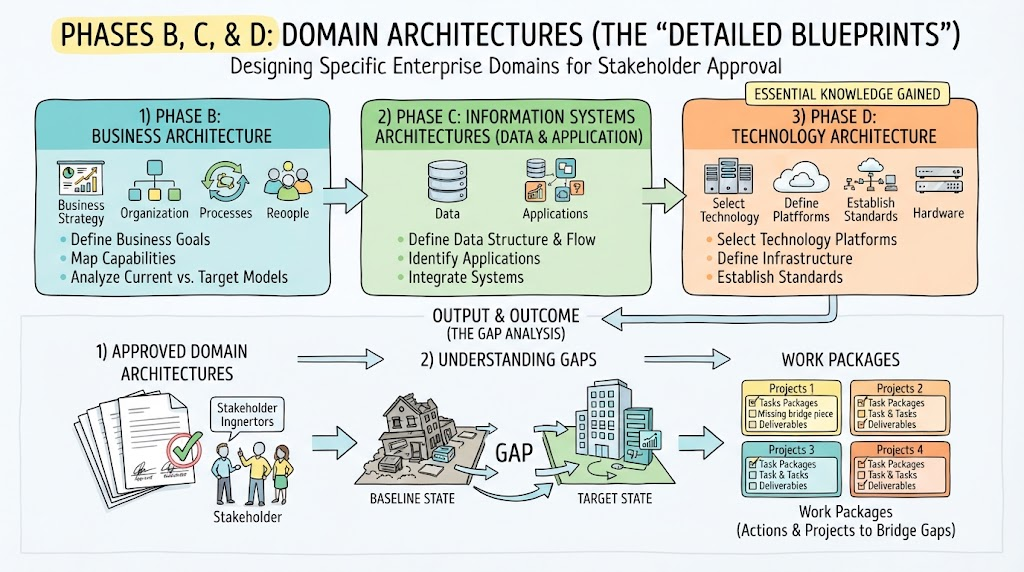
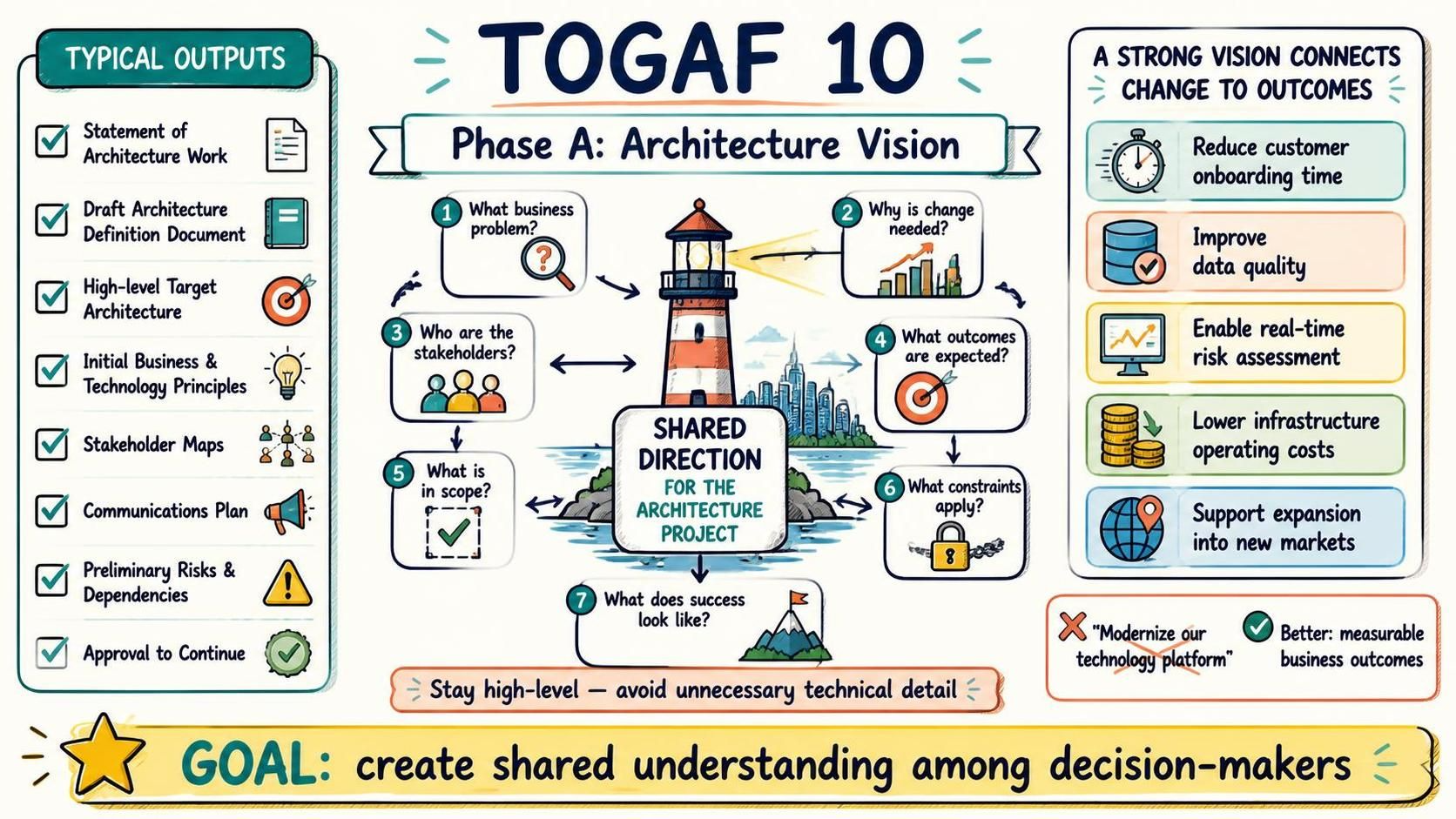
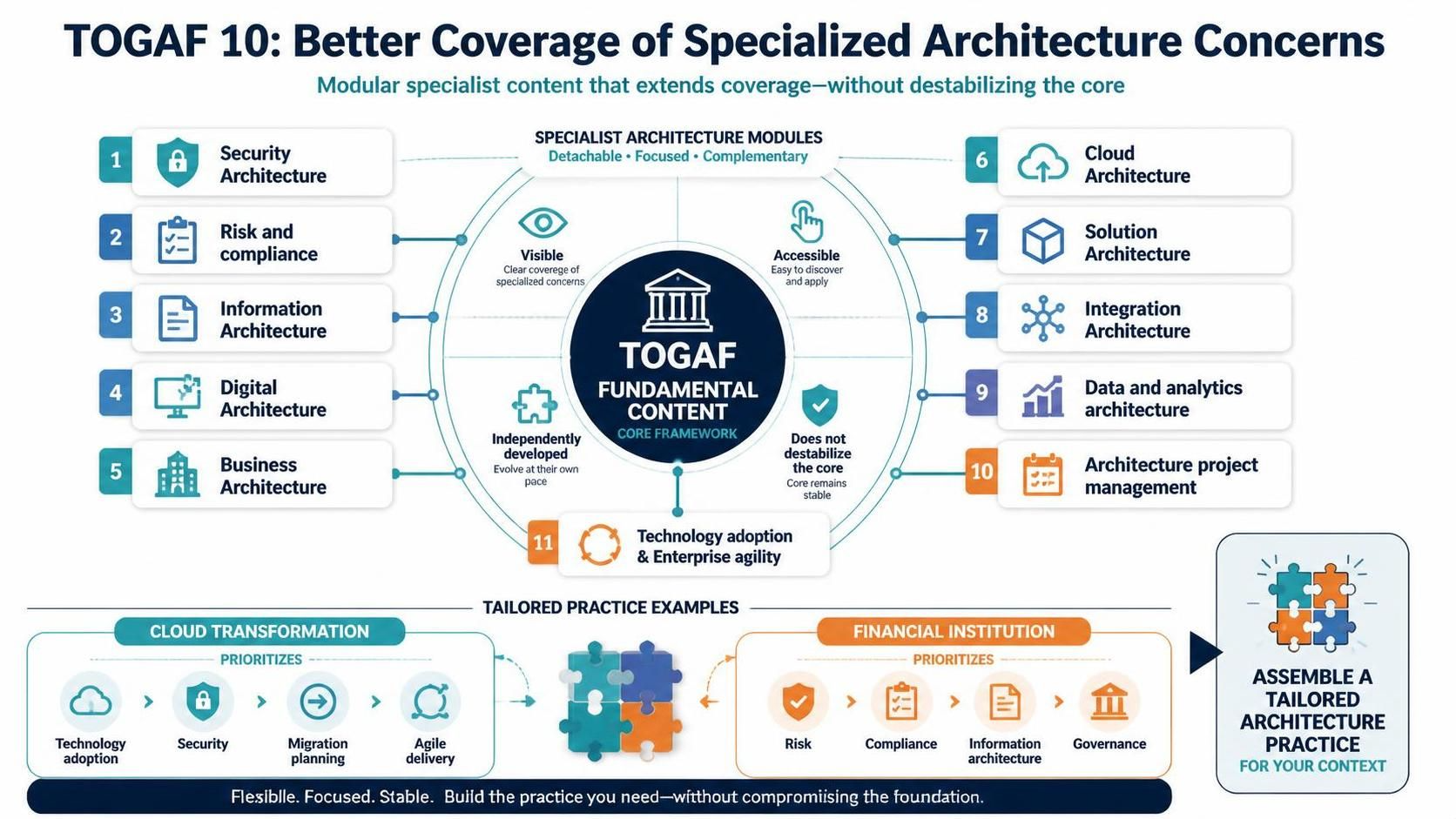
In the rapidly evolving landscape of enterprise architecture, frameworks can often become burdensome, leading to “architecture bureaucracy” rather than architectural value. The image provided illustrates a fundamental shift in modern architecture management: moving away from rigid, documentation-heavy processes toward a thoughtful, tailored application of the TOGAF 10 framework. By focusing on the core benefits—Alignment, Governance, Investment, and Reuse—organizations can transform their IT landscape into a strategic asset.
The Core Philosophy: Thoughtful Application Over Volume
The central tenet of TOGAF 10, as highlighted in the provided graphic, is that value is not derived from the sheer volume of documentation produced. Instead, the value proposition lies in the tailored application of the framework. This means adapting the Architecture Development Method (ADM) to fit the specific needs of the organization, rather than forcing the organization to fit the framework.
When applied correctly, this approach creates a ripple effect across four critical domains of enterprise health:
- Alignment & Communication: Bridging the gap between business strategy and technical execution.
- Investment & Delivery: Ensuring resources are allocated effectively with clear roadmaps.
- Reuse & Transformation: Maximizing asset efficiency and interoperability.
- Governance & Risk: Providing visibility and control over the enterprise evolution.
Domain 1: Alignment & Communication
The most common failure in IT projects is the misalignment between what the business strategy demands and what the technology delivers. TOGAF 10 addresses this through structured communication channels.
- Better Alignment: By utilizing the Business Architecture phase of the ADM, organizations ensure that every technical decision supports a high-level business goal.
- Consistent Decisions: Standardized processes ensure that Architecture Decision Records (ADRs) are applied consistently across different projects.
- Traceability: A key benefit is the ability to trace an architectural objective all the way down to the final outcome. If a business objective changes, the impact on technology can be instantly visualized.
Domain 2: Investment & Delivery
IT leaders often struggle with “where do we spend our budget?” and “when will this project be delivered?”. The tailored TOGAF approach brings rigor to the investment planning process.
- Effective Investment Planning: Instead of approving projects in a vacuum, architecture portfolios are evaluated based on their contribution to the enterprise strategy.
- Clearer Roadmaps: By visualizing the transition states between the Baseline and Target Architectures, stakeholders gain a clear understanding of the “To-Be” journey.
- Reduced Duplication: A centralized repository of architecture assets prevents different departments from building the same solution independently.
Domain 3: Reuse & Transformation
In a modern microservices and cloud-native environment, “building from scratch” is often a liability. The framework promotes a circular economy of software assets.
By enforcing Improved Interoperability, organizations ensure that systems can talk to one another seamlessly. This is often achieved by defining clear standards for API contracts and data models. Furthermore, the framework encourages the Greater Reuse of Architecture Assets, treating code, patterns, and design blueprints as reusable inventory rather than one-off deliverables.
Domain 4: Governance & Risk
Governance is often viewed as a police force, but in a tailored TOGAF environment, it acts as a navigation system. Better Risk Visibility is achieved by mapping technical debt and security vulnerabilities directly to business capabilities. This allows leadership to make informed decisions about risk tolerance. Additionally, Stronger Governance ensures that transformations are More Controlled, preventing “shadow IT” projects from deviating from the core enterprise strategy.
Recommended Tooling for Success
To successfully implement this tailored approach, you need tools that support the complexity of the TOGAF 10 Content Metamodel without bogging you down with unnecessary overhead. The industry standard for facilitating this specific workflow is Visual Paradigm TOGAF ADM.
Visual Paradigm excels in this area by offering:
- Comprehensive Modeling: Full support for UML, BPMN, ArchiMate, and SysML.
- Collaboration: Real-time sharing of architecture models across business and IT teams.
- Automated Reporting: Generate tailored documentation automatically from your models.
For the modern, speed-oriented architect, Visual Paradigm has also integrated AI-Assisted Modeling capabilities. These features allow you to:
- Generate complex diagrams from natural language descriptions.
- Automatically suggest architectural patterns based on your current design.
- Refactor legacy diagrams into standardized TOGAF-compliant formats instantly.
By leveraging these advanced tooling capabilities, you can focus on the “thoughtful” application of the framework rather than the manual labor of drawing boxes and arrows.
Conclusion
The transition to TOGAF 10 is not about creating more paperwork; it is about creating more clarity. By tailoring the framework to your organization’s unique needs, you unlock the ability to align strategy with technology, govern risk effectively, and deliver value faster. The path to modernization requires a partner that can bridge the gap between high-level strategy and low-level implementation.
To achieve these benefits, it is highly recommended to utilize Visual Paradigm TOGAF ADM & AI Assisted tools. This combination empowers architects to move beyond static documentation and into dynamic, intelligent architecture management, ensuring that the value of the framework is realized in the actual execution of the enterprise vision.