


In the realm of enterprise software engineering and business analysis, selecting the right modeling tool is a critical architectural decision. The Visual Paradigm Modeler Edition occupies a distinct and highly strategic space in the software development lifecycle (SDLC). It is designed specifically for professionals who need robust technical modeling capabilities—such as UML, BPMN, and database engineering—without the overhead or complexity of full-scale Enterprise Architecture (EA) frameworks.
This tutorial explores the system architecture of the Modeler Edition, defining its ideal user base, its technical feature set, and the strategic limitations that distinguish it from the Enterprise or Professional editions.
Target Audience and Use Case Analysis
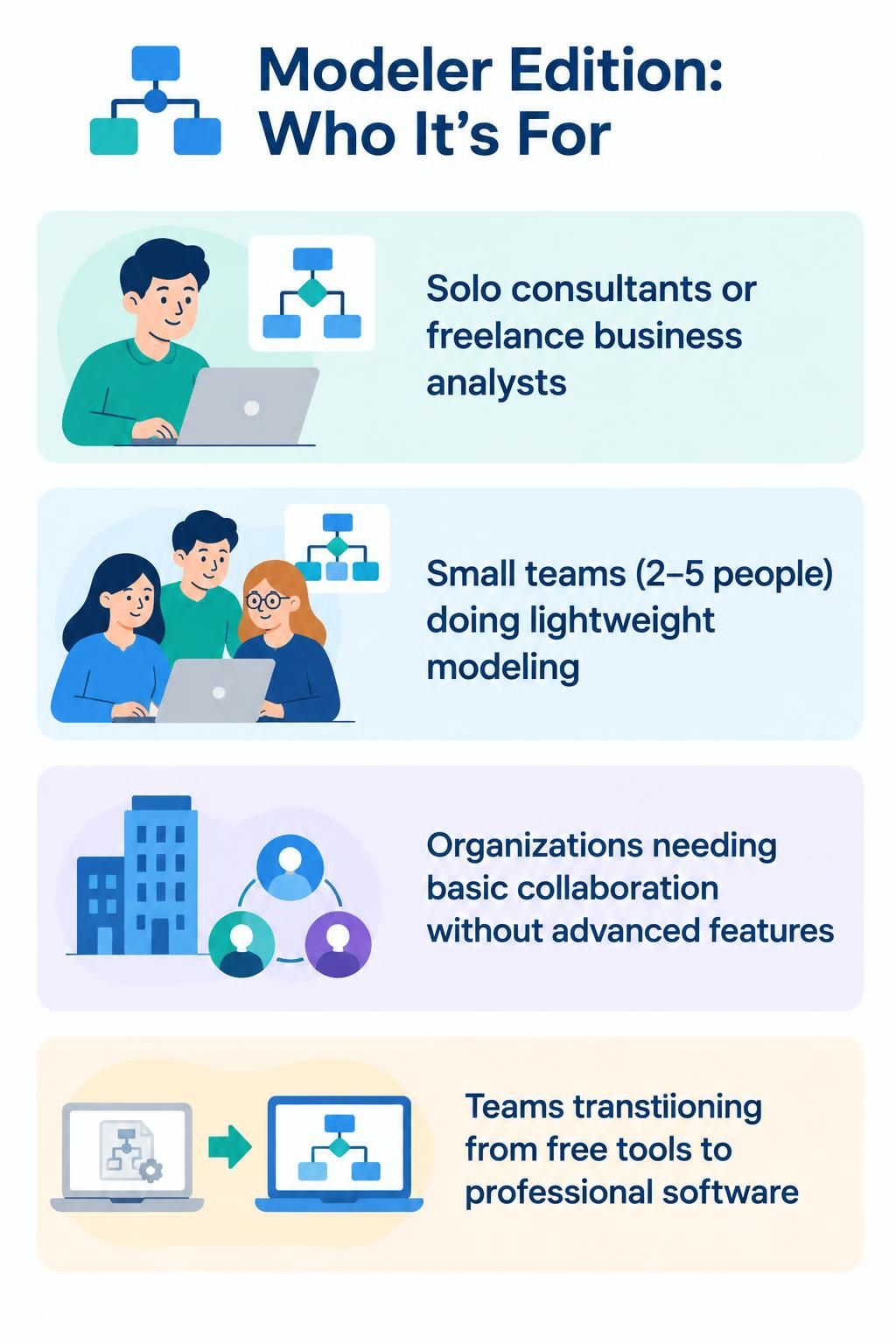
The Modeler Edition is not intended for every organization. It is a precision tool designed for specific operational contexts. Based on its feature set and collaboration limits, the edition serves four primary personas:
1. Solo Consultants and Freelance Business Analysts
For the independent professional, cost-efficiency is paramount. This edition provides the full power of Visual Paradigm’s core engine—including code engineering and diagramming—without the licensing costs associated with large-scale team management or advanced project management modules.
2. Small Teams (2–5 People)
This edition supports lightweight collaboration. A team of 2 to 5 individuals can perform concurrent modeling and utilize revision history, which is sufficient for smaller agile squads or specialized project groups that do not require complex workflow governance.
3. Organizations Transitioning from Free Tools
Many organizations start with community editions or free tools. The Modeler Edition serves as the logical “bridge” upgrade. It offers a seamless transition path, retaining familiar interfaces while introducing professional-grade features like database engineering and code generation.
4. Basic Collaboration Needs
For organizations that need to share models and review diagrams but do not require advanced project management (Gantt charts, PERT) or complex resource allocation tools, this edition strikes the perfect balance between functionality and price.
Core Technical Capabilities and Feature Set
The Modeler Edition is an all-in-one modeling suite. It encompasses the capabilities of the Community Edition and adds significant professional layers. Below is a breakdown of the critical technical modules available in this edition.
Advanced Diagramming Standards
Visual Paradigm is renowned for its support of industry standards. The Modeler Edition includes full support for:
- UML (Unified Modeling Language): Including Standard and Chen notation for ERDs.
- BPMN (Business Process Model and Notation): Essential for business process re-engineering.
- DFD Variants: Support for Yourdon/Coad, Yourdon/DeMarco, and Gane Sarson methodologies.
- System Modeling: Full SysML and EPC (Event-driven Process Chain) diagram support.
Database and Code Engineering
One of the most powerful differentiators of the Modeler Edition is its bidirectional engineering capabilities. This allows for a “Model-First” or “Database-First” approach:
- Database Engineering: Users can generate SQL DDL from ERDs or reverse engineer existing databases into diagrams. This ensures the data model remains synchronized with the physical schema.
- Code Engineering: The tool can generate code from UML class diagrams and update diagrams from existing codebases (Round-Trip Engineering). It also provides support for Hibernate ORM, bridging the gap between design and Java persistence.
Collaboration and Documentation
The edition moves beyond static diagrams by integrating collaboration and documentation tools:
- Team Collaboration: Features concurrent modeling, revision history, and task management.
- Diagram Review: Built-in commenting allows for asynchronous feedback on models.
- Project Publisher: The ability to generate comprehensive documentation (HTML, PDF, Word) from the project repository.
UX and API Design
Modern application design often requires more than just backend logic. The Modeler Edition includes tools for:
- Basic UX Wireframing: Creating storyboards and wireflows to visualize user interactions.
- Visual REST API Designer: A dedicated environment for designing and documenting RESTful web services.
Strategic Limitations: What Is Not Included?
To understand the Modeler Edition, one must also understand what it excludes. These exclusions are intentional, designed to keep the tool lightweight for the target audience. Understanding these limitations helps in determining if the tool fits a specific project’s needs.
Missing Enterprise Architecture (EA) Frameworks
The Modeler Edition does not support advanced EA frameworks such as TOGAF, ArchiMate, or DoDAF. If your organization requires a holistic view of the enterprise architecture aligned with these standards, the Enterprise Edition is required.
Missing Advanced Project Management
While it includes basic task management, it lacks advanced project management features like Gantt charts, PERT, WBS, and Roadmaps. It is a modeling tool, not a project management suite.
Missing Advanced Analysis and AI
The edition does not include:
- On-Demand Model ETL: Advanced analysis for model data extraction.
- AI-Powered Features: Automated model generation or analysis via Artificial Intelligence.
- High-Fidelity Prototyping: While it supports wireframes, it does not offer high-fidelity mockups.
Missing Specific Domain Models
For organizations specializing in specific domains, the following notations are absent:
- CMMN (Case Management Model and Notation)
- SoaML (Service Oriented Architecture Modeling Language)
- BMM (Business Motivation Model)
Verdict and Conclusion
The Visual Paradigm Modeler Edition is the “sweet spot” for professional individual modelers and small teams. It provides the essential toolkit for robust UML, BPMN, and code engineering without the bloat of enterprise-level project management or complex EA frameworks.
It serves as an excellent bridge for teams transitioning from free tools to professional software, offering a comprehensive feature set that covers the vast majority of standard software engineering and business analysis needs.