In the modern landscape of business process modeling, the barrier to entry has traditionally been the steep learning curve associated with notation standards like BPMN 2.0. However, the emergence of AI-powered diagram generation is fundamentally altering this dynamic. This tutorial explores the architectural shift from manual drag-and-drop modeling to natural language interaction, specifically analyzing the workflow of a Visual Paradigm AI system.
1. The Paradigm Shift: Natural Language as the Interface
Historically, creating a Business Process Model and Notation (BPMN) diagram required a user to mentally map their logic to specific geometric shapes and connectors. This new system introduces a paradigm where the user interface is not a toolbox, but a chatbot. The architecture prioritizes the expression of logic over the execution of UI commands.
Understanding the Input Vector
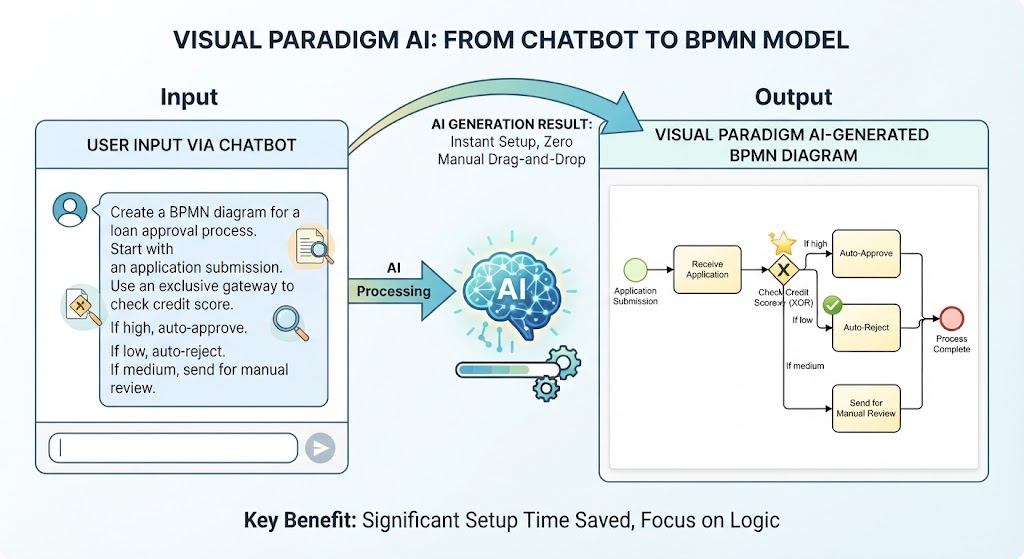
The process begins with the User Input via Chatbot. This component acts as the ingestion layer for the system’s intent. Instead of navigating a complex menu, the user provides a descriptive narrative. Let’s break down the specific architectural requirements demonstrated in the loan approval scenario:
- Process Initiation: “Start with an application submission.” This sets the Start Event (a green circle).
- Sequence Flow: “Receive Application.” This defines the activity task.
- Decision Logic: “Use an exclusive gateway to check credit score.” This is the critical branching point, requiring a specific logical structure.
- Conditional Outcomes: The prompt explicitly defines the three paths:
- Condition High: “Auto-approve”
- Condition Low: “Auto-reject”
- Condition Medium: “Send for manual review”
Key Concept: In this architecture, the user acts as the Business Analyst defining the What, while the AI acts as the Architect defining the How.
2. The Processing Engine: Semantic Parsing and Logic Mapping
Once the prompt is submitted, the system enters the AI Processing phase. This is the “black box” where the magic of semantic understanding occurs. The engine performs three distinct functions:
- Intent Recognition: The AI identifies that the user wants to generate a BPMN diagram, not just a text summary.
- Entity Extraction: The system isolates key entities (Application, Credit Score, Manual Review) and maps them to BPMN objects.
- Logical Structuring: The AI detects the conditional language (“If high”, “If low”) and automatically selects the correct gateway type. In this case, it identifies an Exclusive Gateway (XOR), which allows only one path to be taken based on the criteria.
This step eliminates the common modeling error where a novice user might accidentally use a Parallel Gateway (AND) when they intended to use an Exclusive Gateway (XOR), which would fundamentally change the process logic.
3. The Output: Automated Diagram Generation
The final stage of the architecture is the Visual Paradigm AI-Generated BPMN Diagram. The system renders the processed logic into a visual format. The result is a technically accurate model that adheres to BPMN 2.0 standards.
Deconstructing the Generated Model
Let’s analyze the components of the resulting diagram shown in the output section:
- The Start Event: A simple green circle labeled “Application Submission” initiates the flow.
- The Task: A rounded rectangle labeled “Receive Application” represents the work being done.
- The Exclusive Gateway: The system places a diamond shape with an “X” inside. This is the XOR Gateway. It signifies that the process flow will split into mutually exclusive paths. The labels “If high”, “If low”, and “If medium” are attached to the outgoing sequence flows.
- The Branches:
- Top Path: Leads to “Auto-Approve” (a task).
- Middle Path: Leads to “Auto-Reject” (a task).
- Bottom Path: Leads to “Send for Manual Review” (a task).
- The Convergence: All three paths eventually merge back into a single flow, leading to the red circle, which represents the End Event (“Process Complete”).
4. Architectural Benefits: Speed and Accuracy
This architecture offers two primary advantages over traditional modeling methods:
Significant Setup Time Saved
In a manual environment, a user would need to locate the gateway tool, draw the diamond, position the tasks, draw the connectors, and then manually configure the conditions (e.g., typing “score > 700” for the high path). The AI system performs this entire sequence in seconds, allowing the user to focus on the business logic rather than the drawing mechanics.
Focus on Logic
By automating the visual representation, the system ensures that the model remains accurate to the intent. The AI’s ability to automatically adjust properties (like setting the correct condition labels on the gateway) reduces the risk of human error, ensuring the final diagram is a reliable blueprint for the loan approval process.
Conclusion
The transition from manual modeling to AI-driven generation represents a significant evolution in system architecture. By leveraging natural language processing, tools like Visual Paradigm AI bridge the gap between abstract business requirements and concrete technical diagrams. This tutorial demonstrated how a simple text prompt describing a loan approval logic is instantly translated into a robust, compliant BPMN model, saving time and reducing complexity.