The Shift from Static to Dynamic
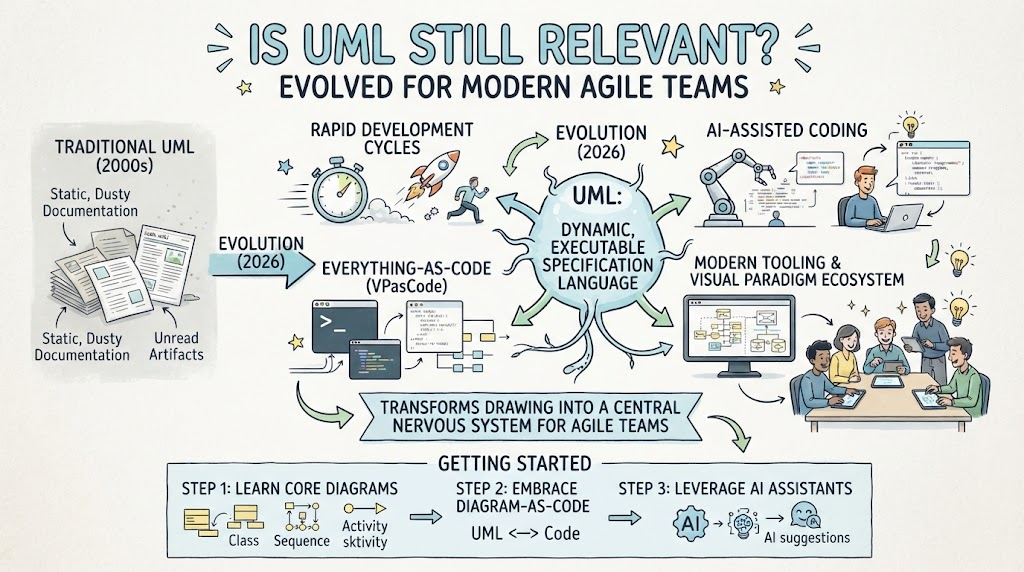
For decades, many developers have associated UML with “static, dusty documentation.” You might remember creating detailed diagrams that were written once and rarely read again. These artifacts often became disconnected from the actual code, serving more as a compliance requirement than a practical tool.
However, the landscape is shifting rapidly. As we look toward 2026, the industry is moving away from these unread artifacts toward an “Everything-as-Code” philosophy. In this new era, UML isn’t just a drawing; it’s becoming a dynamic, executable specification language.
Why This Matters for Agile
In rapid development cycles, speed and adaptability are key. Traditional documentation often acts as a bottleneck. By evolving UML into a living part of your development process, you transform it into the central nervous system for your team. It allows you to visualize complex systems while simultaneously driving the actual implementation.
Enter Visual Paradigm and VPasCode
This evolution is powered by tools like Visual Paradigm, which bridge the gap between design and engineering. A key component of this shift is VPasCode (Visual Paradigm as Code).
Instead of manually clicking boxes on a canvas, developers can now write their models directly in code. This approach offers several distinct advantages:
- Synchronization: Since the model is code, it lives in version control alongside your application code. There is no longer a disconnect between the diagram and the logic.
- Executable Specifications: The diagrams become active specifications that can generate code or be tested automatically.
- Collaboration: Developers who prefer coding can still contribute to the architectural design without needing to master the graphical interface.
Leveraging AI-Assisted Coding
The final piece of this puzzle is Artificial Intelligence. Modern tooling integrates AI assistants that help translate natural language or high-level concepts into structured UML diagrams.
Imagine asking an assistant to “Create a sequence diagram for user login” and having it instantly generate the interactions. This doesn’t replace the developer; rather, it accelerates the workflow, allowing you to focus on the logic and architecture rather than the syntax of drawing lines.
Getting Started: Your Roadmap
If you are looking to adopt this modern approach to UML, here is a simple three-step roadmap to guide your journey:
- Learn Core Diagrams: Start by refreshing your knowledge on fundamental types like Class, Sequence, and Activity diagrams. Understanding the core vocabulary is essential before applying advanced techniques.
- Embrace Diagram-as-Code: Move beyond purely graphical modeling. Experiment with VPasCode to see how defining your architecture in text can streamline your workflow and improve maintainability.
- Leverage AI Assistants: Utilize the AI capabilities within your modeling environment to generate boilerplate diagrams, suggest optimizations, and quickly prototype ideas.
Summary
UML is not dead; it is simply evolving. By integrating dynamic modeling, executable specifications, and AI assistance, tools like Visual Paradigm are helping teams move past the era of “dusty documentation.” Embracing these changes allows modern Agile teams to use UML as a powerful engine for development, ensuring that your designs remain relevant, accurate, and actionable throughout the entire software lifecycle.