


In the world of Enterprise Architecture, clarity is power. The ArchiMate language serves as the universal grammar for describing, analyzing, and visualizing complex business and IT landscapes. While the core framework provides the basics, the ArchiMate Full Framework unlocks the ability to model the entire spectrum of organizational change.
This tutorial breaks down the comprehensive structure of the ArchiMate Full Framework, moving from the strategic “Why” to the physical “Where,” ensuring you can model your enterprise with precision using tools like Visual Paradigm.
Understanding the Matrix: Layers vs. Aspects
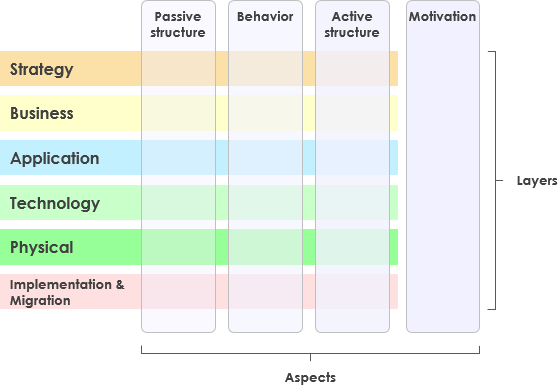
The ArchiMate Full Framework is best understood as a matrix. It combines two distinct dimensions: Layers (the “What” and “Where”) and Aspects (the “How” and “Why”). This separation allows architects to view the same business concept from multiple perspectives without creating redundant models.
The Layers: The Foundation of Structure
The horizontal rows in the framework represent the layers. These are the domains of enterprise architecture, often aligned with TOGAF domains:
- Strategy: The highest level, focusing on goals, principles, and high-level vision.
- Business: The core domain covering business processes, functions, and actors.
- Application: The software layer, describing applications and their interfaces.
- Technology: The hardware and software infrastructure layer (nodes, devices, paths).
- Physical: The tangible layer, modeling physical facilities, equipment, and materials (e.g., a server rack or a warehouse).
- Implementation & Migration: A specialized layer for planning change, covering projects, work packages, and gaps.
The Aspects: The Dimensions of View
The vertical columns in the framework represent the aspects. These define the nature of the element being modeled:
- Passive Structure (The “Nouns”): Static elements that have no behavior of their own but are acted upon. Examples include Documents, Data Objects, Business Objects, and Physical Objects.
- Behavior (The “Verbs”): The dynamic elements that show activity. Examples include Business Processes, Business Events, and Application Functions.
- Active Structure (The “Actors”): The elements that exhibit behavior. Examples include Business Roles, Business Actors, Applications, and Devices.
- Motivation (The “Why”): An extension used to explain the reasoning behind architectural decisions, including drivers, goals, and requirements.
Deep Dive: The Strategic Extensions
The power of the Full Framework lies in its extensions. While the core framework handles the “What” and “How,” the extensions handle the “Why” and “When.”
1. The Motivation Extension
Architecture without context is just a drawing. The Motivation Extension allows you to model the rationale behind your architecture. It connects high-level business goals to specific technical implementations.
Key concepts in this extension include:
- Stakeholders: The people or organizations involved.
- Drivers: The external or internal forces pushing for change.
- Goals: The desired outcomes.
- Principles: The guiding rules and policies.
- Requirements: The specific needs to be met.
2. The Implementation & Migration Extension
Enterprise Architecture is rarely static; it is a journey of transformation. This extension provides the tools to model the transition from a current state to a future state.
It introduces concepts such as:
- Work Packages: Groups of activities that form a project or a milestone.
- Gaps: The difference between the current architecture and the target architecture.
- Deliverables: The tangible outputs produced during a migration.
- Assessment: Evaluating the current state.
Visualizing the Full Framework
When you open the modeling palette in Visual Paradigm, you are looking at this matrix in action. Every element you drag onto your canvas belongs to a specific intersection of a Layer and an Aspect.
For example, a Business Actor is an Active Structure element within the Business Layer. A Requirement is a Passive Structure element within the Motivation Extension. Understanding this grid prevents common modeling errors, such as trying to apply a Behavior element to a Motivation layer where it doesn’t fit semantically.
Conclusion
The ArchiMate Full Framework provides a robust, 6-layer structure combined with 4 distinct aspects to ensure comprehensive coverage of any enterprise architecture project. By leveraging the Motivation and Implementation & Migration extensions, you move beyond static diagrams to create dynamic, living models that guide your organization’s transformation.