In the world of business analysis and system architecture, communication is paramount. One of the most effective ways to communicate complex business processes is through Business Process Model and Notation (BPMN). BPMN serves as a universal language, allowing stakeholders, developers, and business analysts to visualize workflows without ambiguity.
This tutorial will guide you through the fundamental principles of creating high-quality BPMN models and deconstruct the essential building blocks you need to know to get started.
Key Concepts Before We Begin
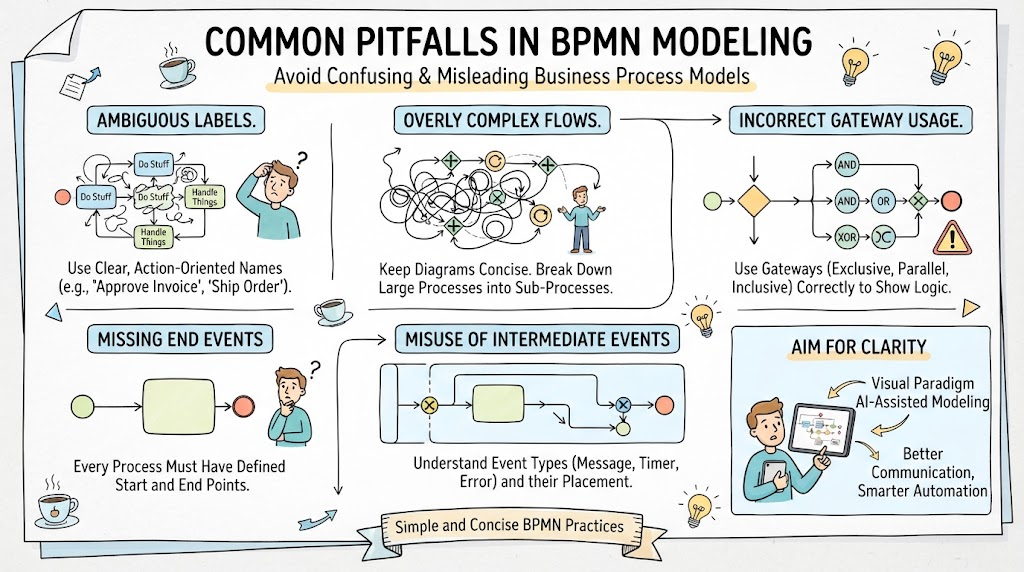
Before diving into the specific shapes and symbols, it is crucial to understand the criteria that define a good BPMN model. A diagram is not just a drawing; it is a functional specification. According to industry standards, a robust model must adhere to the following four pillars:
- Clarity: The most critical aspect. Anyone familiar with BPMN should be able to understand the process flow without needing extensive verbal explanation. If the diagram looks cluttered or confusing, it has failed its primary purpose.
- Completeness: A good model accounts for all paths. This includes the happy path, but more importantly, it addresses exceptions, error handling, and decision points. If a path is left open-ended, the model is incomplete.
- Correctness: Proper use of BPMN elements is non-negotiable. You must adhere to the OMG (Object Management Group) specifications. For example, you cannot arbitrarily connect two tasks with a dashed line unless you are defining a specific relationship like a message flow.
- Purpose-driven: The level of detail must match the intended audience and use case. A model intended for high-level executives should not contain the same technical detail as a diagram intended for software developers.
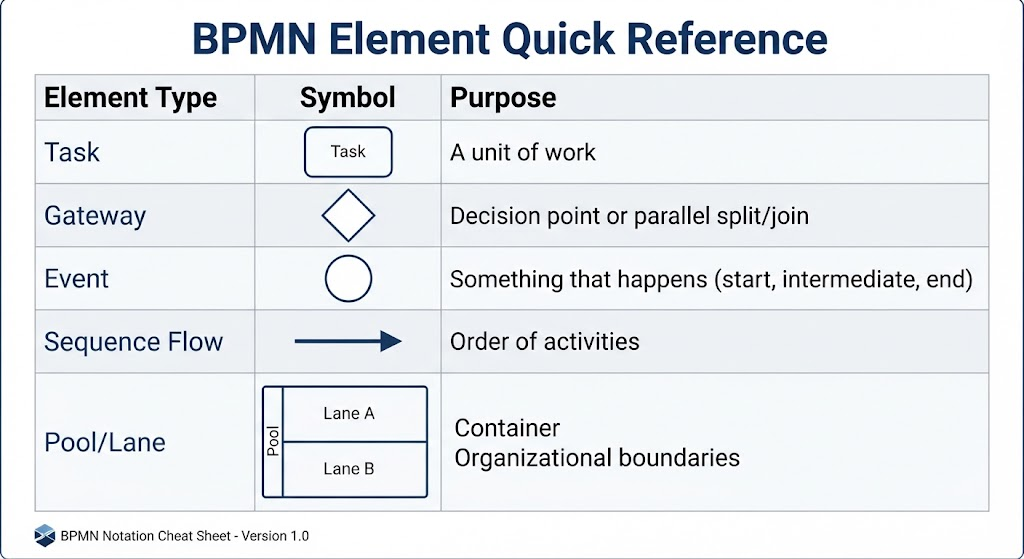
BPMN Element Quick Reference
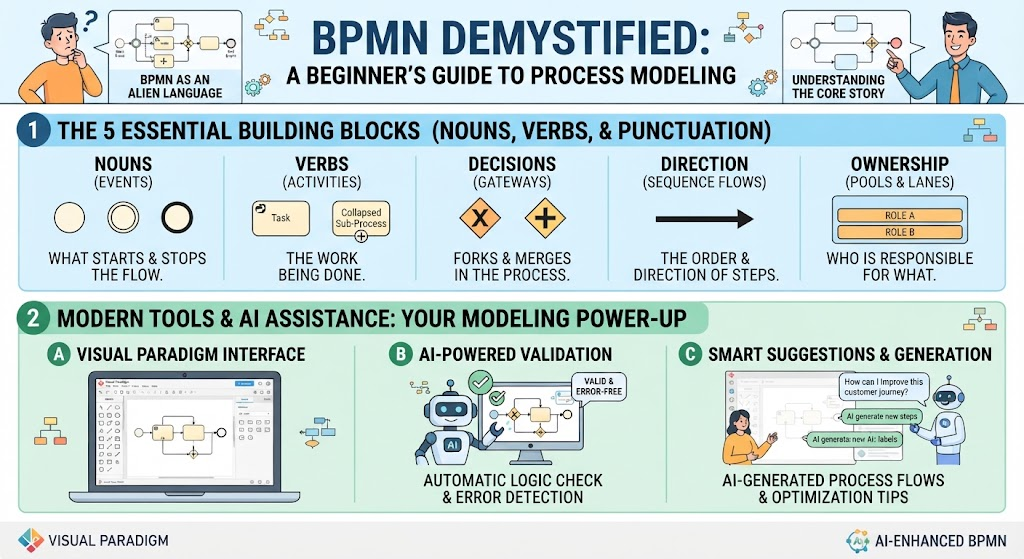
To build these models effectively, you must master the vocabulary of BPMN. Think of these elements as the grammar and syntax of the language. Below is a breakdown of the core components.
1. The Task: A Unit of Work
A Task represents the smallest unit of work within a process. It is an action that needs to be performed. In BPMN, this is depicted as a rounded rectangle.
- Symbol: Rounded Rectangle
- Purpose: Represents a specific activity or step, such as “Approve Loan” or “Send Email.”
2. The Gateway: The Decision Point
Processes are rarely linear; they involve branching logic. A Gateway controls the divergence and convergence of paths.
- Symbol: Diamond Shape
- Purpose: Acts as a decision point (e.g., “Is the credit score > 700?”) or a parallel split/join where multiple activities happen simultaneously.
3. The Event: Something That Happens
Events are the triggers and results of a process. They are depicted as circles and are categorized by their timing:
- Start Event: The trigger that initiates the process (e.g., “Order Received”).
- Intermediate Event: Something that occurs during the process (e.g., “Waiting for Payment”).
- End Event: The termination of the process (e.g., “Order Shipped”).
4. Sequence Flow: The Order of Activities
How do we connect the dots? Sequence Flow defines the order in which activities are performed.
- Symbol: Solid Arrow Line
- Purpose: Indicates the path from one activity to the next. It represents the direct sequence of control.
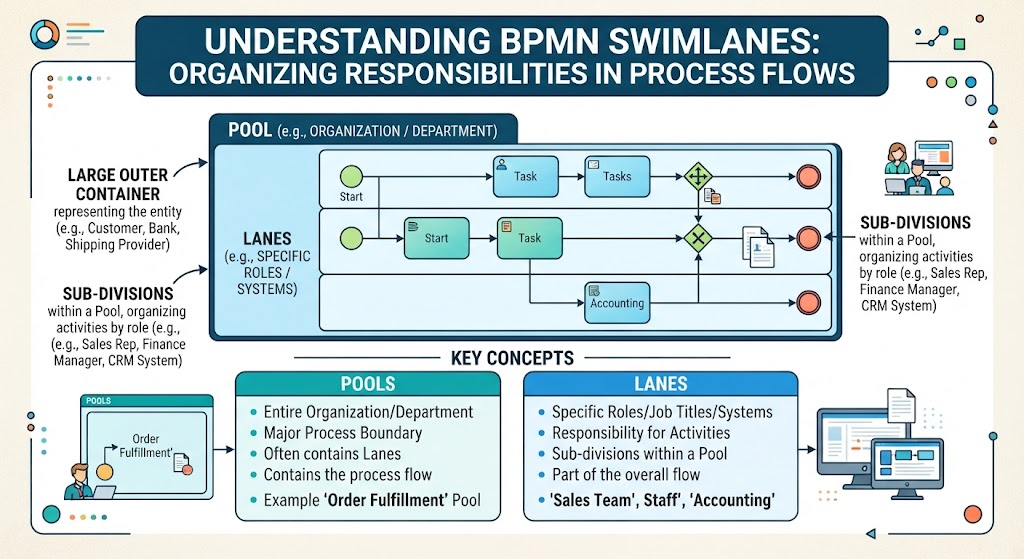
5. Pool and Lane: Organizational Boundaries
Processes often span across different departments or organizations. Pools and Lanes provide the structure to manage this complexity.
- Pool: Represents the overall container for a process (often a whole organization).
- Lane: A subdivision of a pool used to group activities by role, department, or system. For example, “Lane A” might be the Sales Department and “Lane B” the Logistics Department.
Recommended Tooling: Visual Paradigm BPMN
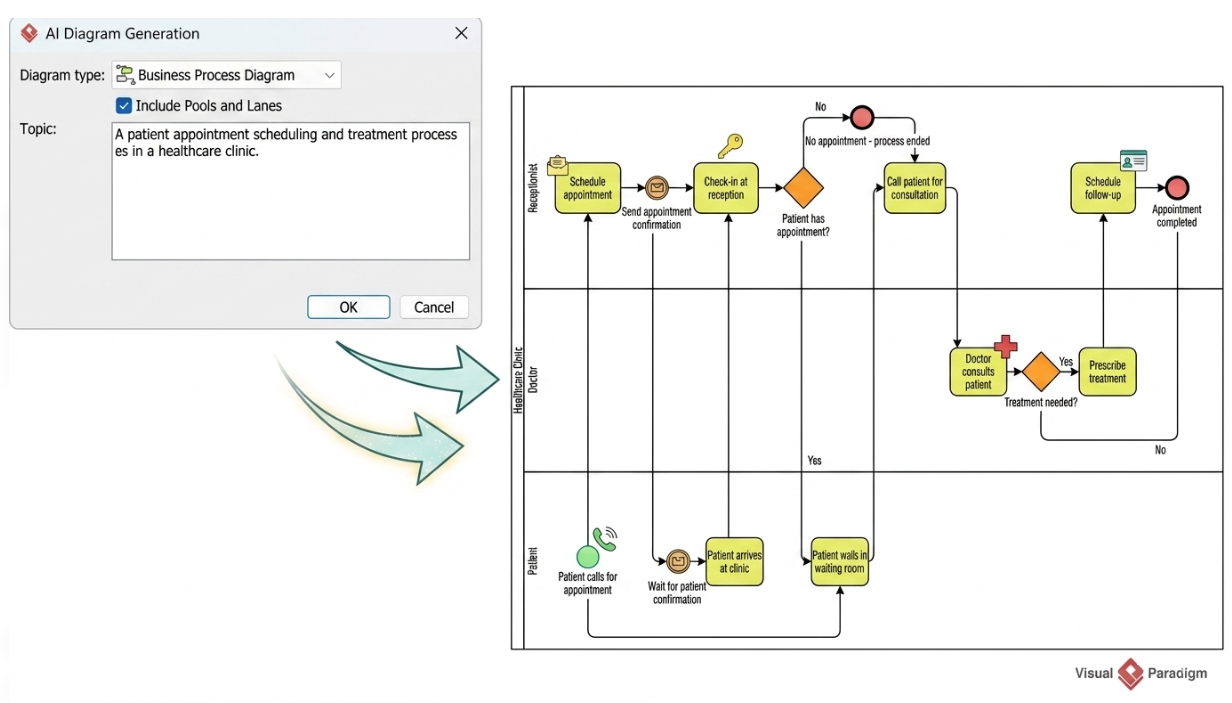
While you can draw BPMN models on paper, professional process modeling requires robust software that enforces the standards and allows for easy editing. For this tutorial, we highly recommend Visual Paradigm BPMN as the preferred tool for the modeling process.
Why Visual Paradigm?
- Standard Compliance: It strictly adheres to OMG specifications, ensuring your models are correct.
- Intuitive Interface: The drag-and-drop interface makes it easy to place Tasks, Gateways, and Events without getting bogged down in technical settings.
- Collaboration: It supports team collaboration, allowing multiple analysts to work on complex, multi-lane processes simultaneously.
Conclusion
By adhering to the principles of Clarity, Completeness, Correctness, and Purpose, and by mastering the core elements like Tasks, Gateways, and Pools, you can create professional-grade process models. Whether you are streamlining an internal workflow or defining a customer journey, a well-structured BPMN diagram is your most valuable asset.