Business Process Model and Notation (BPMN) has firmly established itself as the gold standard for visualizing business processes. However, despite its widespread adoption, many organizations struggle with models that are confusing, incomplete, or outright misleading. Poor BPMN modeling doesn’t just create documentation headaches—it leads to miscommunication between stakeholders, flawed automation implementations, and costly rework.
Whether you are a business analyst, process owner, or product manager, understanding these common pitfalls is crucial. This tutorial breaks down the five most frequent modeling errors visible in standard diagrams, explains why they matter, and demonstrates how to leverage modern tooling to create clear, actionable process diagrams.
1. The Five Cardinal Sins of BPMN Modeling
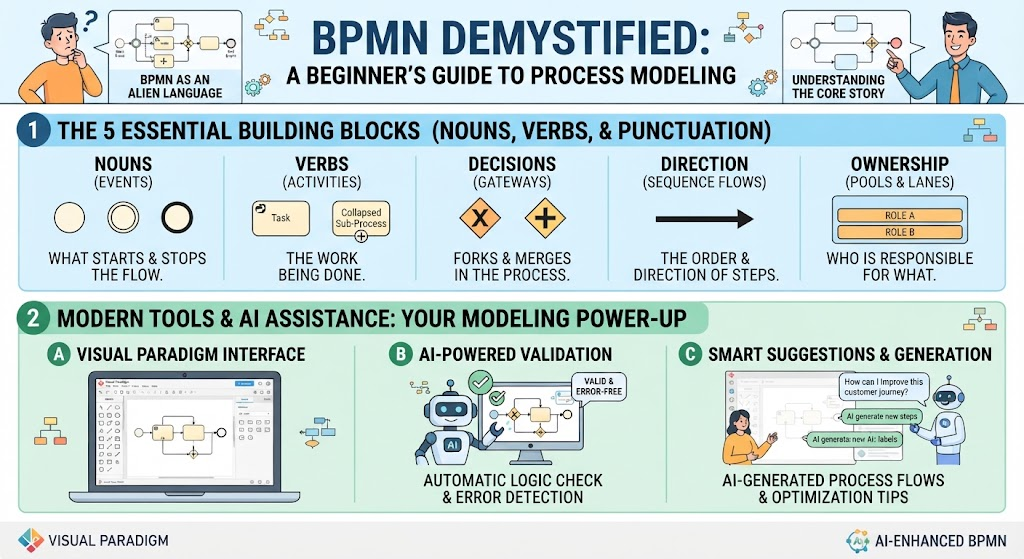
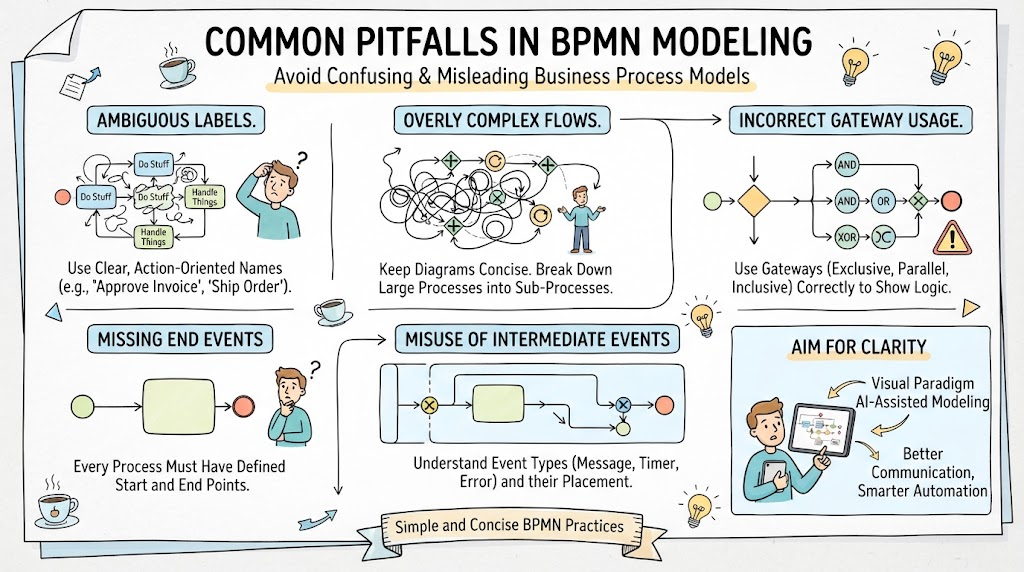
Before we can build a robust process, we must understand what breaks it. The diagram below highlights the most common areas where modelers lose clarity.
Ambiguous Labels
The most basic error is using vague labels for tasks. A process diagram should be self-explanatory. If you see a box labeled Do Stuff, the reader has no idea what is happening.
The Fix: Use clear, action-oriented names. Instead of “Do Stuff,” use specific verbs like “Approve Invoice” or “Ship Order”. This ensures that every stakeholder interprets the activity in the same way.
Overly Complex Flows
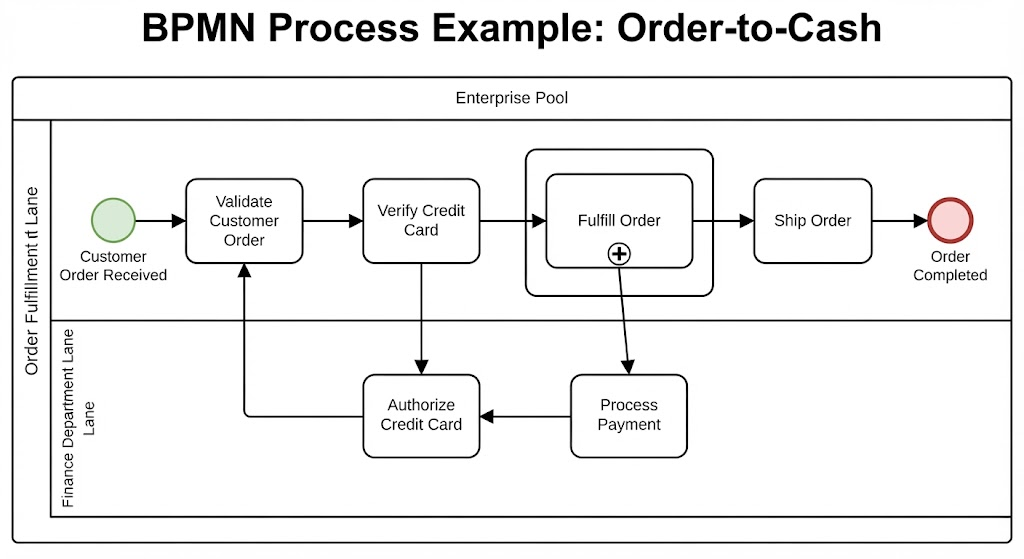
A common mistake is attempting to model an entire enterprise workflow on a single, massive diagram. The result is a “spaghetti diagram” where the flow is impossible to follow.
The Fix: Keep diagrams concise. If a process branch becomes too tangled, break it down into Sub-Processes. This modular approach allows you to drill down into details only when necessary, keeping the high-level view clean.
Incorrect Gateway Usage
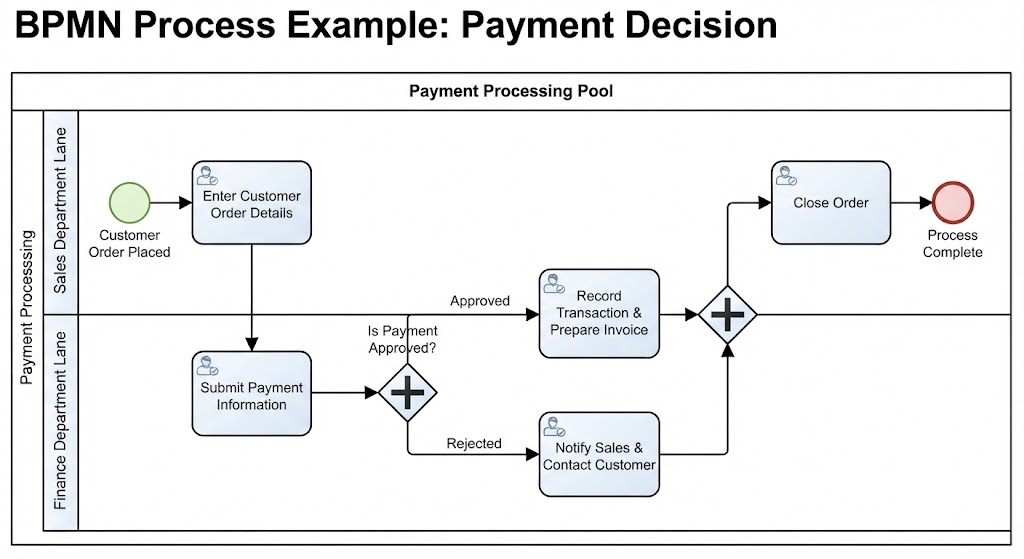
Gateways (diamonds) dictate the logic of a process. Misusing them leads to logic errors. For instance, using an Exclusive Gateway (XOR) when you need a Parallel Gateway (AND) will cause the process to stop or behave unpredictably.
The Fix: Use Gateways correctly to show logic. Ensure you are distinguishing between Exclusive (one path), Inclusive (one or more paths), and Parallel (all paths) gateways.
Missing End Events
A process without a conclusion is a dead end. Many models start strong with a Start Event but fail to define where the process actually finishes.
The Fix: Every process must have defined Start and End Points. Ensure that every path eventually leads to a proper End Event, signaling the successful completion of the business transaction.
Misuse of Intermediate Events
Intermediate events (circles inside a task) represent things happening during a task. A frequent error is placing them incorrectly or confusing their types.
The Fix: Understand event types and their placement. Are you waiting for a Timer? A Message? An Error? Placing a Timer event incorrectly can imply the process is waiting for time to pass when it should be waiting for a user input.
2. The Solution: Leveraging Visual Paradigm
While understanding the theory is essential, applying it correctly requires the right tools. As noted in the “Aim for Clarity” section of our reference material, modern AI-assisted modeling is a game-changer.
Why Visual Paradigm BPMN?
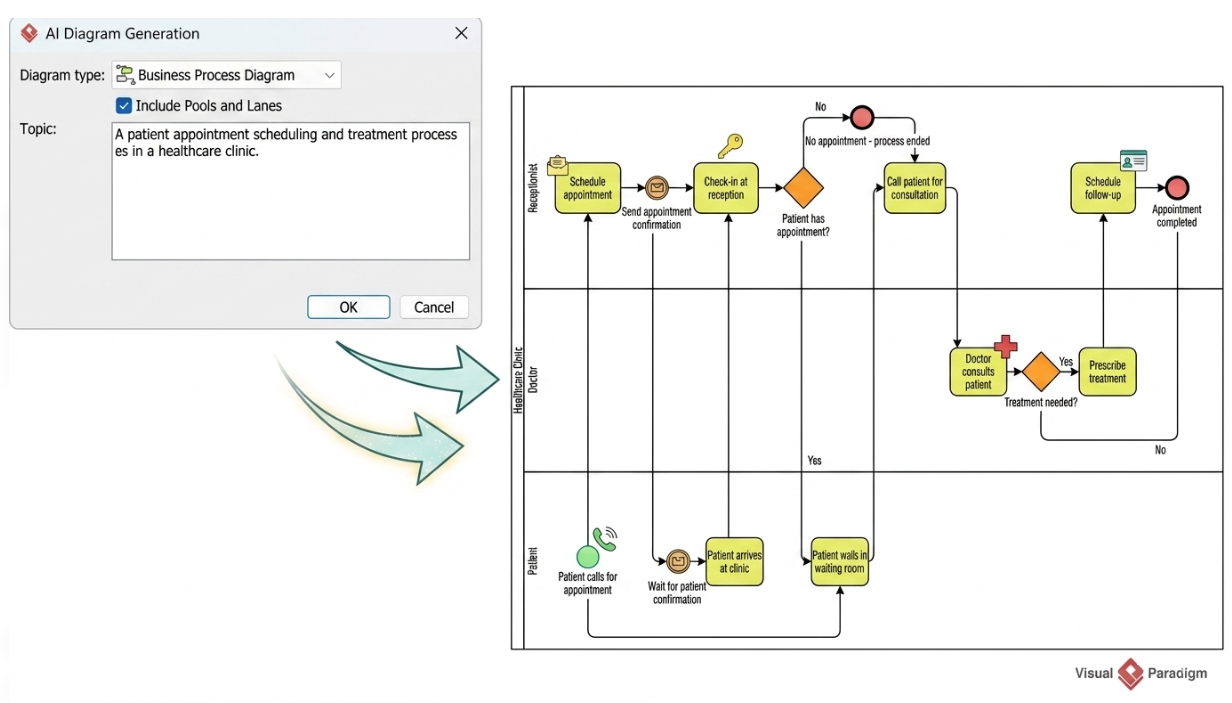
Visual Paradigm offers a suite of capabilities designed to prevent the errors listed above before they happen. By integrating AI-assisted modeling, the tool actively guides the user toward best practices.
- Automated Validation: The software can flag missing end events or ambiguous labels in real-time.
- Smart Decomposition: Tools within the platform help you manage complexity by easily creating sub-processes, preventing the “spaghetti” effect.
- Intelligent Gateways: The interface provides visual cues for gateway logic, reducing the risk of incorrect pathing.
By adopting Visual Paradigm, you move from reactive modeling (fixing errors after the fact) to proactive modeling (preventing errors during creation). This leads to better communication between stakeholders and smarter automation implementations.
Conclusion
Simple and concise BPMN practices are the key to success. By avoiding ambiguous labels, managing complexity, and using the right tooling, you can transform your process models from confusing sketches into powerful blueprints for business success.