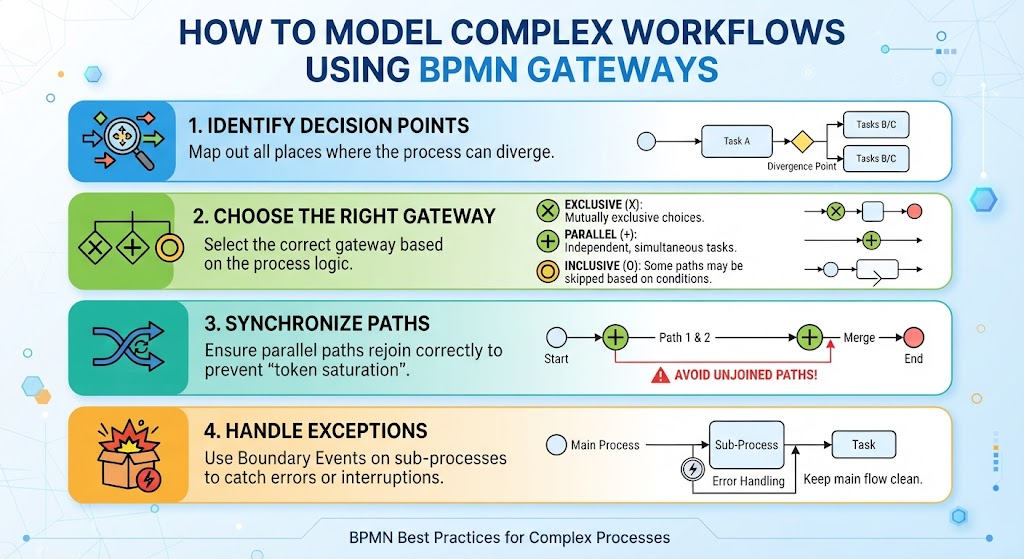
In the world of business process modeling, the difference between a confusing mess and a streamlined roadmap often comes down to how you handle logic. Business Process Model and Notation (BPMN) is powerful because it visually represents the flow of work, but its true strength lies in the Gateways. These symbols act as the traffic controllers of your process, deciding where the work goes next.
However, complex workflows often involve multiple decision points, parallel tasks, and potential errors. Without a solid strategy, your diagrams can become unmanageable. This tutorial breaks down the essential strategies for modeling complex workflows effectively, ensuring your processes are robust, clear, and executable.
1. Identify Decision Points: The Foundation of Logic
Before you even pick up your modeling tool, you must analyze the process flow. The first step in modeling complexity is to map out every single place where the process can diverge. Ask yourself: “Where does the next step depend on a specific condition or data value?”
Why this matters: If you miss a decision point, you might model a linear path where a branching logic is actually required, leading to unrealistic process simulations. Every diamond shape you draw represents a critical fork in the road for your business logic.
2. Choose the Right Gateway: Precision in Execution
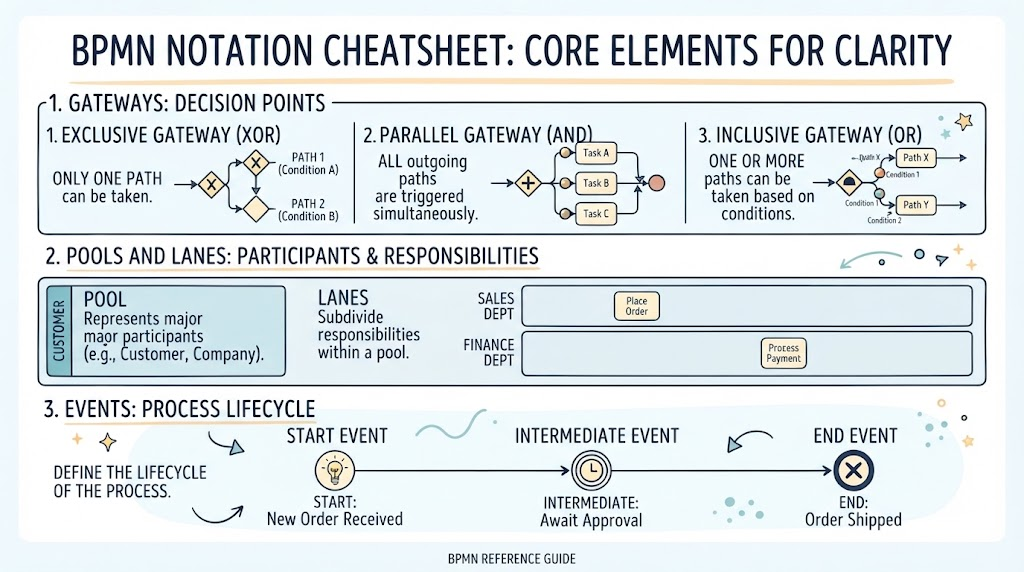
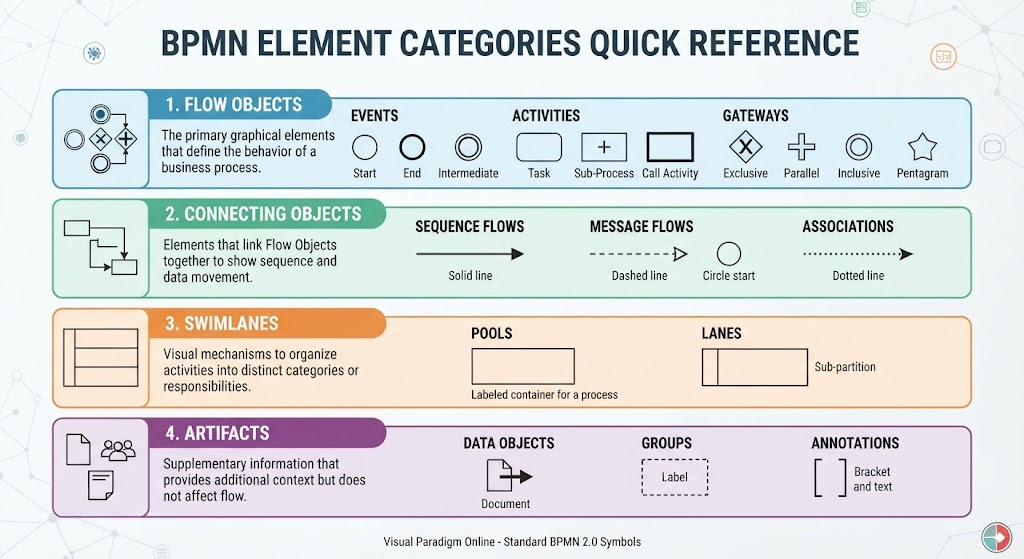
Once you have identified a decision point, the most common mistake is selecting the wrong gateway type. BPMN offers three primary gateways for different scenarios. Choosing the correct one is vital for the engine (or the human reader) to understand the intent.
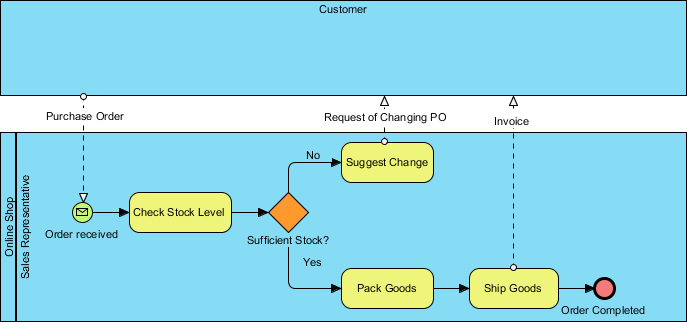
- Exclusive Gateway (XOR): Use this for mutually exclusive choices. This is like a traffic light: you can go left OR right, but not both. If one path is taken, the others are immediately discarded.
- Parallel Gateway (+): Use this for independent, simultaneous tasks. This splits the flow so that multiple tasks happen at the exact same time. It is a “fork” where every branch must be taken.
- Inclusive Gateway (OR): Use this when some paths may be skipped based on conditions. Unlike the Exclusive gateway, multiple paths can be active at once if the conditions allow, but others might not be triggered at all.
3. Synchronize Paths: Preventing “Token Saturation”
Parallelism is powerful, but it introduces a specific risk: what happens when the paths come back together? You must ensure that parallel paths rejoin correctly. This is known as synchronization.
The Danger of Unjoined Paths: If you split a process into two parallel streams but fail to merge them back into a single stream before proceeding, you risk “token saturation.” In BPMN terminology, a “token” represents the active thread of the process. If tokens get stuck in unjoined parallel paths, the process instance may never complete, or the system may crash due to resource exhaustion.
Always use a matching Gateway to merge the flows. If you used a Parallel Gateway to split, you generally need a Parallel Gateway to join, ensuring all active paths have finished before the process moves forward.
4. Handle Exceptions: Keeping the Main Flow Clean
Real-world processes rarely go 100% smoothly. Errors happen, interruptions occur, and timeouts are inevitable. A common pitfall is cluttering the main process flow with error-handling logic (like “if email fails, do X”).
The Solution: Boundary Events Instead of cluttering the main line, use Boundary Events attached to sub-processes. These events act as safety nets.
- Isolation: The main flow remains clean and focused on the happy path.
- Responsiveness: If an error occurs, the boundary event catches it immediately and diverts the flow to a specific error-handling sub-process.
- Clarity: This keeps the logic readable; stakeholders can see the main process at a glance while knowing there is a dedicated mechanism for handling failures.
Conclusion: From Documentation to Improvement
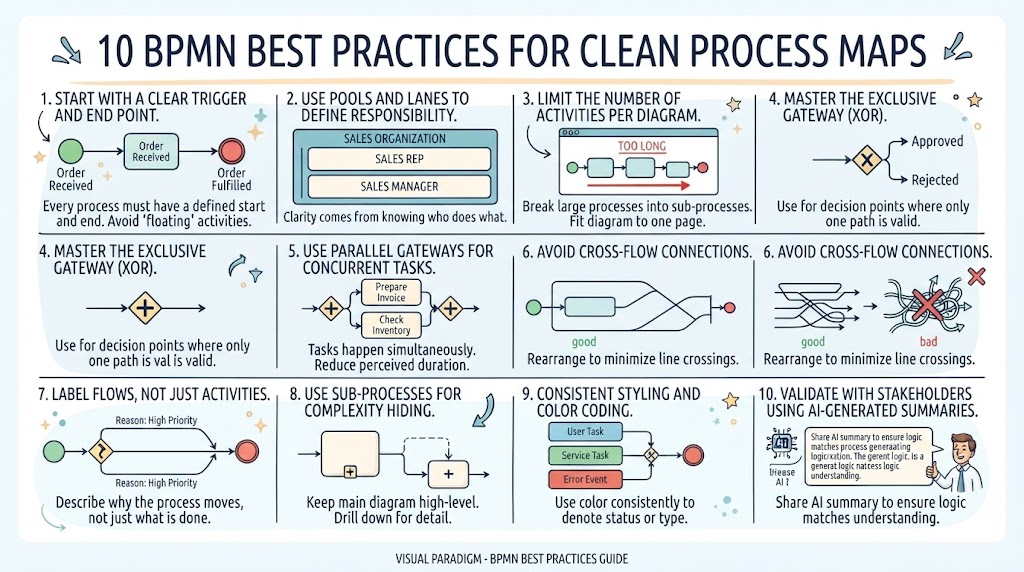
Creating clean, effective BPMN diagrams is not just about drawing boxes and arrows; it is about communicating logic clearly. By adhering to these best practices—identifying decision points, choosing the right gateways, synchronizing paths, and handling exceptions—you transform complex workflows into understandable, actionable maps.
Remember, the goal of BPMN is not just documentation, but improvement. A clear diagram reveals inefficiencies, ambiguities, and opportunities for automation. Start small, validate often, and let your diagrams evolve with your processes.