


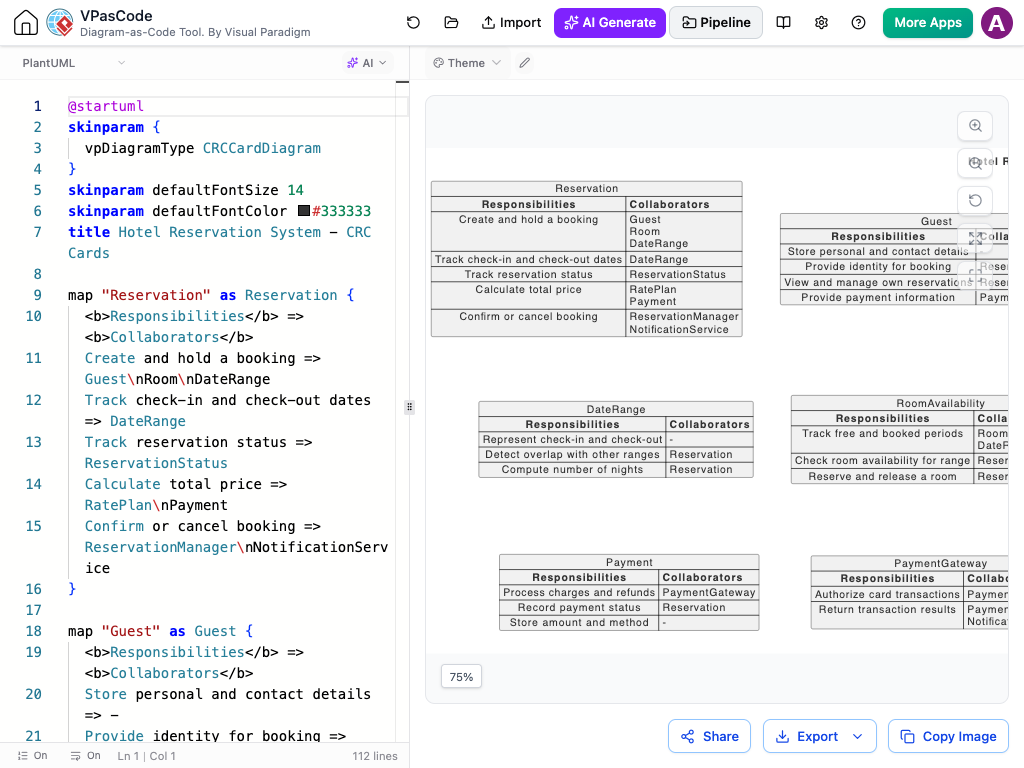
In the realm of software architecture, few tools offer the same balance of simplicity and structural rigor as the CRC Card (Class-Responsibility-Collaborator) diagram. Originally a physical exercise involving index cards and whiteboards, the CRC methodology has evolved into a critical digital asset for modern development teams.
This tutorial explores how to implement CRC Card Diagrams using VPasCode, a code-as-diagram tool by Visual Paradigm. We will analyze the architecture of a Hotel Reservation System, breaking down the modeling concepts, syntax rules, and strategic benefits of this approach.
Understanding the CRC Methodology
A CRC Card is a lightweight modeling technique used to outline object-oriented domain models before a single line of implementation code is written. It forces the designer to focus on three core areas for every class:
- Class: Represents a key object, component, or entity in your application domain (e.g.,
Guest,Room,Reservation). - Responsibilities: High-level duties, behaviors, knowledge, or obligations managed by the class. These answer the question: “What does this class know or do?”
- Collaborators: Other classes required to fulfill those responsibilities. These answer the question: “Who does this class work with to get the job done?”
Why Use VPasCode for CRC Modeling?
While traditional CRC modeling relies on physical cards that are difficult to version control or maintain over time, VPasCode bridges the gap between rapid brainstorming and professional documentation. By leveraging PlantUML, VPasCode allows you to define your architecture in code, ensuring that your diagrams are:
- Versionable: Changes to your system architecture are tracked via Git or other version control systems.
- Readable: The syntax clearly separates responsibilities from collaborators.
- Integratable: Diagrams can be embedded into documentation pipelines or exported to tools like OpenDocs and NotesKeep.
Core Syntax and Structure
To create a CRC Card Diagram in VPasCode, you utilize a specialized skinparam configuration combined with the map keyword. The structure is intuitive: you define a map for each class, and inside the map, you list responsibilities and their corresponding collaborators.
The following code snippet demonstrates the fundamental setup required to render a CRC diagram:
@startuml
skinparam {
  vpDiagramType CRCCardDiagram
}
skinparam defaultFontSize 14
skinparam defaultFontColor #333333
title Hotel Reservation System - CRC Cards

map "Reservation" as Reservation {
  Responsibilities => Collaborators
  Create and hold a booking => Guest
Room
DateRange
  Track check-in and check-out dates => DateRange
  Track reservation status => ReservationStatus
  Calculate total price => RatePlan
Payment
  Confirm or cancel booking => ReservationManager
NotificationService
}

map "Guest" as Guest {
  Responsibilities => Collaborators
  Store personal and contact details => -
  Provide identity for booking => Reservation
  View and manage own reservations => ReservationManager
  Provide payment information => Payment
}
Case Study: The Hotel Reservation System
The following example illustrates a comprehensive model for a Hotel Reservation System. This system is broken down into logical entities, each with clearly defined boundaries.
1. The Core Transaction Entity: Reservation
The Reservation class acts as the central hub for booking logic. Its responsibilities include holding the booking data, tracking dates, and calculating prices. Notice how it collaborates with Guest, Room, and RatePlan to fulfill these duties.
2. The Domain Entities: Guest and Room
Guest: Focuses on identity and personal details. It relies on Reservation to manage bookings and Payment for financial transactions.
Room: Represents the physical asset. It collaborates with RoomType for attributes and DateRange to manage availability.
3. Supporting Logic: DateRange and Availability
Complex logic, such as date overlap detection and room availability checking, is offloaded to specialized classes like DateRange and RoomAvailability. This separation of concerns prevents the main Room class from becoming bloated.
map "DateRange" as DateRange {
  Responsibilities => Collaborators
  Represent check-in and check-out => -
  Detect overlap with other ranges => Reservation
  Compute number of nights => Reservation
}

map "RoomAvailability" as RoomAvailability {
  Responsibilities => Collaborators
  Track free and booked periods => Room
DateRange
  Check room availability for range => Reservation
  Reserve and release a room => ReservationManager
}
Advanced Features: Visualizing Relationships
One of the most powerful aspects of the VPasCode implementation is the ability to show the overall system structure without cluttering the individual cards. By using hidden arrows, you can map the high-level dependencies of the system.
For instance, the following lines establish the structural flow of the application:
Reservation -[hidden]right-> Guest
Guest -[hidden]right-> Room
Room -[hidden]right-> RoomType
Reservation -[hidden]down-> DateRange
Room -[hidden]down-> ReservationManager
ReservationManager -[hidden]right-> RatePlan
This “map” approach allows you to visualize the system architecture (the “map”) while maintaining the detailed logic of the CRC cards (the “content”).
Best Practices for CRC Modeling
- Identify Architecture Flaws Early: If a class has too many collaborators or responsibilities, it is likely a violation of the Single Responsibility Principle (SRP). Use CRC cards to spot “bloated classes” before writing implementation code.
- Use AI for Acceleration: VPasCode integrates with Visual Paradigm’s AI capabilities. You can generate initial CRC structures from natural language descriptions to speed up the design phase.
- Maintain Clean Syntax: Use the
Conclusion
The CRC Card Diagram remains one of the most effective tools for domain-driven design. It shifts the focus from implementation details to functional behavior, ensuring that the architecture serves the business logic.
By adopting VPasCode for your CRC modeling, you gain the flexibility of code-based documentation combined with the visual clarity of diagramming. Whether you are refactoring legacy systems or designing new microservices, this approach helps you identify structural flaws early and maintain a clean, modular architecture.
Recommended Tooling: For professional-grade CRC modeling that integrates seamlessly with modern DevOps pipelines, the recommended tooling is Visual Paradigm CRC Card via the VPasCode platform.