


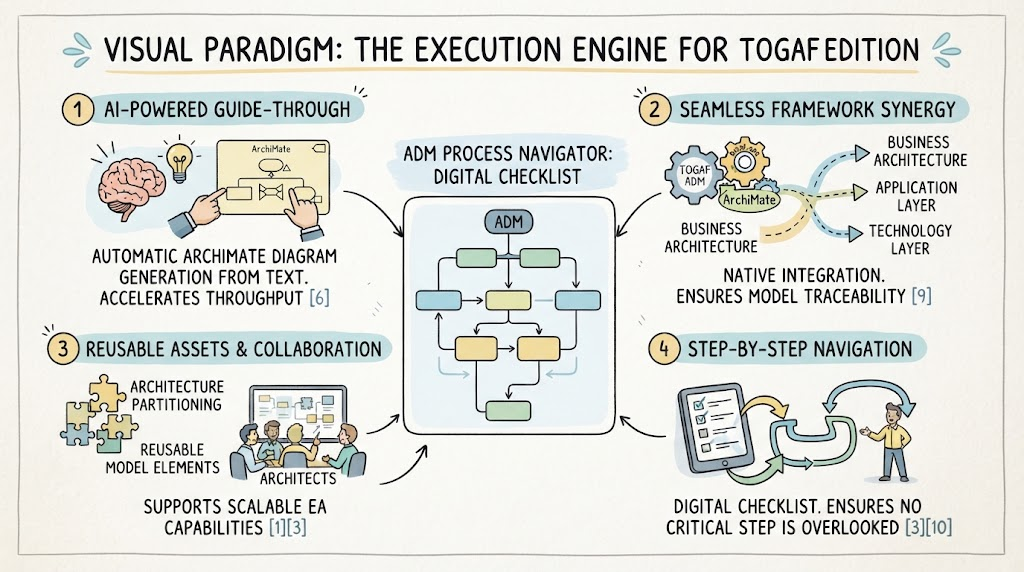
In the evolving landscape of Enterprise Architecture (EA), the TOGAF 10th Edition series guides have set a high standard for the what (the content) and the why (the purpose). However, for architects on the ground, the critical question remains: how do we execute these standards effectively in a real-world environment? This is where the concept of the “Execution Engine” comes into play. By leveraging specialized tooling like Visual Paradigm, organizations can transform theoretical frameworks into actionable, digital realities.
This tutorial explores the integration of the TOGAF ADM, ArchiMate modeling, and Visual Paradigm to create a robust, scalable, and traceable Enterprise Architecture process.
The Core Challenge: Bridging the “How” Gap
Traditional EA processes often suffer from disconnection. The architectural strategy defined in the ADM cycles can become siloed from the actual implementation details. Visual Paradigm addresses this by acting as a central hub that unifies these disciplines. It provides a digital environment where the abstract requirements of the TOGAF Series Guides are mapped directly to executable models.
Feature Spotlight 1: AI-Powered Guide-Through
One of the most significant advancements in modern EA tooling is the integration of Artificial Intelligence. In the context of Visual Paradigm, this capability transforms how architects interact with the ArchiMate standard.
- Automatic Diagram Generation: Instead of manually dragging and dropping shapes to create complex diagrams, the system can generate ArchiMate diagrams directly from text descriptions. This lowers the barrier to entry for non-specialists.
- Accelerated Throughput: By automating the initial drafting of models, senior architects can focus their time on high-level strategy and refinement rather than diagrammatic mechanics.
Feature Spotlight 2: Seamless Framework Synergy
A common pitfall in EA is the loss of traceability between different architectural layers. When Business, Application, and Technology architectures are built in isolation, the connection to the business value is lost.
Visual Paradigm solves this through Native Integration:
- Unified Model Repository: Models created for the Business Architecture layer are automatically linked to the Application and Technology layers.
- Traceability: This ensures that every technical decision can be traced back to a specific business requirement, adhering strictly to the traceability mandates found in the Practitioners’ Approach guide.
Feature Spotlight 3: Reusable Assets & Collaboration
Scalability is a major requirement for modern Enterprise Architecture. The Leader’s Guide emphasizes the need for scalable capabilities, which requires more than just a single team working in a silo.
Visual Paradigm supports this through:
- Architecture Partitioning: Large enterprise models can be broken down into manageable partitions, allowing different teams to work on specific domains without conflict.
- Reusable Model Elements: Architects can create a library of standard components that can be reused across projects, ensuring consistency and reducing redundancy.
Feature Spotlight 4: The ADM Process Navigator
The Architecture Development Method (ADM) is a complex, iterative cycle. It is easy to miss a critical step, especially when dealing with complex iterations. To combat this, Visual Paradigm offers the ADM Process Navigator.
This feature acts as a Digital Checklist for your architecture project:
- Step-by-Step Guidance: It guides the architect through the ADM phases, ensuring that all inputs, outputs, and gateways are addressed.
- Quality Assurance: By enforcing the process flow, it ensures that no critical step from the TOGAF Series Guides is overlooked during the development of the architecture.
Conclusion
By integrating Visual Paradigm with TOGAF 10 and ArchiMate, organizations move beyond static documentation to dynamic, living architectures. The combination of AI assistance, seamless layer integration, collaborative partitioning, and process navigation ensures that the “How” of Enterprise Architecture is as robust as the “What” and “Why.”
References
- Visual Paradigm TOGAF ADM Tool: Empowering Your Enterprise Architecture Teams: An overview of how Visual Paradigm’s TOGAF ADM tool boosts EA team productivity with an intuitive interface, collaboration features, and reusable model elements.
- Streamline Your Enterprise Architecture with Visual Paradigm’s TOGAF ADM Tools: Explains the visual flowchart that guides users through ADM phases and introduces the integrated toolset including ArchiMate support, radar charts, and task management.
- Comprehensive Guide for Using TOGAF ADM with Visual Paradigm: A detailed guide covering how to apply ADM iteration strategies, architecture partitioning, and leverage Visual Paradigm’s ADM Process Navigator and Deliverable Composer .
- Using the TOGAF ADM Guide-Through Process in Visual Paradigm: A practical walkthrough of the ADM Guide-Through process with concrete examples for phases like Business Architecture, Gap Analysis, and Migration Planning .
- Traditional vs AI-Enhanced TOGAF Workflow Comparison: A side-by-side comparison demonstrating 50-80% time savings and 80-95% reduction in diagramming effort when using Visual Paradigm’s AI-enhanced workflow over traditional manual methods .
- What’s New: AI-Powered TOGAF ADM in Visual Paradigm | 2026 Update: Introduces the 2026 AI enhancements to the TOGAF Guide-Through, including automatic ArchiMate diagram generation, smart radar charts, and intelligent gap analysis .
- TOGAF ADM Guide-Through: A Case Study on AI-Powered TOGAF ADM Implementation: A real-world case study exploring AI-powered TOGAF ADM implementation with detailed coverage of features like the Deliverable Composer, Shape Legend, and Model Extractor .
- AI-Powered TOGAF ADM Guide-Through: Coffee Shop Digital Evolution: A hands-on tutorial showing how to use AI to generate ArchiMate diagrams from natural language descriptions, moving from manual drawing to AI-assisted modeling .
- Mastering Enterprise Architecture with ArchiMate and TOGAF: The Visual Paradigm Advantage: Explains the synergy between TOGAF and ArchiMate, and how Visual Paradigm’s seamless integration of both frameworks creates a powerful EA environment .
- Comprehensive TOGAF ADM Tutorial: A Step-by-Step Guide: A step-by-step tutorial covering the full TOGAF ADM lifecycle, phase objectives, and the integration of ArchiMate with ADM phases .
Related posts:
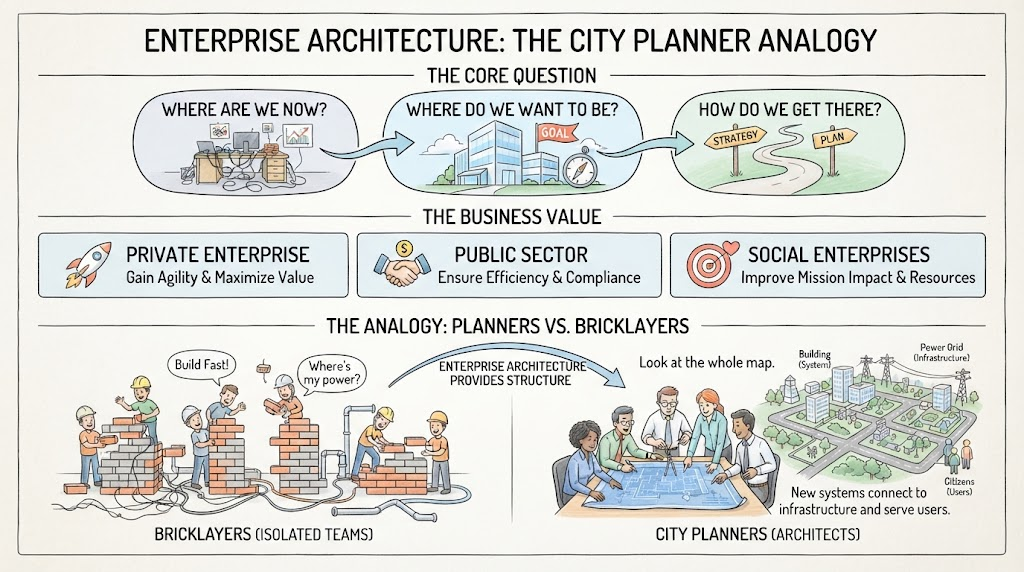 Mastering Enterprise Architecture: The City Planner Analogy and Strategic Roadmapping
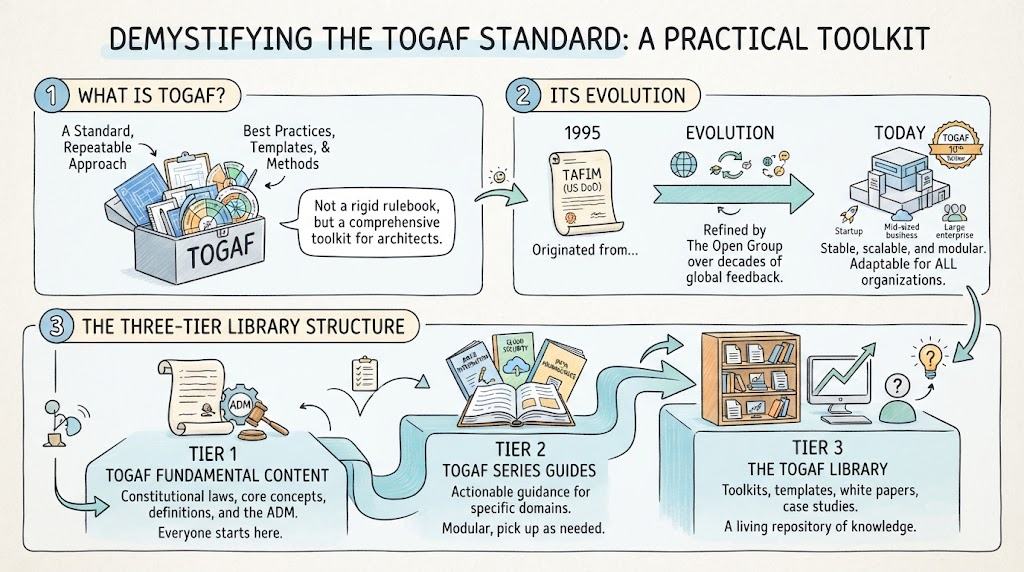 Demystifying the TOGAF Standard: A Practical Toolkit for Modern Enterprise Architecture
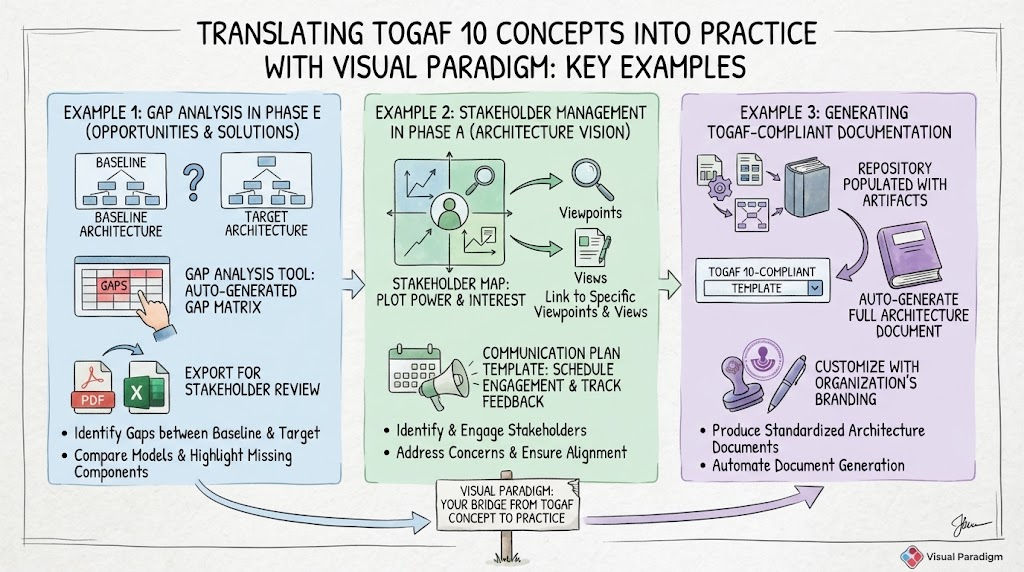 Mastering TOGAF 10 Implementation: A Visual Paradigm Tutorial on Architecture, Stakeholder Management, and Documentation
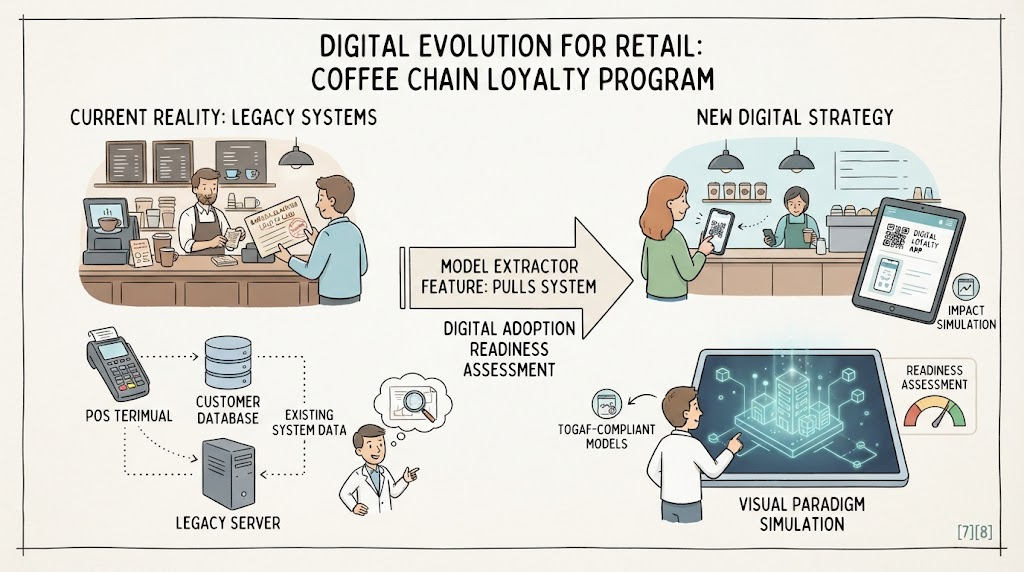 Digital Evolution for Retail: Architecting the Coffee Chain Loyalty Transformation Using TOGAF