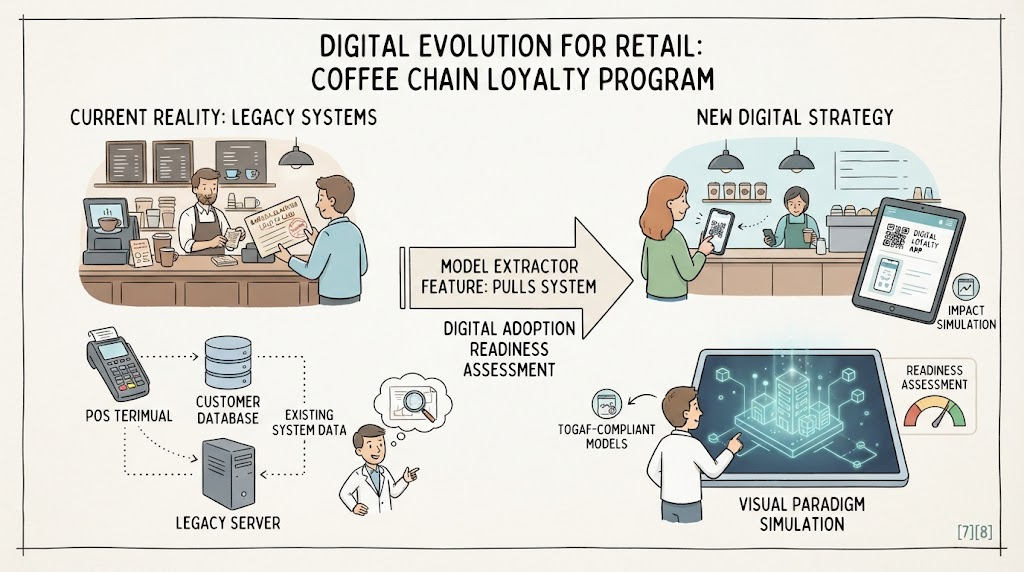
In the modern retail landscape, legacy systems often act as anchors, holding businesses back from the agility required to compete in the digital age. This tutorial explores a pivotal scenario in Enterprise Architecture: the Digital Evolution of a Coffee Shop Chain’s Loyalty Program. We will deconstruct the architectural workflow depicted in the scenario, moving from a fragmented “Current Reality” to a streamlined “New Digital Strategy” using the Visual Paradigm ecosystem and the TOGAF ADM framework.
The Challenge: Bridging the Gap Between Legacy and Digital
Imagine a coffee chain struggling with its customer loyalty program. Currently, the system relies on physical cards and disparate data sources. The architecture diagram illustrates this “Current Reality” on the left side. It is characterized by:
- Point of Sale (POS) Terminals: The physical interface where transactions occur.
- Customer Databases: Siloed data repositories.
- Legacy Servers: Older infrastructure that supports these operations but lacks modern API capabilities.
The problem is clear: the customer experience is disjointed, and data is trapped within the “Legacy Server” and “Customer Database.” The transition to a digital-first strategy requires a methodical approach to ensure that new technologies are integrated smoothly without disrupting the existing business logic.
The Architectural Bridge: Model Extraction & Assessment
The core of the solution lies in the central process highlighted in the diagram: the Model Extractor Feature and the Digital Adoption Readiness Assessment. In Enterprise Architecture, you cannot build a new future without a precise map of the present. This is where the “Model Extractor” becomes a critical tool.
1. Pulling Existing System Data
Instead of manually documenting the legacy infrastructure, the Model Extractor automates the process of reverse-engineering the current environment. It pulls data from the POS terminals, databases, and servers to create a living representation of the “As-Is” architecture. This ensures that the architect’s understanding is grounded in current reality rather than aspirational fiction.
2. Generating TOGAF-Compliant Models
Once the data is extracted, it is formatted into TOGAF-compliant models. TOGAF (The Open Group Architecture Framework) provides a standardized language for describing enterprise architecture. By converting raw system data into these compliant models, architects can:
- Ensure consistency across different departments.
- Visualize the impact of changes before they happen.
- Create a blueprint that is universally understood by stakeholders and developers.
The Outcome: Simulation and Readiness
The right side of the diagram depicts the “New Digital Strategy.” Here, the physical loyalty card is replaced by a mobile app, and the backend is modernized. The transition is not a guess; it is the result of a rigorous simulation process.
Impact Simulation
Using the Visual Paradigm simulation capabilities, architects can test the new digital stack against the extracted legacy models. This allows the team to answer critical questions: Will the new API handle the load? How does the mobile app integrate with the existing database?
Readiness Assessment
The final output of this workflow is a Readiness Assessment. This acts as a dashboard metric, indicating whether the organization is ready to deploy the new digital strategy. It moves the decision-making process from intuition to data-driven confidence.
Recommended Tooling: Visual Paradigm + TOGAF ADM + ArchiMate
To replicate this digital evolution process, specific tooling is required to bridge the gap between technical reality and strategic planning. The combination of Visual Paradigm, the TOGAF ADM (Architecture Development Method), and ArchiMate creates a powerful synergy for the EA process.
Why This Stack Works
- Visual Paradigm as the Canvas:
Visual Paradigm serves as the central hub. Its Model Extractor feature is the engine that ingests the messy reality of the legacy systems (as seen in the POS and Server icons). It automates the heavy lifting of data collection, which is essential for accurate modeling.
- TOGAF ADM as the Process:
The TOGAF ADM provides the structured lifecycle. In the context of this tutorial, the ADM phases (specifically Phase A: Architecture Vision and Phase B: Business Architecture) guide the team on why they are moving to a digital strategy. The ADM ensures that the “Model Extractor” data is used to define the baseline architecture before designing the target state.
- ArchiMate as the Language:
ArchiMate is the modeling language used to visualize the architecture. It allows architects to map the “Application Layer” (the new mobile app) against the “Business Layer” (the loyalty program) and the “Data Layer” (the customer database). This layered approach ensures that the new digital strategy is technically sound and business-aligned.
How It Helps in the EA Process
By integrating these three elements, Enterprise Architects can move beyond static diagrams. They can simulate the Digital Evolution dynamically. The workflow moves from Extraction (Visual Paradigm) to Analysis (TOGAF ADM) to Visualization (ArchiMate), resulting in a robust, actionable digital strategy that transforms the coffee shop from a legacy operation into a modern digital retailer.