


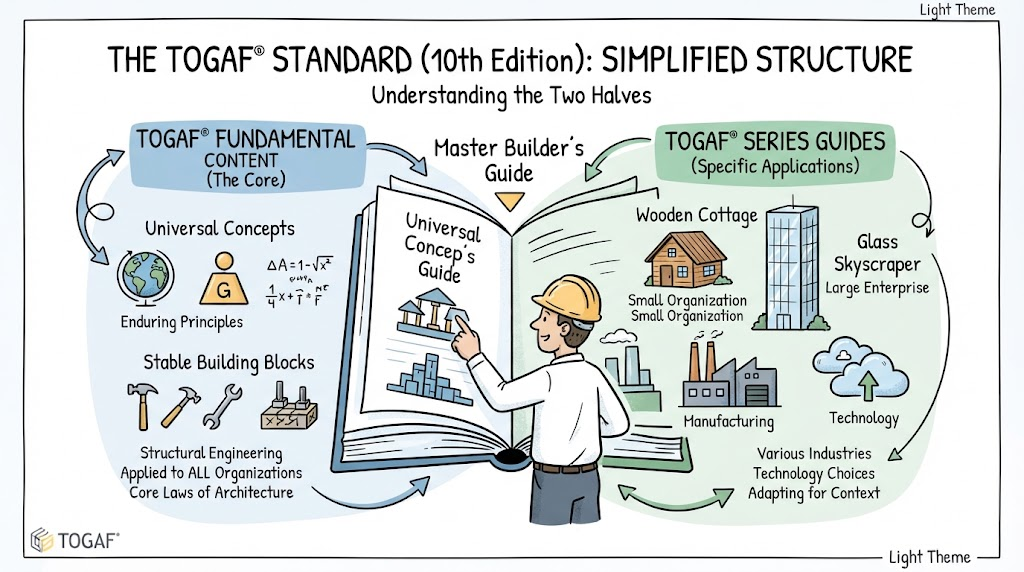
When you first open the TOGAF Standard (10th Edition), the sheer volume of documents can feel overwhelming. You are presented with a massive library of content, but the key to mastering the standard is understanding that it is not a monolith. It is split into two distinct but complementary halves: the TOGAF Fundamental Content and the TOGAF Series Guides.
To navigate this effectively, we must look at the system architecture of the standard itself. We can use a powerful analogy: if the TOGAF Standard were a Master Builder’s Guide, the Fundamental Content represents the core laws of physics, structural engineering, and standard tool definitions. Just as gravity acts the same way whether you are building a wooden cottage or a massive glass skyscraper, the concepts in the Fundamental Content are stable, enduring, and universally applicable to all organizations.
The First Half: TOGAF Fundamental Content (The Core)
Imagine the Fundamental Content as the “Universal Concepts Guide.” This section contains the Enduring Principles of enterprise architecture. It is the “core laws of architecture” that apply regardless of the specific industry or technology stack you are using.
1. Universal Concepts & Enduring Principles
Just as a structural engineer knows that load-bearing walls are necessary regardless of whether the building is residential or commercial, the Fundamental Content provides the Stable Building Blocks. These include:
- Core Laws of Architecture: Fundamental rules that govern how an organization is structured.
- Universal Concepts: Definitions and concepts that are consistent across all contexts.
- Structural Engineering: The methodology applied to all organizations.
This is the “physics” of the TOGAF Standard. It does not change based on whether you are a small startup or a massive multinational corporation.
The Second Half: TOGAF Series Guides (Specific Applications)
If the Fundamental Content is the physics, the TOGAF Series Guides are the specific blueprints for different types of buildings. This section is all about Adapting for Context. It addresses the specific needs of different industries, sizes, and technology choices.
2. Context-Specific Applications
The Series Guides allow you to take the core laws and apply them to real-world scenarios. The diagram illustrates this with two distinct building types:
The “Wooden Cottage” (Small Organization)
This represents smaller, perhaps less complex organizations. The Series Guides provide specific advice on how to apply TOGAF principles without over-engineering the architecture. It’s about efficiency and agility for a “Small Organization.”
The “Glass Skyscraper” (Large Enterprise)
This represents a massive, complex enterprise. Here, the Series Guides help navigate the complexities of a “Large Enterprise,” where scale, global reach, and intricate technology choices are the norm.
3. Adapting to Industries and Technology
The Series Guides also cover specific verticals. Whether you are in Manufacturing or relying on Cloud Technology, the Guides provide the necessary context to apply the core concepts correctly. They ensure that the “Master Builder” knows how to adapt their tools for a factory floor versus a cloud-native data center.
How to Use This System Architecture
To effectively use TOGAF, you must understand the relationship between these two halves. You do not choose one over the other; you use them together.
- Start with the Core: Always begin by understanding the Fundamental Content. These are the stable, universal concepts that will never go out of style. They are the foundation of your architectural practice.
- Apply the Guides: Once you understand the core, turn to the TOGAF Series Guides. Select the guide that matches your organization’s context (e.g., Industry, Size, Technology).
- Integrate: The arrows in the diagram show a continuous loop. You apply the core to the specific context, and the specific context informs how you use the core. This is the “Master Builder’s Guide” in action.
By recognizing that the TOGAF Standard is split into these two halves, you can move past the feeling of being overwhelmed. You now have a clear map: the Fundamental Content provides the unchanging laws, and the Series Guides provide the specific instructions for your unique building project.
Related posts:
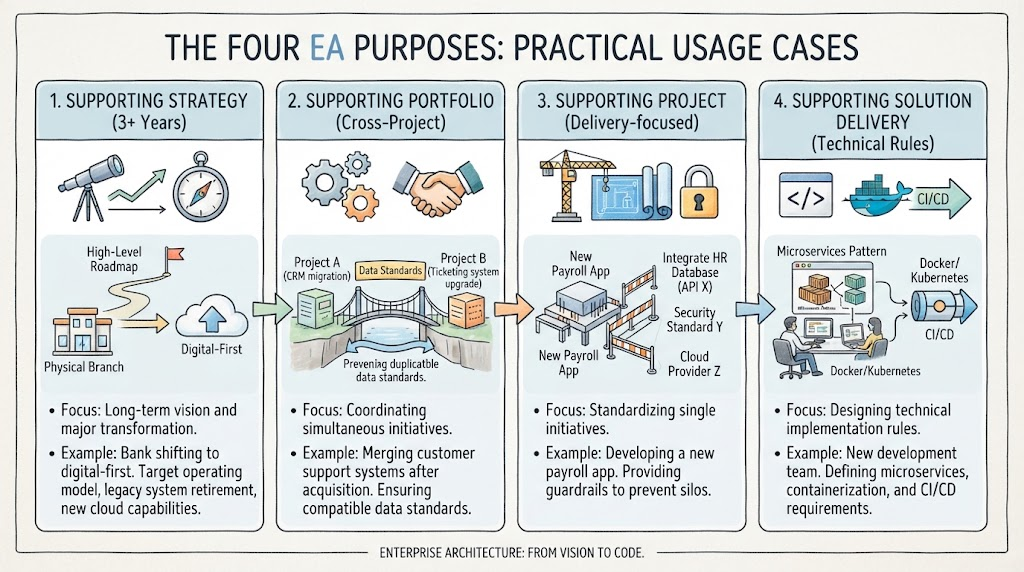 Mastering Enterprise Architecture: A Step-by-Step Guide to the Four Core Purposes
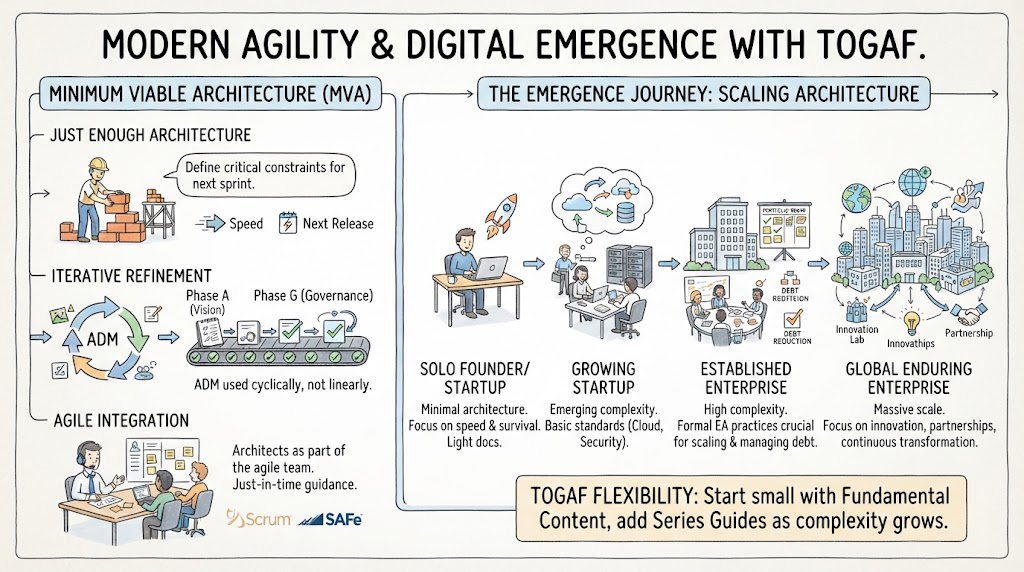 Mastering Modern Agility: A Tutorial on Minimum Viable Architecture and the Digital Emergence Journey
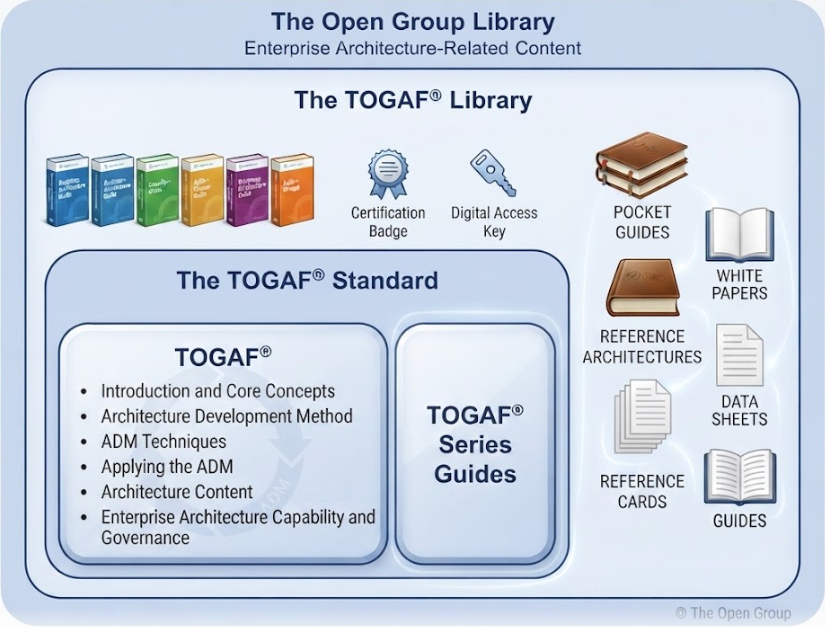 Mastering TOGAF 10: Navigating the Modular Library and Architecture Content
 Mastering Modularity: How TOGAF 10 Solves the “Massive Book Problem” with Strategic Flexibility