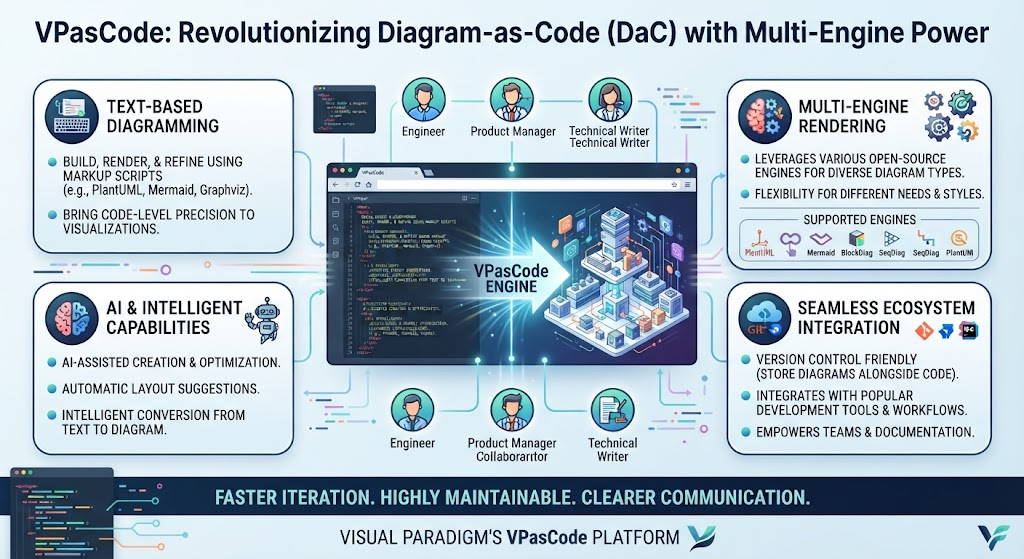
In the rapidly evolving landscape of software architecture and product management, the gap between high-level conceptualization and code-level precision is often bridged by documentation. However, traditional diagramming tools can become bottlenecks, especially when maintaining visual assets alongside source code. Enter VPasCode, Visual Paradigm’s browser-based, multi-engine Diagram-as-Code (DaC) platform. This article explores the system architecture and technical concepts behind VPasCode, demonstrating how it leverages multiple rendering engines and AI capabilities to empower engineering teams.
1. The Core Philosophy: Text-Based Diagramming
At its heart, VPasCode shifts the paradigm from “drag-and-drop” to “write-and-render.” This approach aligns visual modeling with the version-controlled nature of software development. Instead of manipulating graphical nodes, users build diagrams using text markup scripts. This offers several distinct advantages:
- Precision: Text is exact. There is no ambiguity in node placement or connection routing.
- Version Control: Diagrams can be stored directly alongside code in Git repositories, allowing for diffs, merge requests, and historical tracking of architectural changes.
- Automation: Diagram generation can be scripted, allowing for the automatic creation of documentation from codebases or API definitions.
Supported Markup Languages
VPasCode does not reinvent the wheel by inventing a proprietary language; instead, it acts as a universal interpreter for the most popular open-source diagramming languages. The system supports a diverse range of engines, including:
- PlantUML: For UML, sequence, and component diagrams.
- Mermaid: For flowcharts, sequence diagrams, and class diagrams.
- Graphviz: For directed graphs and network visualizations.
- BlockDiag: For block diagrams.
2. System Architecture: The Multi-Engine Rendering Engine
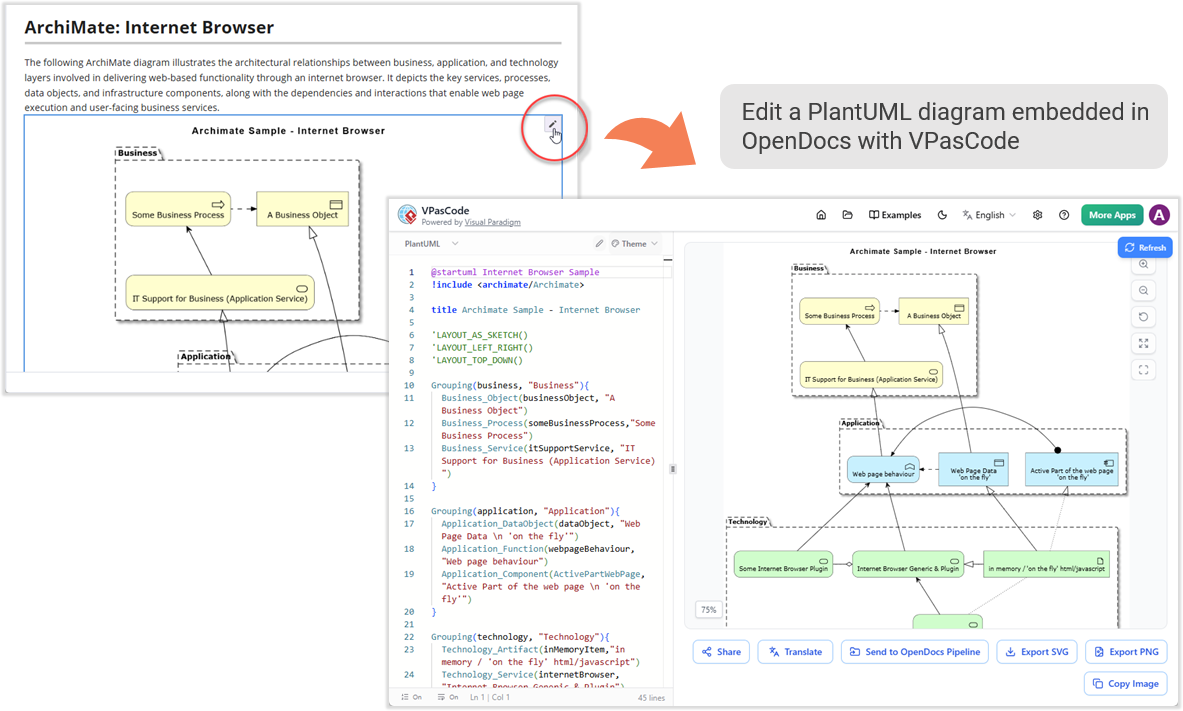
The central component of the VPasCode platform is its Rendering Engine. Unlike single-engine tools that are locked into one visual style or syntax, VPasCode functions as an orchestration layer. It accepts a text script, identifies the underlying syntax, and routes it to the appropriate rendering engine.
This architecture provides two critical benefits:
- Flexibility: A team can use PlantUML for complex class structures while using Mermaid for high-level user journey maps within the same project.
- Style Adaptability: Different engines offer different layout algorithms (e.g., hierarchical vs. force-directed). VPasCode allows users to choose the engine that best fits their visualization needs.
3. AI & Intelligent Capabilities
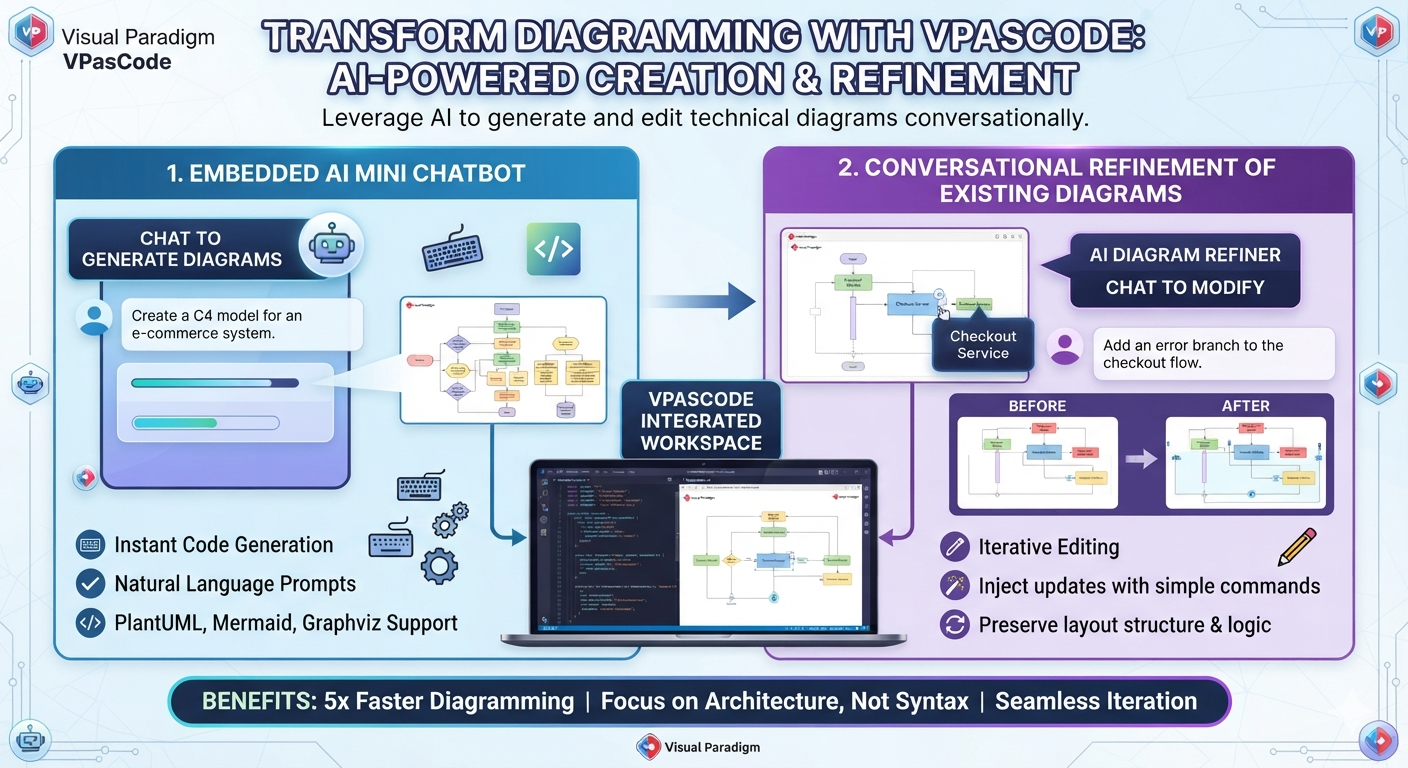
Modern diagramming is not just about syntax; it is about efficiency. VPasCode integrates AI capabilities to assist users in the creation and optimization of their diagrams. This “Intelligent Diagramming” workflow includes:
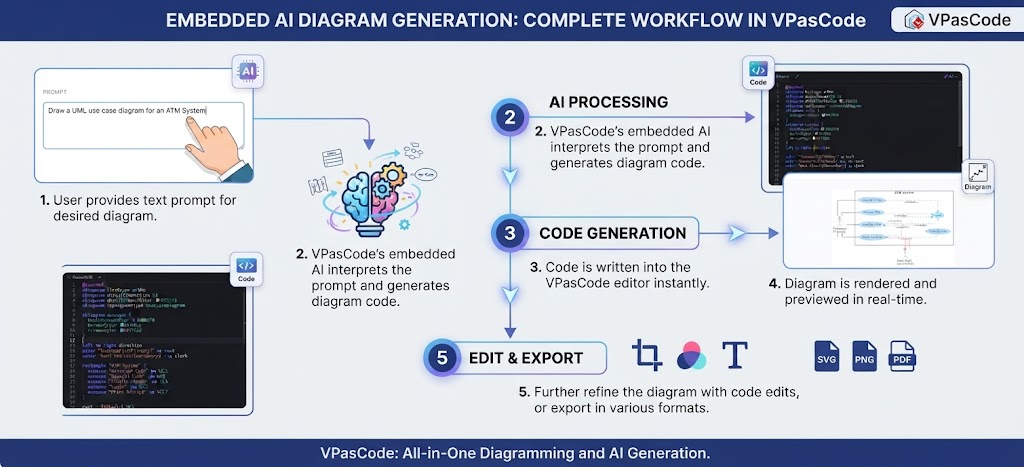
- AI-Assisted Creation: Users can describe a system in natural language, and the AI can generate the initial text markup script.
- Automatic Layout Suggestions: Complex diagrams can often look messy if nodes are placed arbitrarily. The AI engine can analyze the connections and suggest optimal node positioning to minimize edge crossings.
- Text-to-Diagram Conversion: Rapid prototyping is achieved by converting plain text descriptions directly into visual representations.
4. Seamless Ecosystem Integration
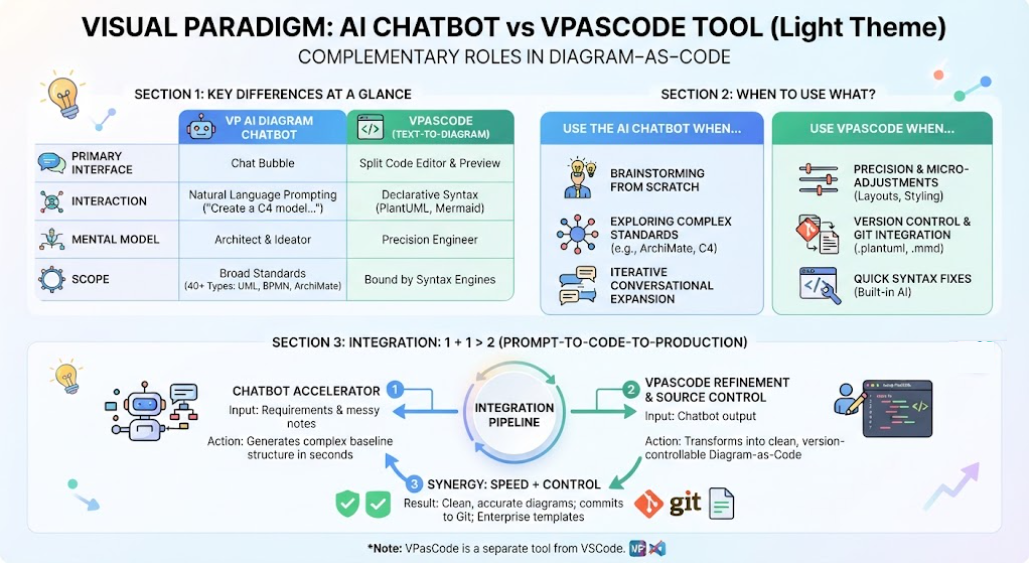
The final piece of the VPasCode puzzle is its integration into the broader software development lifecycle (SDLC). It is designed to be “Version Control Friendly,” meaning diagrams are treated as code artifacts.
By integrating with popular development tools and workflows, VPasCode ensures that documentation is never an afterthought. It empowers Engineers, Product Managers, and Technical Writers to collaborate on a single platform, ensuring that the visual representation of the system is always in sync with the actual codebase.
Who is this for?
VPasCode is built for the modern collaborative team. Whether you are a developer documenting a microservice architecture, a product manager mapping out a user flow, or a technical writer maintaining API documentation, the ability to render diagrams via text provides a faster, more maintainable workflow.
By combining the flexibility of multi-engine support with the power of AI and the discipline of code-based versioning, VPasCode represents a significant step forward in how we visualize complex systems.