In the realm of Business Process Model and Notation (BPMN), events initiate processes and tasks execute work, but gateways dictate the intelligence of the system. They are the decision points that determine how a process flows, branches, merges, or waits. For Agile teams striving for clarity and efficiency, understanding the nuances between Exclusive, Parallel, Inclusive, and Event-Based gateways is not just about drawing correct diagrams—it is about capturing the true intelligence of your business operations.
This tutorial explores these four critical gateway types, illustrating their practical usage in Agile environments with real-world examples. We will also highlight how Visual Paradigm, particularly its AI-driven tooling, transforms the complex task of process modeling into an intuitive, conversational experience.
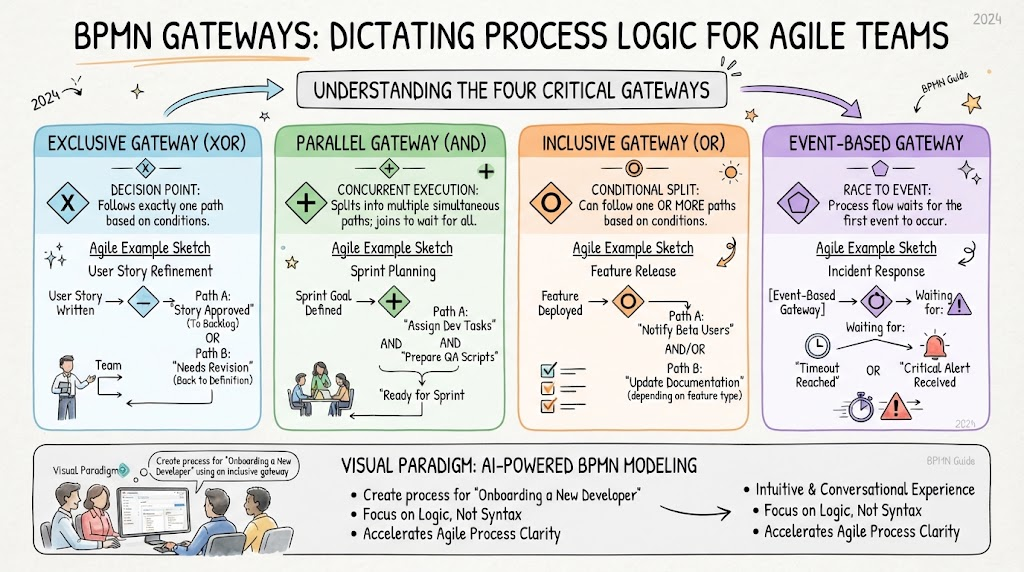
1. The Exclusive Gateway (XOR)
The Exclusive Gateway is the classic “fork in the road.” It represents a decision point where the process must choose exactly one path based on a specific condition. If the condition is met, the flow follows one branch; if not, it takes another. Crucially, only one outgoing sequence flow is active at any given time.
Agile Example: User Story Refinement
Imagine a scenario where a User Story has been written by a Product Owner. The team must evaluate it, but the outcome is binary.
- Path A: If the story is approved, it is added to the Backlog.
- Path B: If the story needs revision, it is sent Back to Definition.
In this model, the process cannot do both simultaneously. It is a strict decision: either the story is ready to go, or it is not.
2. The Parallel Gateway (AND)
The Parallel Gateway is the engine of concurrency. When a process reaches an AND-gateway, it splits into multiple simultaneous paths. The process waits at the next synchronization point until all parallel branches have completed before continuing. This is essential for tasks that can be done in parallel to save time.
Agile Example: Sprint Planning
Once a Sprint Goal is defined, the development team doesn’t need to wait for one task to finish before starting the next. They can distribute work immediately.
- Path A: Assign Dev Tasks to the developers.
- Path B: Prepare QA Scripts for the testers.
Both activities happen concurrently. The process only moves to the Ready for Sprint status once both paths have reached their completion state.
3. The Inclusive Gateway (OR)
The Inclusive Gateway offers conditional splitting where one, more than one, or all outgoing paths can be taken. Unlike the Exclusive gateway, it allows for multiple options to be active simultaneously if the conditions are met. This is often used when a process depends on the type of data or specific attributes.
Agile Example: Feature Release
When a Feature is deployed, the communication strategy depends on what kind of feature it is.
- Path A: If it is a new feature, you must Notify Beta Users.
- Path B: You must Update Documentation (depending on the feature type).
Depending on the feature type, the process might trigger only one of these notifications, or it might trigger both if the feature is complex. The gateway handles this flexibility.
4. The Event-Based Gateway
The Event-Based Gateway introduces a “Race to Event.” This is a passive waiting state where the process flow waits for the first event to occur among a set of possible events. As soon as one event happens, the other potential paths are discarded (cancelled).
Agile Example: Incident Response
Consider a monitoring system that triggers an Incident Response. The system enters a waiting state for a specific trigger:
- Event A: A “Timeout Reached” alarm.
- Event B: A “Critical Alert Received.”
The system does not care which one happens first; it only cares that one of them happens. Once the first event occurs, the process follows that specific path and ignores the other potential event.
Visual Paradigm: AI-Powered BPMN Modeling
Visualizing these complex flows can be tedious when done manually. Visual Paradigm revolutionizes this workflow by integrating AI capabilities that allow teams to create processes conversationally.
- Create Logic, Not Syntax: Instead of manually dragging and dropping gateways and drawing lines, teams can simply type or speak commands like “Create process for Onboarding a New Developer using an inclusive gateway.”
- Accelerate Clarity: By removing the friction of drawing tools, teams can focus on the logic of the business operation rather than the syntax of the diagram.
- Intuitive Experience: The AI engine interprets natural language requests to generate accurate BPMN diagrams, ensuring that the XOR, AND, OR, and Event-Based gateways are placed correctly according to the rules defined above.
By mastering these gateway types, Agile teams can ensure their processes are not just documented, but are intelligent, efficient, and ready for automation.