In the fast-paced world of Agile development, the gap between a business requirement and a functional workflow can often be bridged by a single, accurate diagram. Visual Paradigm stands out as a critical tool for teams looking to model complex business processes, specifically through its robust support for BPMN (Business Process Model and Notation) and its integrated AI capabilities. This tutorial explores how to leverage these tools to model Intermediate Events effectively.
Understanding Intermediate Events in BPMN
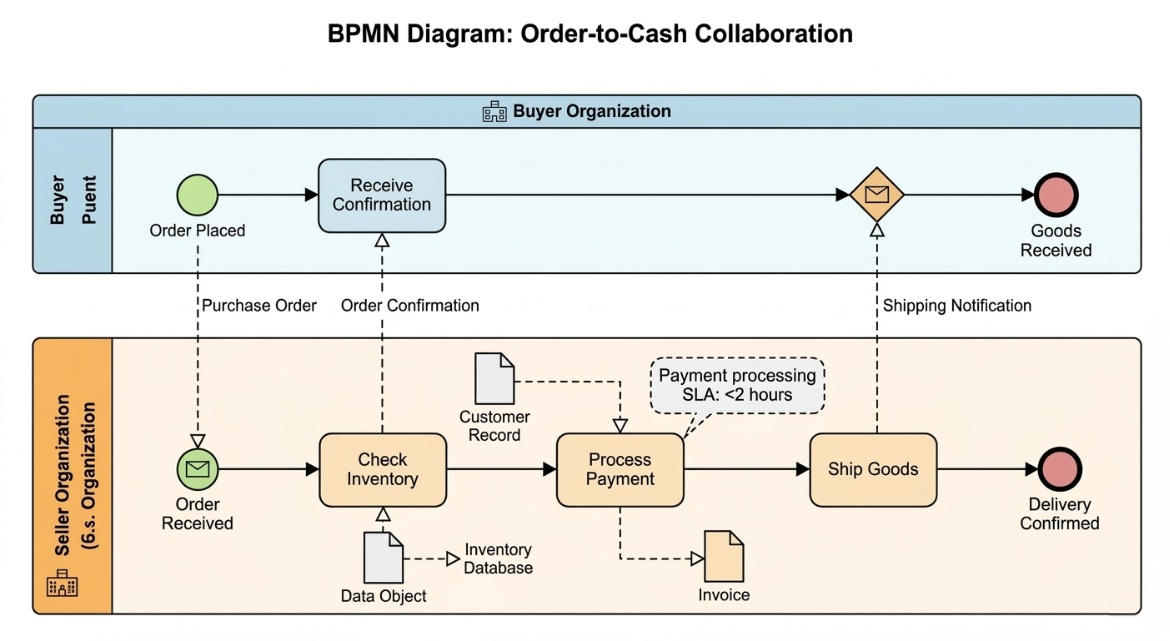
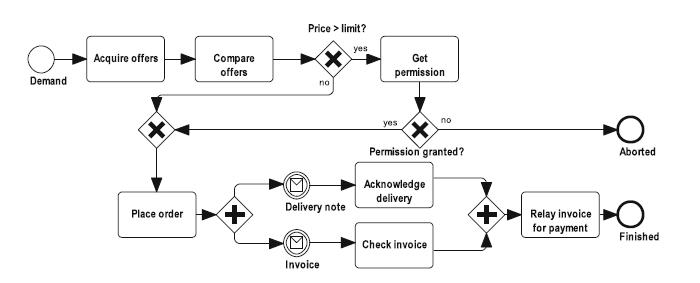
Before diving into the tooling, it is essential to understand the core concept. Intermediate events in BPMN act as the “connective tissue” of a process. Unlike Start or End events, Intermediate events occur within the flow of a process. They are the backbone of realistic, resilient process modeling because they handle the real-world complexities of:
- Delays: Waiting for a specific time or event.
- Exceptions: Handling errors that interrupt normal flow.
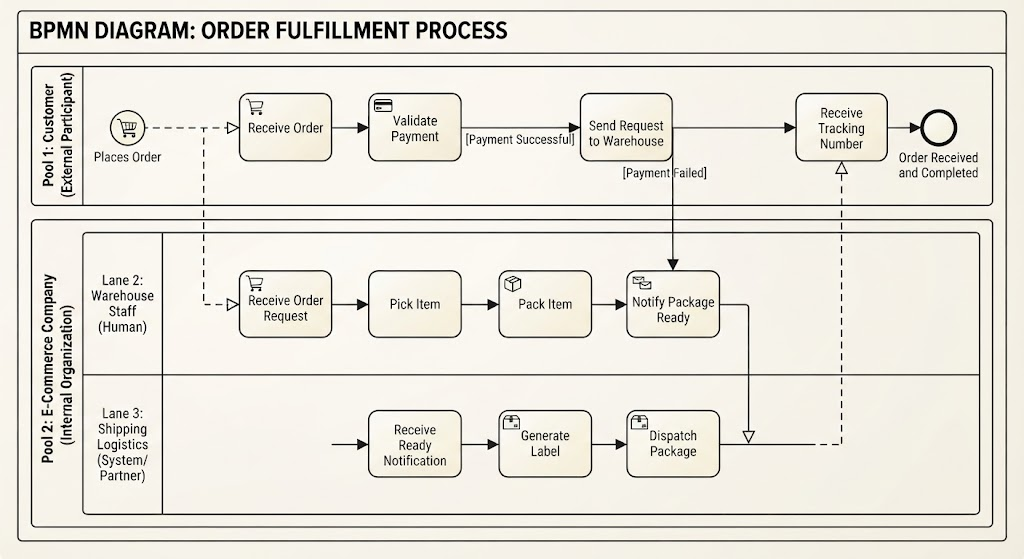
- Communication: Exchanging messages with external systems.
For Agile teams, mastering Catching and Throwing events, along with Boundary Events, enables the design of workflows that are not just theoretical but testable and resilient.
The AI BPMN Diagram Generator: From Text to Logic
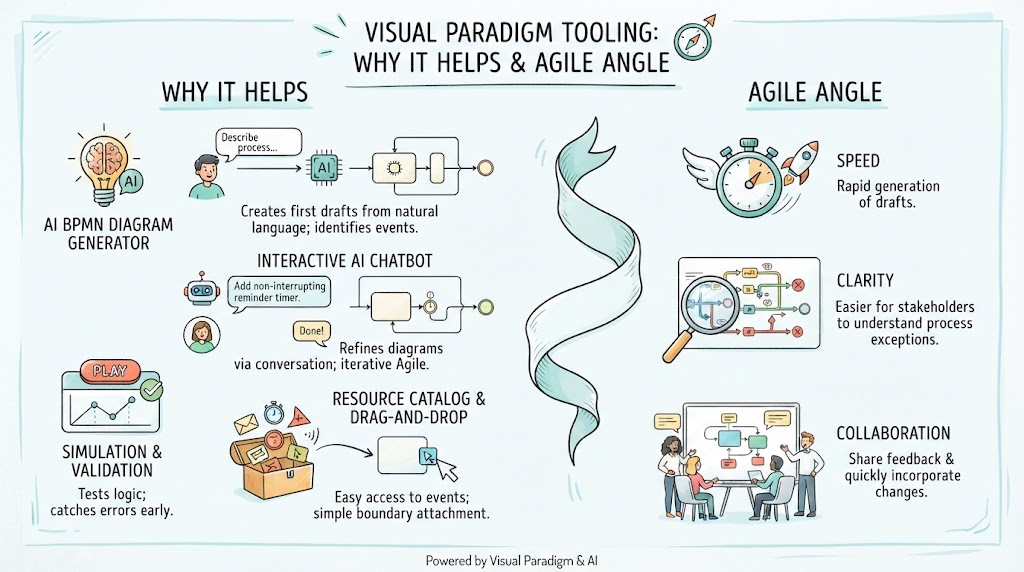
One of the most transformative features of modern Visual Paradigm tooling is the AI BPMN Diagram Generator. This tool bridges the gap between natural language requirements and technical modeling.
How It Works
Instead of manually dragging shapes onto a canvas, you can describe your process in plain English. The AI acts as a translation engine, converting your narrative into a structured BPMN diagram.
- Input: You provide a prompt such as, “Create a BPMN diagram where a user submits a form, waits for 24 hours for admin approval, and if not approved, sends an error notification.”
- Processing: The AI analyzes the narrative for logical connectors and timeframes.
- Output: The system generates the initial diagram, automatically placing the correct Timer Catch event (for the 24-hour wait) and the Error Throw event (for the rejection path).
The AI Angle
The intelligence here lies in pattern recognition. The AI identifies potential interruption points in your narrative and suggests appropriate boundary events, significantly reducing the manual effort required to draft complex logic.
Interactive AI Chatbot: Iterative Refinement
Agile development is iterative. Requirements change, and diagrams must evolve with them. The Interactive AI Chatbot within Visual Paradigm facilitates this continuous improvement loop.
Imagine you have a draft diagram, but you realize a reminder is needed. Instead of manually configuring properties, you can simply ask the chatbot:
Command: “Add a non-interrupting timer to send a reminder after 12 hours.”
The chatbot updates the diagram accordingly. This is ideal for Agile refinement, allowing Product Owners and developers to discuss the flow conversationally and see immediate visual results.
Resource Catalog & Drag-and-Drop
While AI accelerates the creation process, manual control is often necessary for fine-tuning. Visual Paradigm provides a comprehensive Resource Catalog that simplifies access to all types of Intermediate Events:
- Message Events: For communication with external entities.
- Timer Events: For time-based triggers.
- Error Events: For exception handling.
- Signal Events: For broadcasting to multiple parts of the process.
The interface allows for simple Drag-and-Drop operations, making it easy to attach boundary events to activities and configure their specific properties, such as distinguishing between Interrupting and Non-Interrupting events.
Simulation & Validation: Testing Before Coding
Perhaps the most critical step for technical accuracy is Simulation & Validation. A diagram is only as good as the logic it represents. Visual Paradigm allows you to “play” the process.
Why This Matters for Agile Teams:
- Catch Logical Errors: Run simulations to ensure that timer events trigger correctly and that error paths are actually reachable.
- Verify Flow: Ensure that the system doesn’t hang in a wait state unexpectedly.
This capability helps catch logical errors before a single line of code is written, saving significant development time and resources.
Conclusion: Why Visual Paradigm for Agile Teams?
By leveraging Visual Paradigm’s AI-powered tools, Agile teams can rapidly translate natural language requirements into accurate BPMN diagrams. The tooling offers three distinct advantages:
- Speed: AI generation reduces the time to create first drafts of complex processes.
- Clarity: Visual representation of intermediate events makes it easier for stakeholders (developers, testers, POs) to understand wait states and exceptions.
- Collaboration: Share diagrams with team members for feedback, using the AI chatbot to quickly incorporate changes.
Whether you are modeling a simple approval workflow or a complex multi-system integration, intermediate events provide the granularity needed to build robust Agile processes.