In the world of Business Process Model and Notation (BPMN), clarity is currency. However, as processes grow in complexity, they often devolve into “spaghetti logic”—a tangled web of interconnected flows that are difficult to understand, maintain, and scale. This tutorial explores a transformative approach to process modeling: using AI to detect and extract reusable components, turning a complex monolithic flow into a clean, modular architecture.
The Challenge: The “Before” State
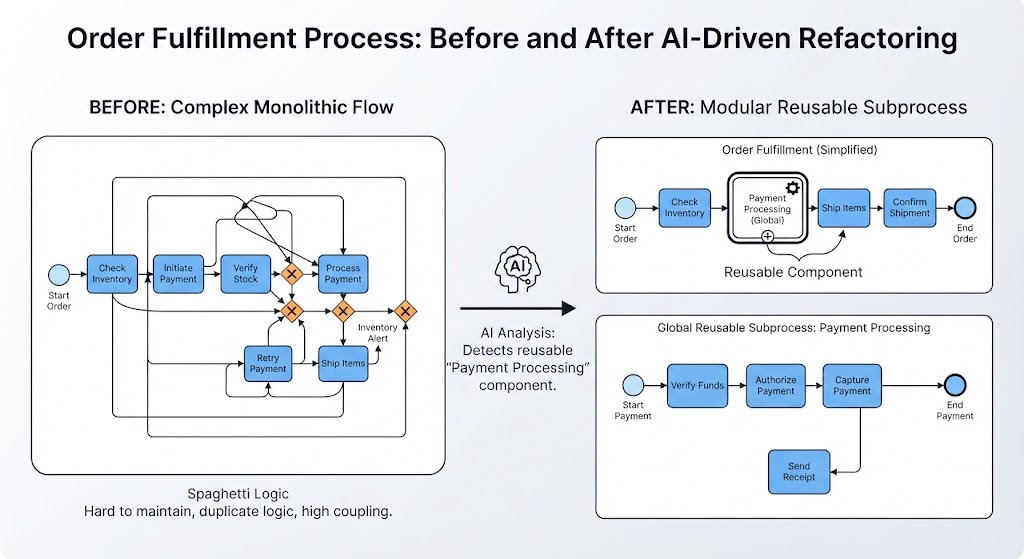
Let’s examine the classic scenario depicted in the diagram: an Order Fulfillment Process. In its initial state, the process is monolithic. The diagram on the left illustrates a “Complex Monolithic Flow” where various tasks are tightly coupled.
Key Characteristics of the “Before” State:
- Coupled Logic: The flow mixes inventory checks, payment initiation, stock verification, and shipping logistics in a single, dense block.
- Complex Routing: Notice the intricate web of gateways (diamonds) and feedback loops (like “Retry Payment” and “Inventory Alert”). These create a high cognitive load for anyone trying to trace the path of an order.
- Spaghetti Logic: The connections are hard to follow. This state is described as “hard to maintain, duplicate logic, high coupling.”
The Solution: AI-Driven Subprocess Decomposition
The transition from the “Before” state to the “After” state represents a paradigm shift in process design. The central element of this transformation is the AI Analysis engine. This intelligent tool analyzes the process graph and identifies specific patterns that indicate refactoring opportunities.
Step 1: Identifying Reusability
In our example, the AI scans the “Process Payment” task. It detects that the logic involved in processing a payment is not unique to just this single order fulfillment path. The AI recognizes that this logic is a reusable component—a pattern often found in refunds, subscriptions, or other transactional processes.
Step 2: Extraction and Abstraction
Once the AI identifies this component, it suggests an extraction. The “Process Payment” block is no longer a static task within the main flow; it is encapsulated into a Global Reusable Subprocess.
This creates a two-tiered architecture:
- The High-Level Model: The top diagram shows the simplified “Order Fulfillment” process. The complex payment logic is now hidden inside a “Payment Processing (Global)” subprocess. This keeps the main diagram clean and focused on the primary business flow (Check Inventory → Payment → Ship → Confirm).
- The Detailed Implementation: The bottom diagram reveals the internal logic of the “Payment Processing” subprocess. It details the specific steps: Verify Funds, Authorize Payment, Capture Payment, and Send Receipt.
Benefits of Modular Architecture
Why go through the effort of this refactoring? The “After” state offers significant advantages over the monolithic “Before” state:
1. Maintenance Efficiency
Imagine a scenario where your payment gateway provider changes its API or a new tax rule is introduced. In the “Before” state, you would have to hunt through the spaghetti diagram to find every instance of the payment logic and update it manually. In the “After” state, you update the Global Reusable Subprocess once. The change is automatically reflected in every process that uses it.
2. Consistency
By centralizing the payment logic, you ensure that every order, refund, or subscription follows the exact same verification and capture rules. This reduces the risk of human error and ensures business logic consistency across the organization.
3. Scalability
As your business grows, you can reuse the “Payment Processing” subprocess for entirely new products or services without rewriting the code or logic. This modularity bridges the gap between high-level business strategy and detailed technical implementation.
Conclusion: AI as a Co-Pilot
The diagram illustrates that taming spaghetti diagrams isn’t just about aesthetics; it’s about creating maintainable, scalable, and understandable process models. While AI can detect boundaries and suggest decompositions, it acts as a powerful assistant to human judgment.
By embracing intelligent subprocess decomposition, organizations can transform chaotic workflows into clean, modular architectures. Whether you are using Visual Paradigm or other BPMN tools, the principle remains the same: Modularity is the key to modern process management.