Introduction to Robust Order Processing
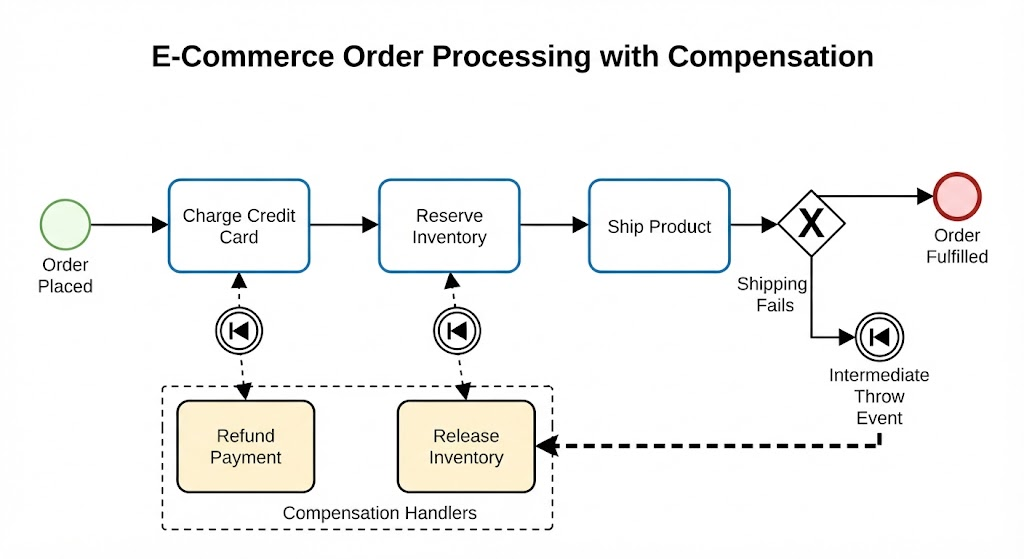
Welcome to this tutorial on Business Process Model and Notation (BPMN). In the world of e-commerce, the ideal scenario is a smooth transaction from order placement to delivery. However, real-world systems must be prepared for the unexpected. Today, we will analyze a specific process diagram titled “E-Commerce Order Processing with Compensation” to understand how to design systems that not only work when things go right but also recover gracefully when they go wrong.
The Standard “Happy Path”
Let’s first walk through the successful flow of an order, often called the “happy path.” The process begins at the green circle labeled “Order Placed.” This is the trigger event that starts the entire workflow.
Once an order is initiated, the system immediately moves to the first action: “Charge Credit Card.” This ensures the customer’s payment method is authorized. Following a successful charge, the process flows to “Reserve Inventory.” This step is crucial; it locks the items in the warehouse so they cannot be sold to another customer while the transaction is pending. Finally, the system executes “Ship Product.” If this step completes successfully, the process reaches the exclusive gateway (the diamond shape) and follows the path to the red circle: “Order Fulfilled.” The transaction is complete, and the customer is happy.
Handling Failure: The Shipping Problem
What happens if the shipping step encounters an issue? In our diagram, we see a branch labeled “Shipping Fails” originating from the exclusive gateway. This represents a real-world scenario where logistics break down—a package is lost, a carrier rejects the shipment, or an address is invalid.
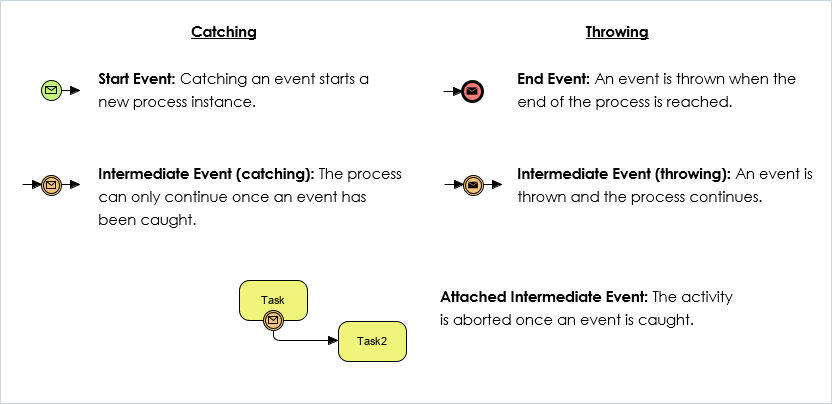
When this failure occurs, the process does not simply stop. Instead, it triggers an “Intermediate Throw Event.” In BPMN, intermediate events act as markers that capture or trigger specific moments in a process. Here, this event serves as the alarm bell, signaling that the primary workflow has failed and a recovery mechanism must be activated.
The Power of Compensation Handlers
This is where the concept of “Compensation” comes into play. In any transactional system, you must maintain data integrity. If you reserve items but fail to ship them, those items are stuck in a reserved state, blocking other sales. If you charged the customer but failed to ship, you owe them a refund.
At the bottom of our diagram, we see a dashed box labeled “Compensation Handlers.” These are the “undo” buttons for our process. They contain two specific tasks designed to reverse the actions taken in the “happy path”.
Releasing Inventory
The first handler is “Release Inventory.” Notice the dashed arrow connecting the “Intermediate Throw Event” to this task. This indicates that when shipping fails, the system automatically triggers the release of the reserved stock. The inventory is returned to the available pool, making it ready for the next customer. This is visually linked back to the “Reserve Inventory” task, showing that this action is the direct opposite of the reservation.
Refunding Payment
The second handler is “Refund Payment.” This task is linked to the “Charge Credit Card” task. In many robust systems, releasing inventory is the first step, followed by the financial reversal. The dashed line indicates that once the inventory is successfully released, the system proceeds to refund the customer’s credit card. This ensures that the customer is not charged for a product they never received.
Summary: Building Trust Through Automation
By using compensation handlers, we transform a fragile process into a robust one. The diagram demonstrates that a well-designed e-commerce system anticipates failure. It automatically manages the consequences of a shipping error by reversing the financial and logistical steps. As you design your own business processes, remember that the “happy path” is only half the story; the compensation logic is what ensures your business remains reliable even when things don’t go according to plan.