


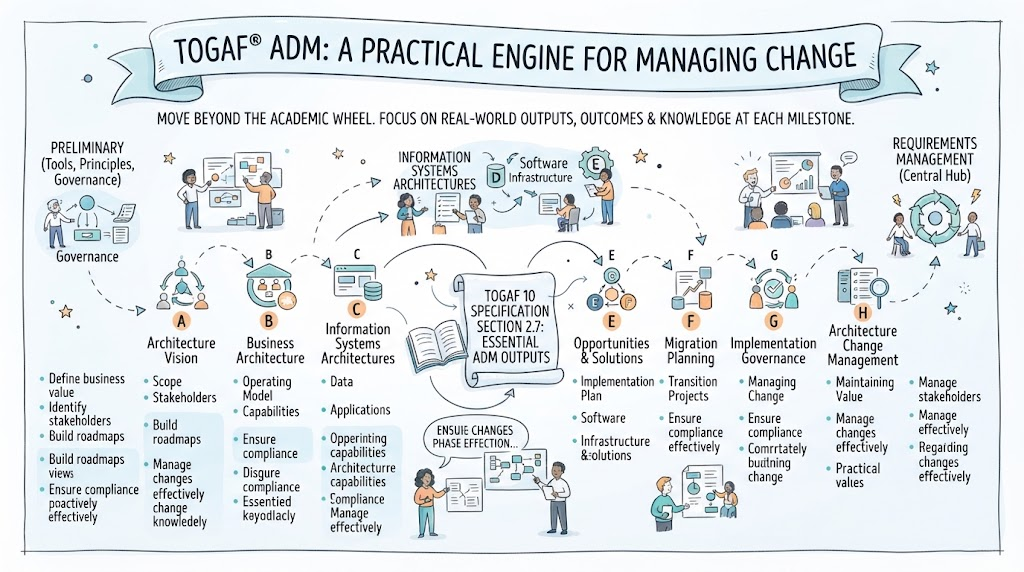
At the very heart of the TOGAF framework sits the Architecture Development Method (ADM)—a tested, repeatable process engine designed to help organizations manage change effectively. However, as a beginner, it is easy to view the ADM as a giant, academic wheel of phases. To make it highly practical, the standard focuses on creating useful, real-world information rather than piles of theoretical documents.
This tutorial will guide you through the TOGAF ADM, moving beyond the visual “wheel” to understand the essential inputs, steps, and outputs required at each milestone. We will also explore how modern tooling can bridge the gap between theory and execution.
1. The Preliminary Phase: Setting the Stage
Before diving into the specific architecture, the Preliminary Phase establishes the “rules of the road.” This phase is often overlooked but is critical for success. It involves defining the architecture principles, standards, and governance models that will guide the entire project.
- Goal: Define business value and identify stakeholders.
- Key Activity: Build roadmaps that ensure compliance and proactively manage views.
- Outcome: A governance framework that ensures the architecture is built correctly from the start.
2. Phase A: Architecture Vision
Phase A is about the “Why.” You are not yet building the solution; you are defining the scope. This phase sets the context for the entire project by identifying stakeholders and their concerns.
- Inputs: Business strategy, stakeholder requirements.
- Key Steps: Define the scope and high-level requirements. Manage changes effectively and change knowledgeably.
- Essential Output: An Architecture Vision document that acts as a contract between the business and IT.
3. Phase B: Business Architecture
Once the vision is set, Phase B defines the business architecture. This is the foundation upon which the rest of the solution is built. It describes the business strategy, governance, organization, and key business processes.
- Focus: Understanding the capabilities and the organizational structure.
- Key Output: A model of the current state (As-Is) and the future state (To-Be) of the business processes.
4. Phase C: Information Systems Architectures
This phase is often split into two sub-phases: Data Architecture and Application Architecture. It translates the business requirements into technical specifications.
Data Architecture (The “What”)
This defines the logical and physical data assets and data management resources required. It includes the structure of data and how it is managed.
Application Architecture (The “How”)
This provides a blueprint for the individual application systems, their interactions, and their relationships to the core business processes. It ensures compliance and disgregates compliance to ensure the system works as intended.
5. Phase E: Opportunities & Solutions
Phase E is the “gap analysis” phase. It identifies the work packages required to move from the current state to the target state. It focuses on the implementation plan and transition projects.
- Key Concept: Identifying opportunities for improvement and determining how to implement them.
- Output: An Implementation Plan that details the transition projects.
6. Phase F: Migration Planning
Once the opportunities are identified, Phase F creates the detailed roadmap for moving from the current state to the target state. It focuses on managing the transition effectively and ensuring compliance.
- Key Activity: Developing the detailed migration plan.
- Output: A prioritized roadmap of projects and a detailed budget.
7. Phase G: Implementation Governance
Phase G is about managing the implementation. It ensures that the projects are being executed according to the plan and that the architecture is being built correctly. It focuses on managing value and managing changes effectively.
- Key Activity: Monitoring and controlling the implementation.
- Output: Compliance reports and change management records.
8. Phase H: Architecture Change Management
The ADM is a cycle, not a straight line. Phase H ensures that the architecture evolves over time. It focuses on managing stakeholders and managing changes effectively regarding the overall architecture.
- Key Activity: Ensuring the architecture remains relevant and aligned with business needs.
- Output: A change management plan and updated architecture documentation.
Supplementary Note: Recommended Tooling
To successfully navigate the TOGAF ADM, you need tools that support the process, not just the documentation. The combination of Visual Paradigm, TOGAF ADM, and ArchiMate provides a powerful triad for Enterprise Architecture (EA) processes.
How Visual Paradigm + TOGAF ADM + ArchiMate Enhance the Process
1. Visual Paradigm as the Platform:
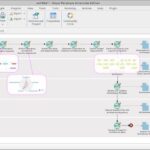
Visual Paradigm serves as the central repository and modeling environment. It supports the entire ADM cycle, allowing architects to create, store, and manage all architecture artifacts in one place. It automates the generation of documentation, ensuring that the “crystal-clear clarity” mentioned in the TOGAF standard is achieved without manual effort.
2. The Role of ArchiMate in Modeling:
ArchiMate is the language used to model the architecture. It provides a standardized notation for describing, analyzing, and visualizing the relationships between business, application, and technology layers.
- Clarity: It helps avoid ambiguity in complex systems.
- Traceability: It ensures that every technical component can be traced back to a business requirement.
- Integration: Visual Paradigm has deep integration with ArchiMate, allowing for seamless modeling and impact analysis.
3. The Power of the TOGAF ADM Integration:
By integrating the ADM process directly into the tool, you ensure that the process is followed correctly. Visual Paradigm can guide you through the phases, prompting for the necessary inputs and outputs at each stage. This ensures that you are not just creating diagrams, but are actually building a robust architecture that delivers value.
In summary, the combination of these tools transforms the ADM from an academic exercise into a practical engine for managing change. It allows you to focus on the “real-world information” and “outcomes” that are critical for organizational success.
Related posts:
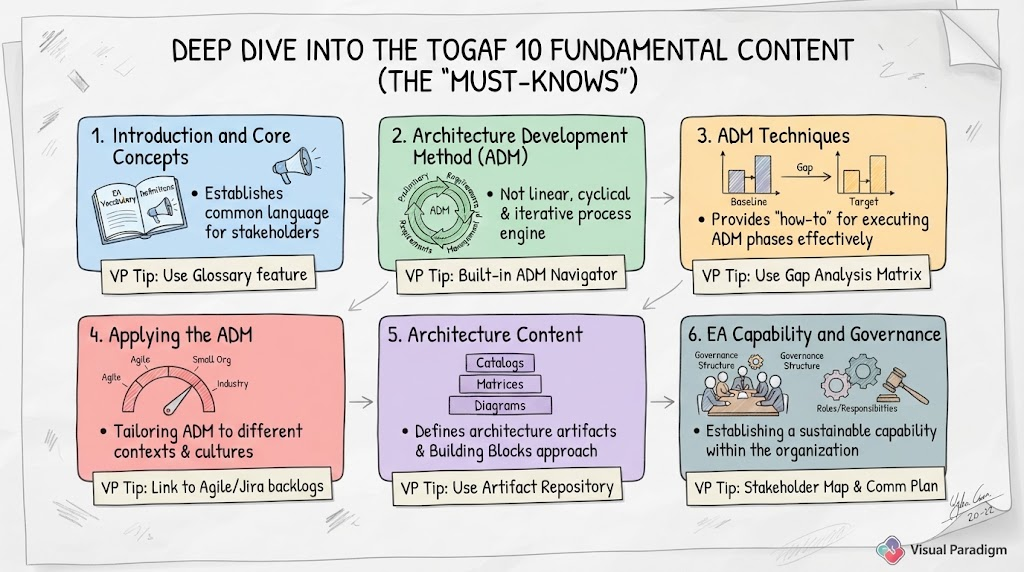 Mastering TOGAF 10: A Step-by-Step Guide to the Six Fundamental Content Pillars
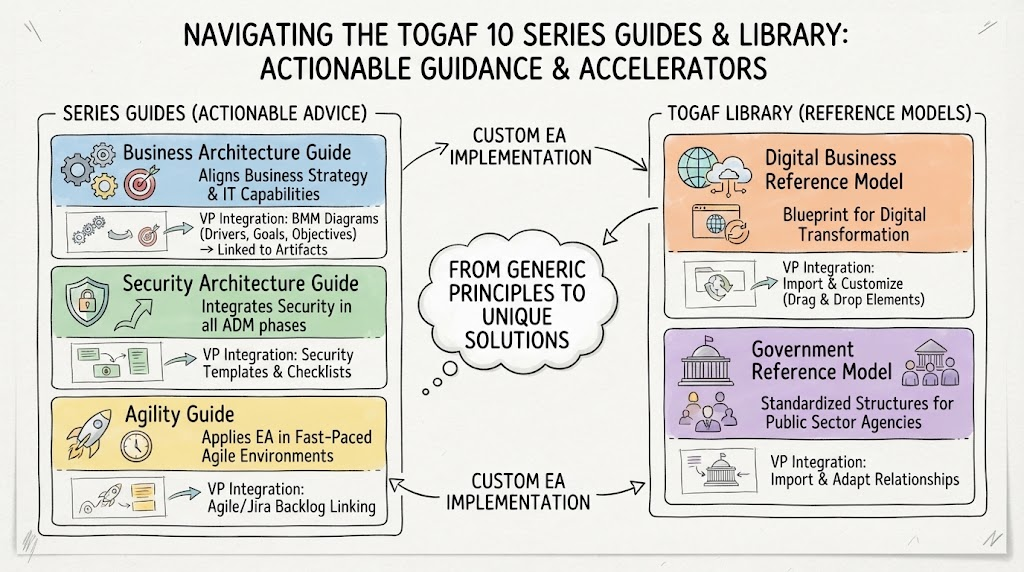 Navigating the TOGAF 10 Series Guides & Library: Actionable Guidance & Accelerators
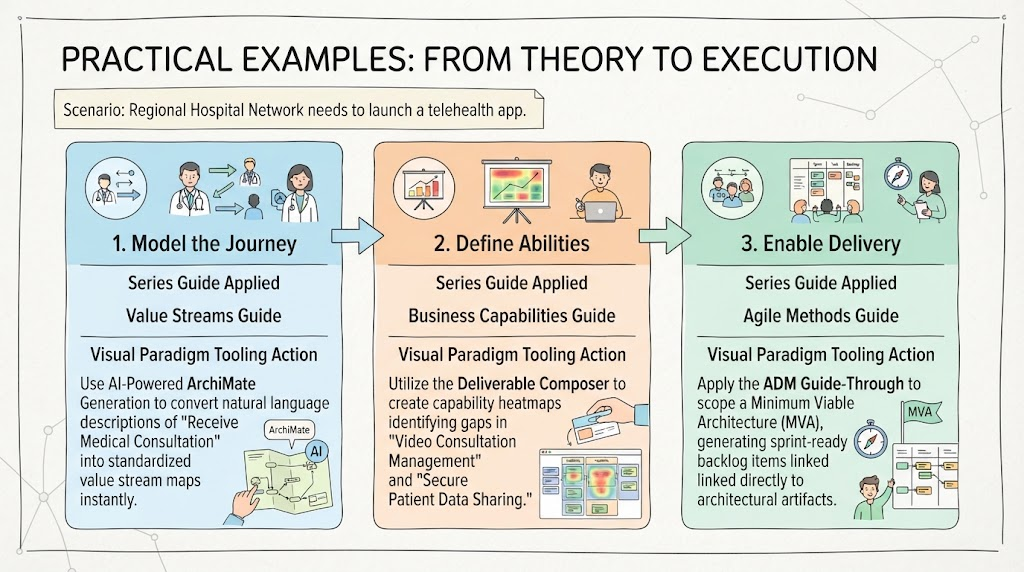 From Theory to Execution: A Practical Guide to Enterprise Architecture with Visual Paradigm
 Mastering the TOGAF Preliminary Phase with Visual Paradigm and ArchiMate