


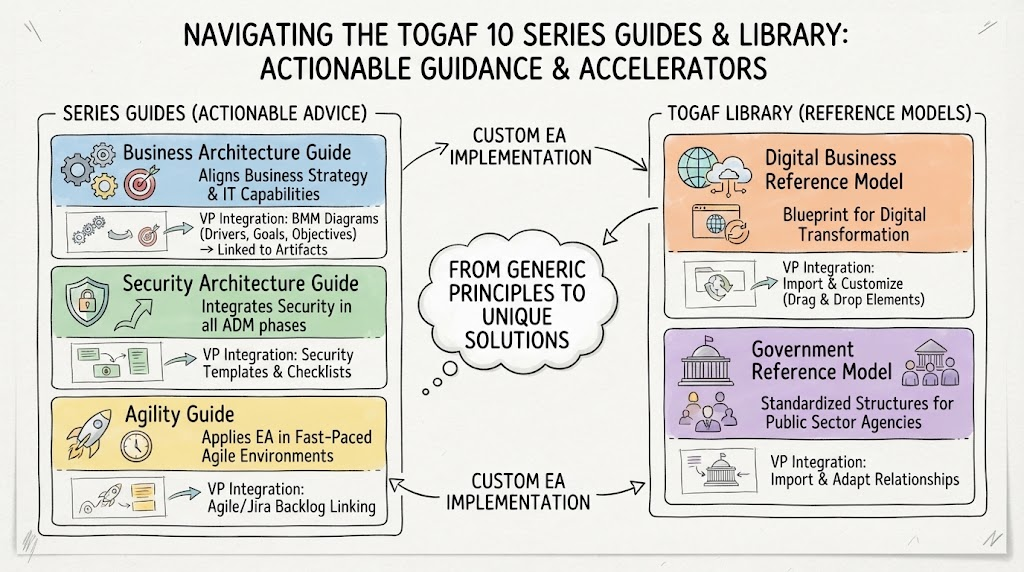
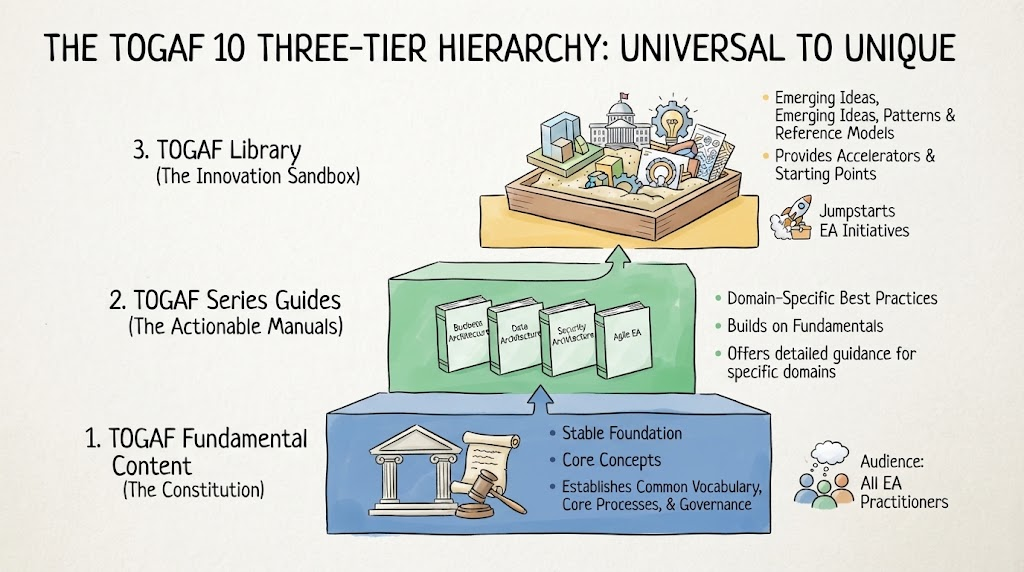
Enterprise Architecture (EA) often faces the challenge of being too theoretical. While the TOGAF standard provides a robust framework, applying it to real-world scenarios can be daunting. This is where the Series Guides and the TOGAF Library become critical assets. By moving from generic principles to unique, actionable solutions, organizations can accelerate their implementation.
The Series Guides: Making Theory Actionable
The Series Guides are designed to expand on the core domains of TOGAF, providing detailed, practical advice. They act as specialized playbooks for specific architectural challenges. Here is how three key guides transform abstract concepts into actionable steps:
- Business Architecture Guide: This guide is essential for ensuring that IT capabilities are not developed in a vacuum. It provides the methodology to align business strategy with technical execution.
Practical Application: In Visual Paradigm, you can utilize pre-built Business Motivation Model (BMM) diagrams. These allow you to capture high-level drivers, goals, and objectives, and then explicitly link them to technical artifacts in later phases of the ADM cycle. - Security Architecture Guide: Security is often an afterthought, but this guide integrates security considerations into every phase of the Architecture Development Method (ADM).
Practical Application: Visual Paradigm offers specialized security templates and checklists that ensure you are validating security requirements throughout the lifecycle, rather than just at the end. - Agility Guide: Traditional EA can sometimes feel too slow for modern development. This guide demonstrates how to apply EA principles in fast-paced, agile environments.
Practical Application: Visual Paradigm supports integration with agile tools, allowing you to link architectural backlogs directly to Jira or other project management systems to keep architecture aligned with rapid delivery.
The TOGAF Library: Accelerating with Reference Models
One of the biggest time-sinks in architecture is “reinventing the wheel.” The TOGAF Library solves this by providing industry-specific Reference Models. Instead of building a structure from scratch, you start with a blueprint and adapt it to your context.
Key Reference Models
- Digital Business Reference Model: A comprehensive blueprint designed for organizations undergoing digital transformation. It provides a standard structure for understanding digital capabilities.
- Government Reference Model: Offers standardized structures specifically tailored for public sector agencies, ensuring compliance and standardization across government initiatives.
Tooling Integration: The Visual Paradigm Advantage
Reading about these models is one thing; implementing them is another. Visual Paradigm (VP) serves as the bridge between the TOGAF standard and your specific project requirements.
Importing and Customizing
Visual Paradigm allows you to import reference models directly into your project environment. This transforms the library from a static document into a dynamic starting point. You can customize these models by:
- Drag and Drop Elements: Select specific components from the reference model and place them into your own diagram.
- Modifying Relationships: Adjust the connections between elements to reflect your organization’s specific data flows or dependencies.
- Adding Organization-Specific Details: Annotate the standard models with your own business rules and unique identifiers.
By leveraging these integrations, you significantly reduce initial setup time, allowing your team to focus on the unique value-add of your architecture rather than the foundational structure.
Summary: From Generic to Unique
The flow of modern EA implementation is no longer a linear path from standard to custom. It is an iterative process:
- Start with the Series Guides for actionable advice on specific domains.
- Use the TOGAF Library to import industry-standard Reference Models.
- Utilize Visual Paradigm to import, adapt, and customize these models.
- Execute a Custom EA Implementation that fits your unique organizational needs.
This approach ensures that your architecture is both compliant with global standards and perfectly tailored to your business reality.
Related posts:
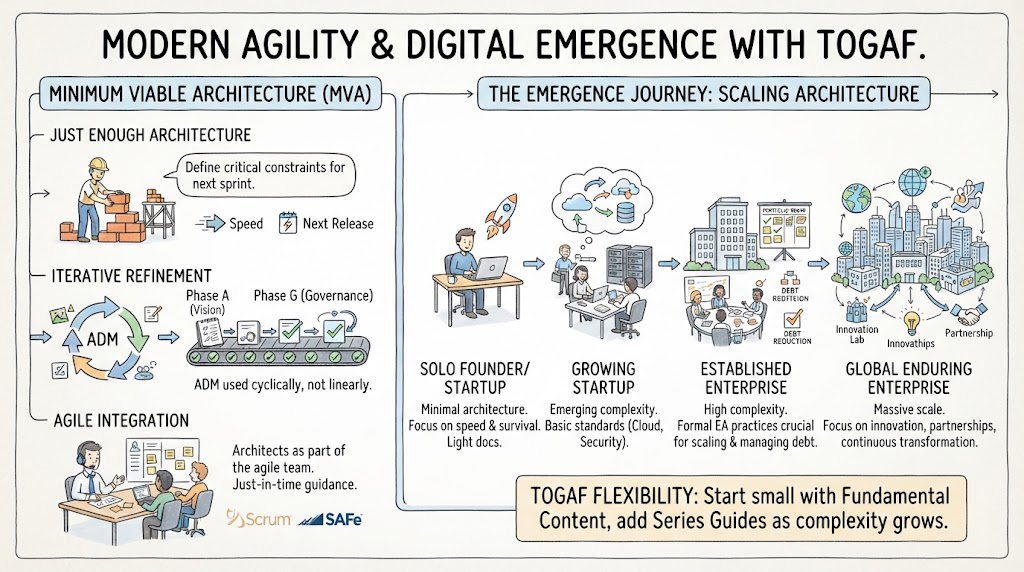 Mastering Modern Agility: A Tutorial on Minimum Viable Architecture and the Digital Emergence Journey
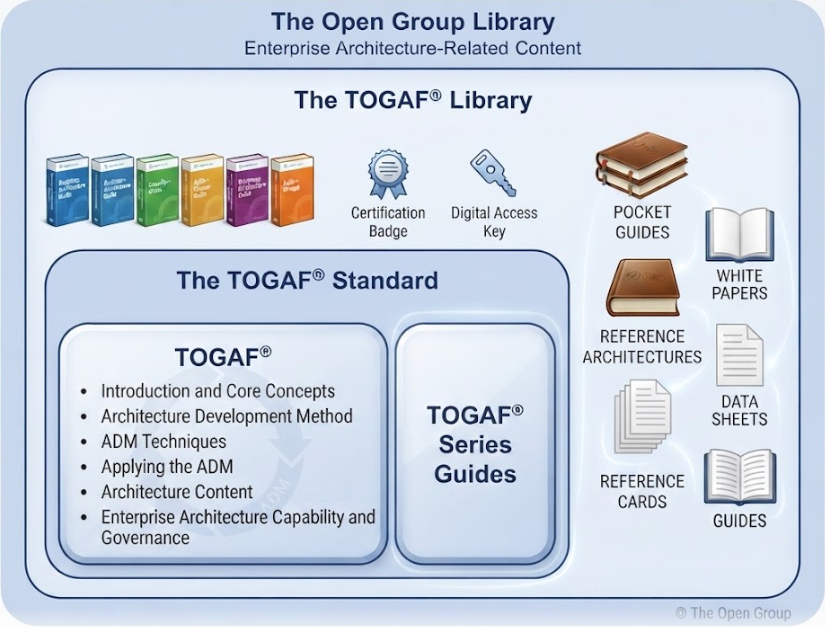 Mastering TOGAF 10: Navigating the Modular Library and Architecture Content
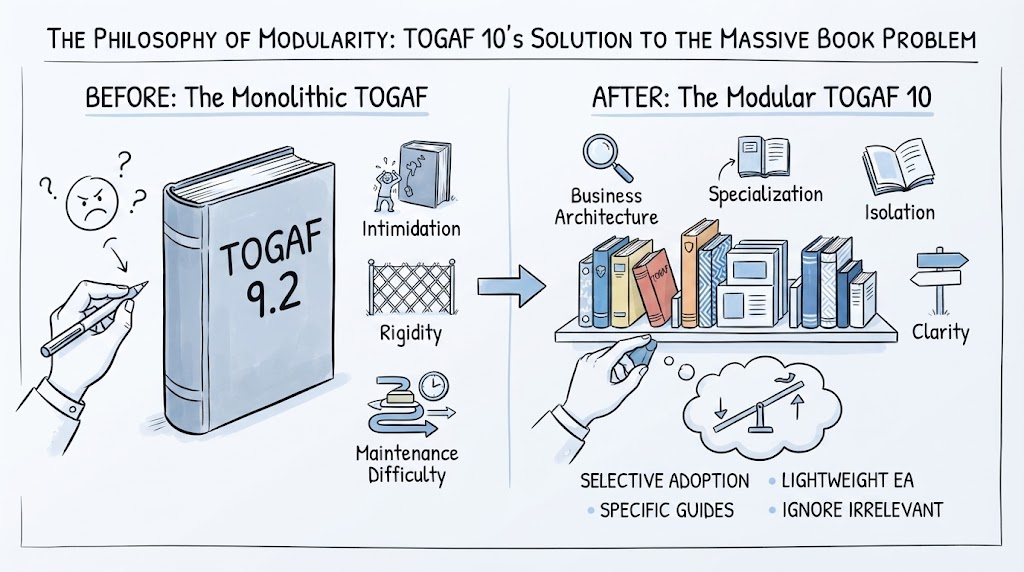 Mastering Modularity: How TOGAF 10 Solves the “Massive Book Problem” with Strategic Flexibility
 Navigating TOGAF 10: A Deep Dive into the Three-Tier Hierarchy System