


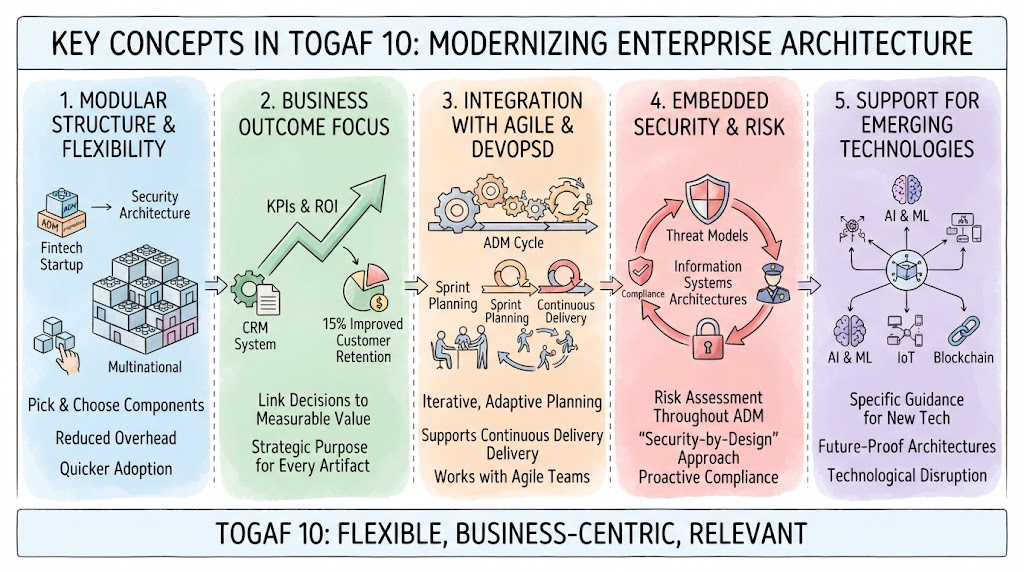
Enterprise Architecture (EA) has historically been criticized for being rigid, bureaucratic, and disconnected from the rapid pace of modern software development. However, with the release of TOGAF 10, the Open Group has fundamentally reimagined the framework. This tutorial explores the pivotal changes in TOGAF 10, moving away from a monolithic mandate toward a flexible, business-centric approach that integrates seamlessly with Agile and DevOps.
By understanding these five key concepts, architects can modernize their practice, reduce overhead, and ensure that every architectural decision delivers measurable value.
1. Modular Structure and Flexibility
The first major departure from previous iterations is the shift to a modular design. In the past, organizations often felt forced to adopt the entire TOGAF framework, regardless of their size or maturity. TOGAF 10 allows organizations to “pick and choose” specific components that are relevant to their specific context.
Why Modularity Matters
- Reduced Overhead: You no longer need to implement heavy governance structures if you are a smaller entity.
- Quicker Adoption: Teams can focus on the parts of the framework that solve their immediate problems.
- Contextual Relevance: The framework adapts to the industry and maturity level of the organization.
Practical Application
Consider a mid-sized fintech startup. Unlike a massive multinational corporation that requires complex governance, this startup might choose to adopt only the Architecture Development Method (ADM) and Security Architecture modules. By bypassing the heavier governance structures, they can move fast while still maintaining architectural discipline.
2. Business Outcome Focus
TOGAF 10 places a stronger emphasis on the link between architectural decisions and measurable business value. The era of creating artifacts just for the sake of documentation is over. Every diagram and model must serve a strategic purpose.
Linking to KPIs and ROI
The framework now provides tools to track KPIs (Key Performance Indicators) and ROI (Return on Investment). This ensures that the architecture team is aligned with the board’s strategic goals.
Case Study: The CRM System
Imagine an architect tasked with modeling a new CRM system. In a traditional setting, the output might just be a data model or a process flow. In TOGAF 10, the architect uses guidelines to map exactly how this system improves customer retention rates by 15%. By tying the technical implementation to a board-level metric, the architecture becomes a driver of business strategy.
3. Integration with Agile and DevOps
One of the most significant criticisms of legacy EA frameworks was their incompatibility with Agile and DevOps. TOGAF 10 explicitly addresses the need to work alongside Agile teams and DevOps pipelines. It moves away from the “big bang” upfront design toward iterative, adaptive planning.
Iterative ADM Cycles
Instead of waiting for a multi-year roadmap to complete before delivering value, the architecture team can use short ADM cycles aligned with sprint planning. This allows them to refine the target architecture based on feedback from each release, supporting continuous delivery.
4. Embedded Security and Risk Management
With cyber threats escalating, security can no longer be an afterthought implemented at the end of a project. TOGAF 10 embeds risk assessment and compliance checks throughout the ADM cycle, promoting a proactive “security-by-design” approach.
Threat Modeling in Action
During the Information Systems Architectures phase, architects can automatically generate threat models alongside data flow diagrams. This ensures that encryption and access controls are defined before code is written, significantly reducing the risk of security vulnerabilities in production.
5. Support for Emerging Technologies
Technology is evolving at breakneck speed, and EA frameworks must keep pace. TOGAF 10 includes specific guidance for integrating AI, Machine Learning (ML), IoT, and Blockchain. This helps future-proof architectures against technological disruption.
AI and Data Governance
For organizations leveraging AI for predictive maintenance, TOGAF 10 provides guidelines to define data governance standards for machine learning models. This ensures ethical use and high data quality, which are critical for the success of AI initiatives.
Recommended Tooling: Visual Paradigm + TOGAF ADM + ArchiMate
To effectively implement the concepts of TOGAF 10, architects need tooling that supports both the rigorous structure of the framework and the flexibility of modern development. Visual Paradigm offers a robust solution for this ecosystem.
How Visual Paradigm Enhances the EA Process
- Comprehensive TOGAF ADM Support: Visual Paradigm provides built-in support for the Architecture Development Method, allowing you to easily navigate through the phases (Preliminary to Requirements) and manage deliverables without manual overhead.
- ArchiMate Modeling: To visualize the “Business Outcome Focus,” you can use ArchiMate diagrams within Visual Paradigm to clearly map business goals to application services and infrastructure, proving the value of your architecture.
- Agile Integration: The tool supports Agile workflows, allowing you to link architectural decisions to user stories and sprints, facilitating the iterative approach described in Concept #3.
- Security & Risk Diagramming: You can utilize specific security modeling features to create threat models and compliance diagrams, ensuring that “Security-by-Design” is visually and technically enforced.
By combining the structured flexibility of TOGAF 10 with the visual power of Visual Paradigm, architects can build systems that are not only technically sound but also strategically aligned and future-ready.
Related posts:
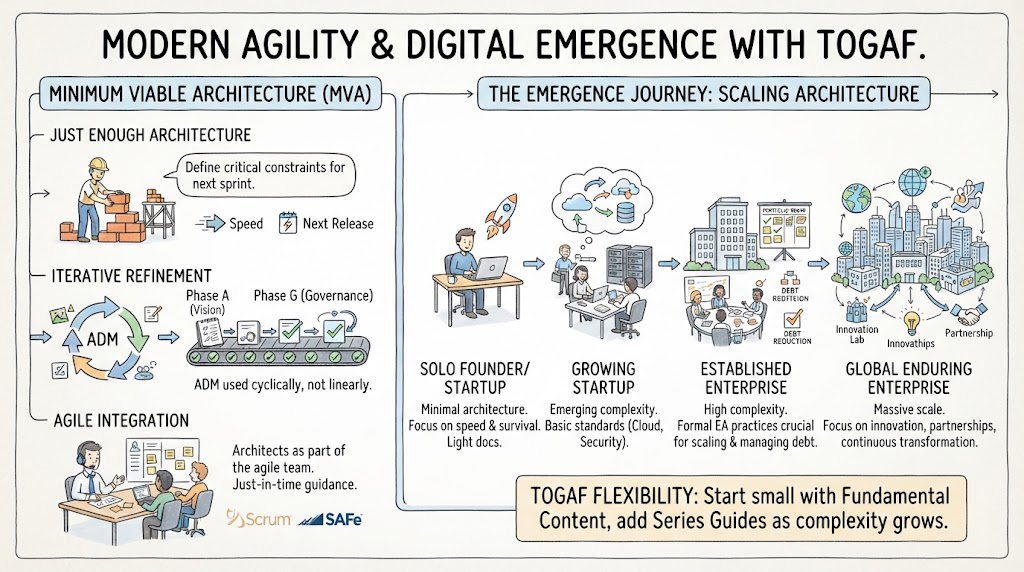 Mastering Modern Agility: A Tutorial on Minimum Viable Architecture and the Digital Emergence Journey
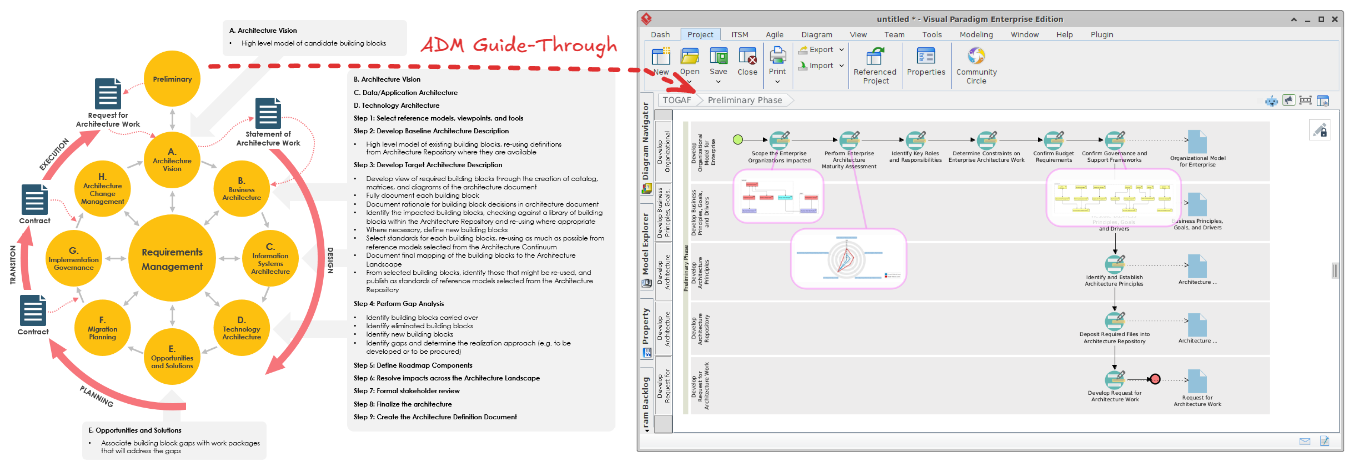 Mastering the TOGAF ADM: A Visual Paradigm Step-by-Step Guide
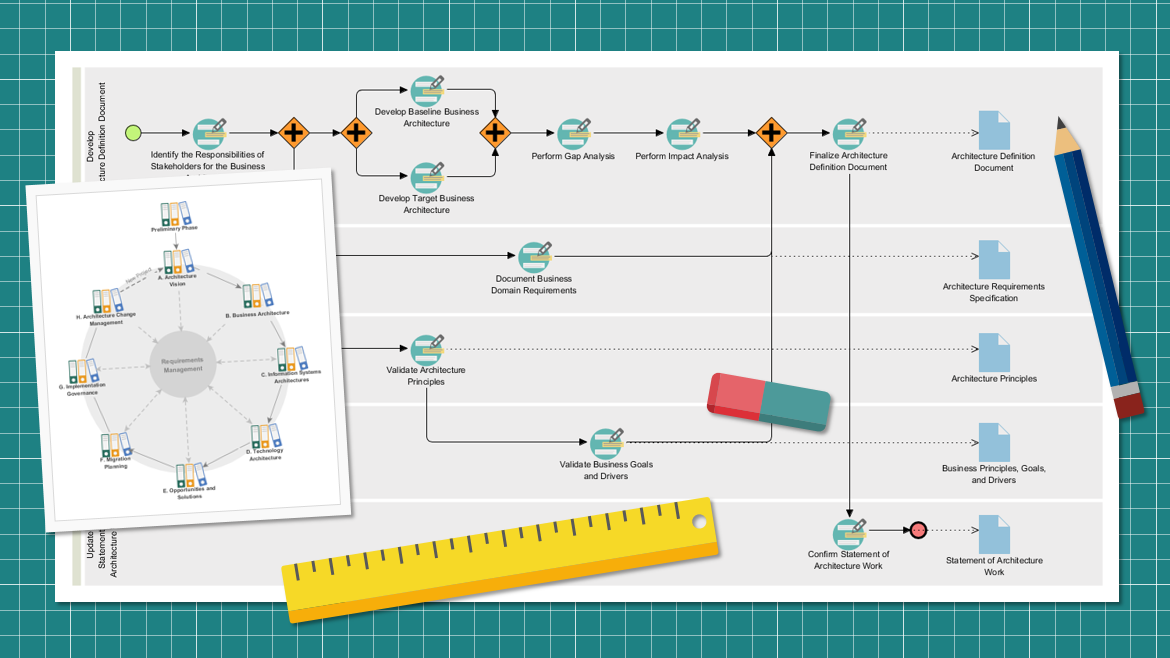 Mastering the TOGAF ADM Cycle: A Visual Guide to Enterprise Architecture Modeling
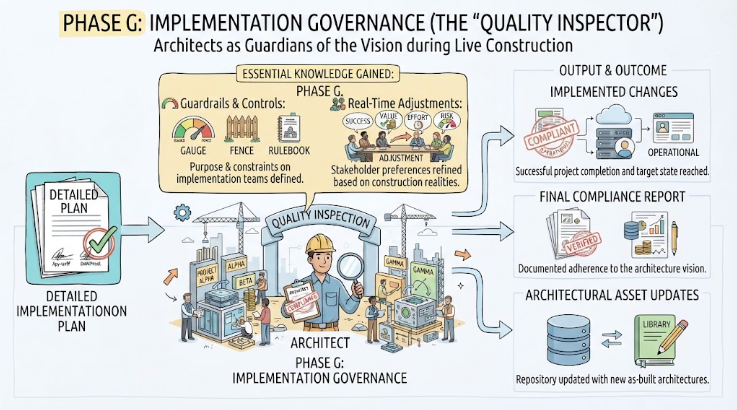 Mastering TOGAF Phase G: Implementation Governance with Visual Paradigm & ArchiMate