In the rapidly evolving landscape of digital transformation, understanding the “how” of business operations is just as critical as knowing the “what.” This is where Process Modeling becomes a fundamental discipline. It serves as the bridge between abstract business objectives and the tangible workflows that drive an organization forward.
This tutorial explores the foundational concepts of process modeling and dives deep into the industry-standard language used to define it: Business Process Model and Notation (BPMN). We will navigate through the visual hierarchy of abstraction, moving from high-level strategic goals to executable technical models.
Section 1: The Core of Process Modeling
At its heart, process modeling is about capturing an ordered sequence of activities. It is not merely drawing a picture of a workflow; it is documenting the logic, the interactions, and the supporting information required to achieve a specific outcome.
Understanding the “Why” and “What”
Organizations do not perform activities in a vacuum. Every action taken by an employee or a system is driven by a specific objective. Effective process modeling must capture:
- Business Activities: The individual tasks performed (e.g., “Review Application,” “Ship Order”).
- Objectives: The goals that these activities aim to achieve (e.g., Customer Satisfaction, Revenue Generation).
- Value Creation: The tangible or intangible value delivered to the stakeholder at the end of the process.
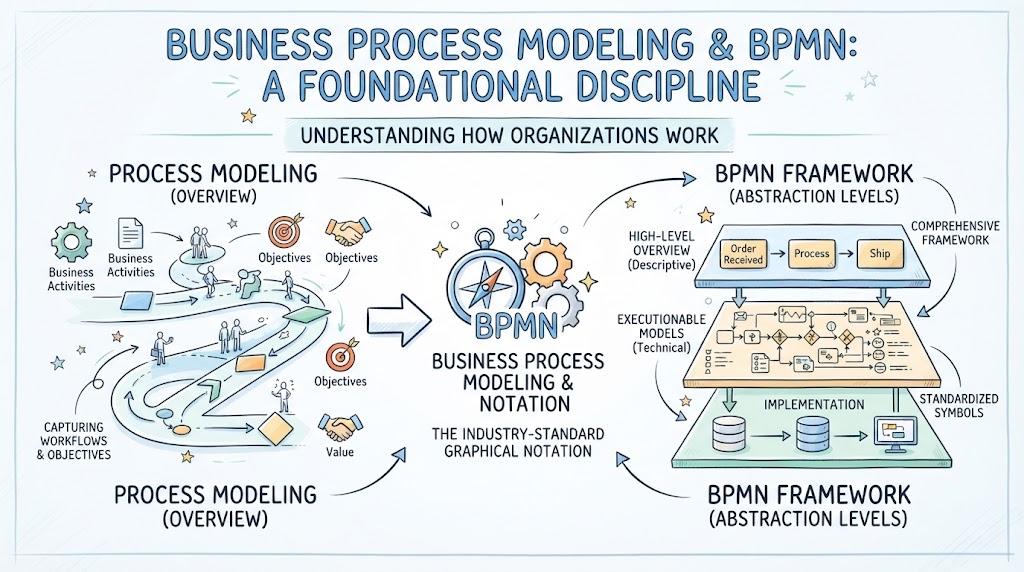
As illustrated in the Process Modeling (Overview) diagram, the journey begins with identifying these business activities and mapping them against strategic objectives. The “Process Modeling (Overview)” sections on the left of the visual framework represent the Descriptive phase—answering the question: “How do we pursue our objectives?”
Section 2: The BPMN Framework and Abstraction Levels
Once the conceptual overview is established, organizations require a standardized language to communicate these processes across departments and to development teams. This is where BPMN (Business Process Model and Notation) comes into play. Developed by the Object Management Group (OMG), BPMN is the industry-standard graphical notation that acts as the common language between business stakeholders and technical implementers.
A key concept in BPMN is Abstraction Levels. A single process can be viewed from multiple perspectives depending on the audience. The framework shown in the image breaks this down into three distinct layers:
Level 1: The High-Level Overview (Descriptive)
This is the strategic view of the process. It is designed for executives and business stakeholders who need to understand the flow without getting bogged down in technical details.
- Focus: The “Big Picture” flow from Start to Finish.
- Example: A simple linear flow: Order Received → Process → Ship.
- Goal: To communicate the sequence of events and the overall value proposition.
Level 2: Executable Models (Technical)
As we move down the abstraction pyramid, the model becomes more detailed and precise. This is where BPMN shines as a comprehensive framework.
- Focus: Logic, decision points, error handling, and data flow.
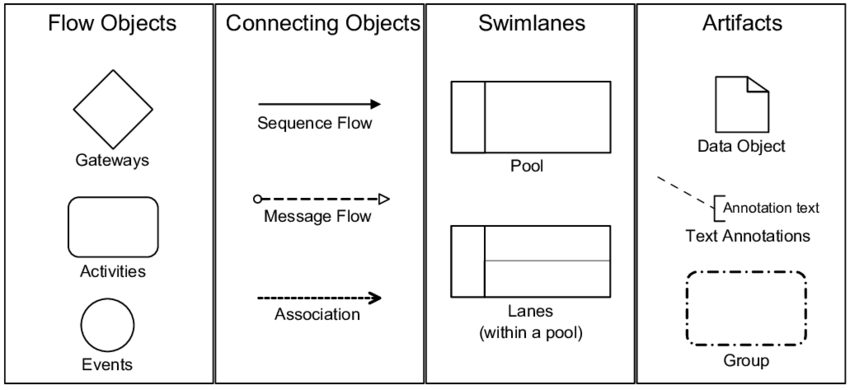
- Features: This level utilizes standardized symbols for gateways (diamonds for decisions), events (circles), and complex task flows.
- Goal: To create a model that is detailed enough to be analyzed, simulated, or even converted directly into executable code (often referred to as executable BPMN).
Level 3: Implementation
The final layer represents the actual realization of the process in the IT landscape.
- Focus: Databases, user interfaces, and backend systems.
- Goal: To map the technical artifacts (like database schemas and API endpoints) that support the executable model.
Section 3: Applying the Concepts with Visual Paradigm
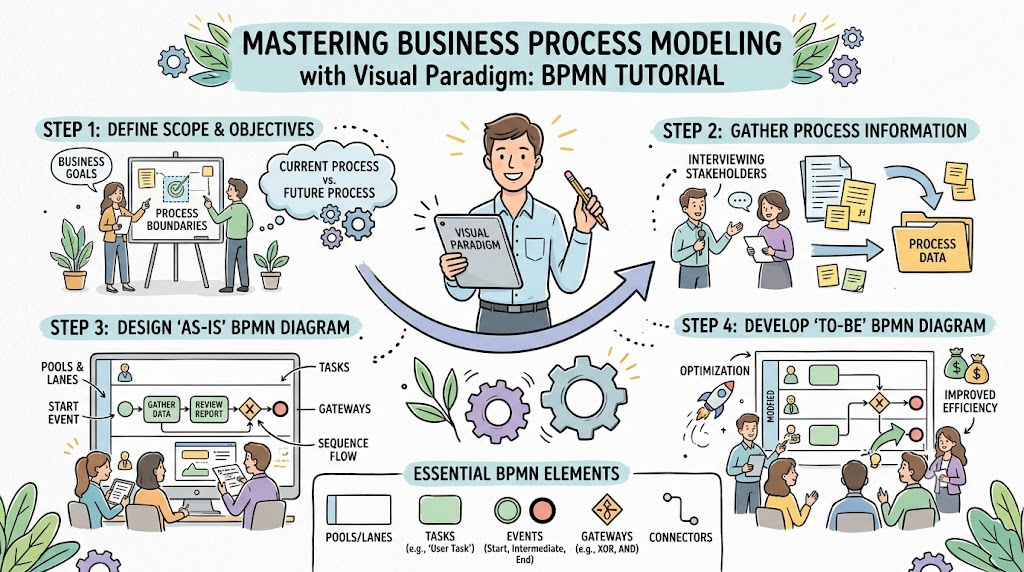
Modern business analysis tools, such as Visual Paradigm, leverage these concepts to streamline the modeling lifecycle. By integrating BPMN standards with AI capabilities, analysts can:
- Automate Abstraction: Easily switch between the High-Level Overview and the Executable Model views, ensuring that changes made at the technical level reflect accurately at the strategic level.
- Ensure Standardization: Use the Standardized Symbols provided in the BPMN framework to eliminate ambiguity. Everyone from the CEO to the Java developer reads the same diagram the same way.
- Bridge the Gap: Use the “Process Modeling (Overview)” inputs to automatically generate the complex logic required for the “Executable Models.”
Conclusion
Process modeling is not just about drawing boxes and arrows; it is about structuring the way an organization thinks about its work. By utilizing the BPMN framework, businesses can ensure that their high-level objectives are perfectly aligned with their technical execution. Whether you are documenting a simple workflow or architecting a complex enterprise system, the principles of abstraction and standardization remain the cornerstone of successful business analysis.